The majority of people make the expensive way to learn to trade, they put their money into this and make unnecessary mistakes and they pay for the lessons. According to SEBI’s own research, most individual traders of F&O trade in India, go on to lose money. It’s reasonable to question whether one could pick up the basics for a price that low.
You can practice first, with virtual cash at the actual market prices. However, is this practice working? Realistic assessment of its ability and limitations.
What Is Virtual Trading?
A virtual trading app lets you trade stocks, futures and choices either utilizing an online virtual money than utilizing reality capital. The rates are taken from the real market and your trades follow the trend of the real market. When purchasing a stock at ₹500 and it rises to ₹520, then your virtual portfolio displays the gain.
How a Paper Trading App Works
Most of the platforms provide you with an initial balance, for example, ₹10 lakh in virtual currency. You order, create a portfolio and monitor your profit and loss on various segments like equities, intraday, delivery and F&O. A decent paper trading app also provides you with live price data from NSE and BSE, to practice the same prices as real traders do.
Virtual Trading vs Paper Trading
The meaning of the two terms is the same. The term “paper trading” is derived from the time when traders used to make trades on paper. Today it’s by means of an app and the term “virtual trading” is far more prevalent in India.
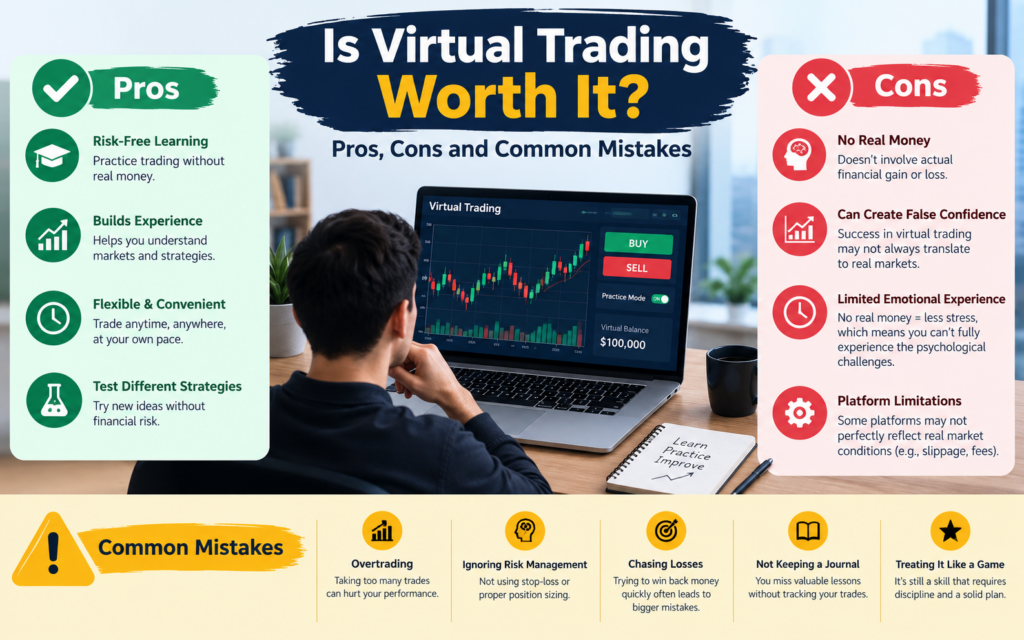
Pros of Using a Paper Trading App
Zero Financial Risk
This is the greatest benefit. There is opportunity to make mistakes – for example, a misplaced stop-loss or an over-sized bet – and incur no losses. Here, it’s okay to be incorrect, as that’s the whole reason for practicing.
Learn How the Platform Works
Many new traders are confused by the different order types, stop loss orders, margin dates and expiry dates. Playing with virtual money can help you familiarize yourself with the process, avoiding any delays when placing a real transaction.
Test Strategies on Live Data
Intraday trading, swing trading and utilizing different options strategies such as covered calls, bull spreads and other strategies can be done in real market conditions. If the strategy doesn’t work, you will learn it at NO COST.
Build Discipline With Analytics
Detailed P&L reports indicate your win rate, average gain and average loss. That information will tell you how successfully you are trading and will allow you to develop the practice of a trading journal.
Cons and Limitations of Virtual Trading
Real Emotions Are Missing
It’s a totally different experience to trade with fake money than trading with real money. Fear, greed and panic are seldom present in a simulation and lead to many real world errors. It’s easy to make a good decision in practice but it’s a different story when it comes to real money.
Order Execution Isn’t Perfect
Typically, simulators will accept orders at the price listed. In real markets the slippage, lack of liquidity and volatility of prices can alter your entry and exit. You may have results which are slightly poorer than your practice results.
The Risk of Overconfidence
It’s easy to think that trading is easier than it is if you have a few weeks at a simulator that you’ve won or lost. Some novices get into the real money too early or do more risk taking because “it worked in practice.
Common Virtual Trading Mistakes to Avoid
Treating Virtual Money Carelessly
As long as you do not gain any experience with trading if you invest all your ₹10 lakh in one trade and call it “not real”, you learn nothing. Play the trades as if they were real trades, keeping in mind appropriate risk sizes and risk level.
Trading Without a Plan or Journal
The random trades give random outcomes. Make notes on why you signed up, what your stop loss is and your goal. Check your journal regularly (Daily or weekly).
Jumping Into F&O Too Early
A stock option or futures contract is a type of leverage and is complex. Master basic equity trading before learning about the behavior of premiums, expiry and margins with F&O simulator.
Ignoring Risk-Reward and Drawdown
You need to have a good winning percentage, but if your losses are greater than your wins, it means little. Keep an eye on your risk/reward ratio, as well as your maximum drawdown in addition to your overall profit.
Never Moving to Real Trading
There are individuals who practice for many months, but never trade the real thing. You can use it for virtual trading but it’s not the final goal of trading. Make a definite point at which you will pass on.
When choosing the best virtual trading app, it is essential to consider the following factors.
All platforms are not created equal. Look for:
- Real-time NSE and BSE data, so your practice matches real conditions
- A meaningful virtual balance that lets you build a diversified portfolio
- An F&O simulator covering Nifty 50, Bank Nifty and top stocks
- P&L analytics with win rate and performance reports
- Market alerts and news, such as FII/DII data and circuit breakers
- A learning library with guides on intraday trading, swing trading and technical analysis
- Free access, so you can try it without commitment
When Are You Ready to Switch to Real Trading?
You’re probably ready when you have been trading for 2-3 months and have at least a positive return on your trades (excluding losses) and you have a written trading plan. Take a moderate amount of money, make small trades and consider your real trades as practice.
The Verdict: Is Virtual Trading Worth It?
Yes, provided that it is used appropriately. While virtual trading won’t give you the same kind of emotional aspect that real trading does, it will develop knowledge, discipline and confidence—with absolutely no cost. Take it seriously and keep an eye on the outcome; bet money little by little.
Now ready to practice without taking any risk with rupees? Trade using virtual capital of ₹10 lakh in real time on the NSE & BSE, test strategies in the F&O simulator and monitor your P&L. Start Free Virtual Trading in the Practice Mode.
Is virtual trading worth it for beginners?
Yes, it helps you learn the market and test strategies before risking real capital.
Can you make real money from a paper trading app?
No, profits are virtual, but the skills and strategies you build can carry over to real trading.
How long should I practise before trading with real money?
Most beginners benefit from two to three months of consistent practice.
How much virtual money do I get to start with?
It varies by app, but most give you a starting balance between ₹1 lakh and ₹1 crore and some let you set your own amount.
What are the limitations of virtual trading?
It can’t replicate the emotions of losing real money, and virtual orders may fill more smoothly than they would in a live market with slippage or low liquidity.
Can I reset my virtual portfolio?
Yes, most apps let you reset your balance and start fresh anytime.
Which markets can I practise on?
Depending on the app, you can trade Indian stocks (NSE/BSE), US stocks, forex, commodities, and crypto.
What strategies can I test with virtual trading?
You can try intraday trading, swing trading, long-term investing, and options strategies like straddles or covered calls.
How do I switch from virtual to real trading?
Once you’re consistently profitable and comfortable with risk management, open a demat and trading account with a SEBI-registered broker and begin with a small amount.
Is my personal data safe on a virtual trading app?
Reputable apps use encryption and don’t require sensitive financial details, but always check the privacy policy before signing up.
Can I compete with other traders on a virtual trading app?
Many apps have leaderboards and contests where you can compare returns with other users, which adds a fun learning element.
Does virtual trading teach risk management?
Yes. You can practise setting stop-losses, sizing positions, and diversifying, all habits that carry over to real trading.