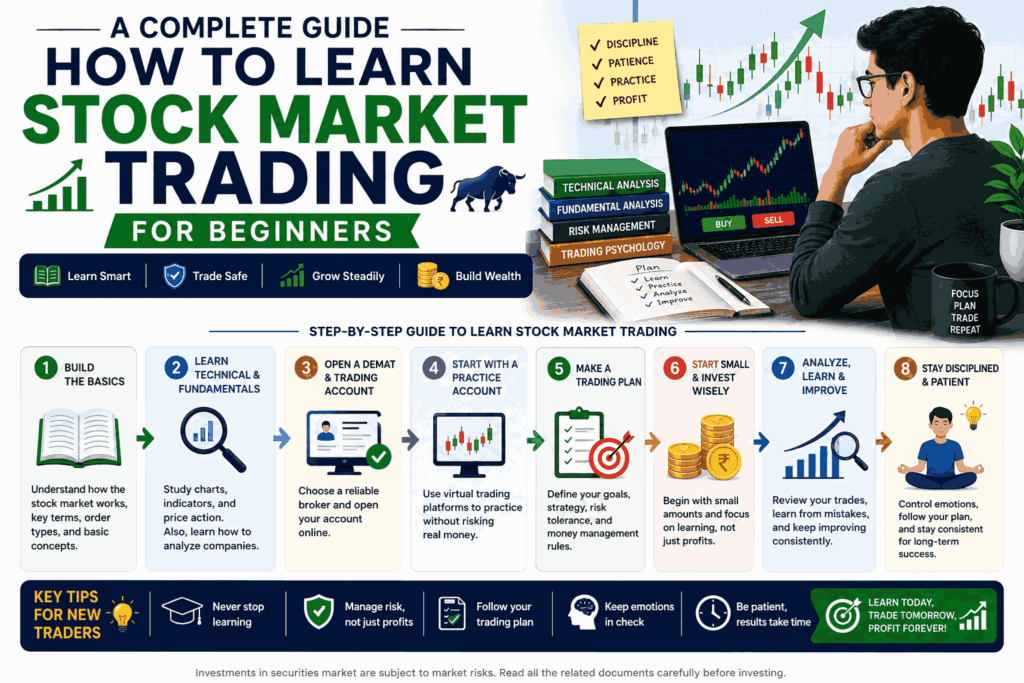
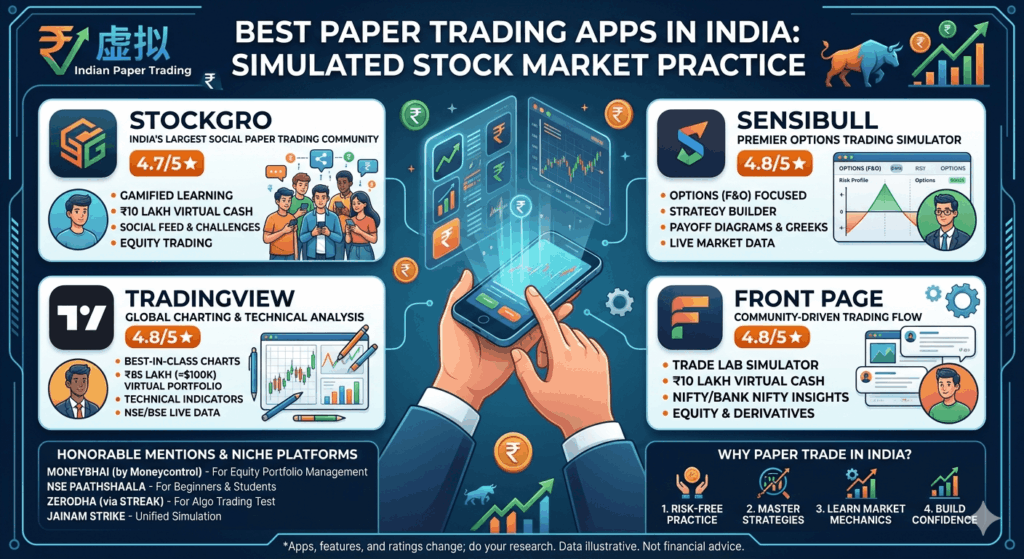
India’s retail investing ecosystem has undergone a structural transformation over the past five years. While most conversations revolve around discount brokers and real-money trading apps, a quieter but equally disruptive segment has emerged—free virtual trading apps (paper trading platforms).
These platforms are no longer just “practice tools.” They are becoming behavioral training engines, regulatory buffers, and market onboarding funnels. This article goes beyond definitions to examine market trends, economic implications, and long-term risks—areas largely ignored in mainstream coverage.
From Simulation to Behavioral Infrastructure
Traditional understanding: virtual trading apps allow users to trade with fake money.
Current reality: they are evolving into high-fidelity market simulators with psychological conditioning layers.
Platforms like:
- MegaBull
- ZeroStake
offer:
- Real-time NSE/BSE data feeds
- Derivatives (F&O) simulation
- Advanced order types (SL, SL-M, limit)
- Performance analytics dashboards
For example, some apps provide ₹5–10 lakh virtual capital and real-time market data, mimicking actual trading conditions closely.
What’s changed?
The shift is from “learning mechanics” → “training decision-making under uncertainty.”
The Gamification–Financialization Convergence
A. Explosion in Retail Participation
India has seen:
- Rapid growth in demat accounts
- Increased participation in derivatives trading
- Younger demographic entering markets (18–30 age group)
Virtual trading apps are acting as low-friction entry points, especially for:
- Students
- First-time investors
- Tier-2 and Tier-3 city users
B. Gamification Is Now Core, Not Optional
Modern apps integrate:
- Leaderboards
- Competitions
- AI coaching
- Scenario-based learning
A Reddit developer described building a platform where users earn XP and simulate real-life financial decisions—essentially “Duolingo for investing.”
This is not trivial. It signals a behavioral shift from investing as a discipline → investing as an engagement-driven activity.
C. Rise of AI-Driven Simulators
Platforms like Zerroday are introducing:
- Emotion tracking
- Strategy feedback loops
- AI-driven coaching
At the institutional level, frameworks like FinRL-X are building end-to-end AI trading simulation ecosystems, blending backtesting and live deployment.
Implication: Retail tools are converging with institutional-grade simulation systems.
Hidden Layer in India’s Capital Market Expansion
A. Lowering the Cost of Financial Education
India historically lacked structured financial literacy.
Virtual trading apps:
- Eliminate the capital requirement
- Reduce entry barriers
- Provide experiential learning
This creates a “pre-investment training economy”, which:
- Improves investor preparedness
- Potentially reduces early-stage capital loss
B. Feeding the Brokerage Funnel
Let’s be direct:
Paper trading apps are acquisition pipelines for brokers.
The lifecycle:
- User starts with virtual trading
- Gains confidence (often prematurely)
- Transitions to real-money trading
This creates:
- Higher trading volumes
- Increased brokerage revenues
- Expansion of derivatives participation
C. Impact on Market Liquidity (Indirect but Real)
While virtual trades don’t impact actual markets, they:
- Encourage higher retail participation
- Increase speculative activity (especially in F&O)
India already has one of the highest derivatives participation rates globally.
Virtual trading apps are accelerating this trend indirectly.
Regulatory Undercurrent: Trust Deficit and Platform Risk
The Indian regulator, Securities and Exchange Board of India, is increasingly concerned about:
- Fraudulent investment apps
- Misleading financial influencers
- Unregulated advisory ecosystems
Key takeaway:
- Only SEBI-registered apps will receive a “verified” badge on app stores
- Around 600 apps have already been verified
- Crackdown on misleading financial promotions
Why this matters for virtual trading apps:
- Many operate in a grey zone (education vs inducement)
- Some blur the line between simulation and real trading expectations
The Psychological Trap: The Most Underreported Risk
Here’s where most articles fail—and where real financial risk lies.
A. Unrealistic Market Conditions
Many apps:
- Ignore slippage
- Assume perfect liquidity
- Provide instant execution
A Reddit user highlighted this bluntly:
“Apps treat the market like a video game… not actual survival.”
B. Overconfidence Bias Amplification
Users often:
- Achieve high returns in simulation
- Underestimate real-world risks
- Transition too quickly to real trading
This leads to:
- Capital erosion
- Emotional trading
- Over-leveraging in derivatives
C. Emotional Disconnect
Trading psychology includes:
- Fear
- Greed
- Loss aversion
Virtual trading removes real consequences, creating a false sense of emotional control.
Long-Term Risk: Structural Implications for Indian Markets
1. Rise of “Simulation-Trained but Reality-Unprepared Traders”
Future risk:
- Traders trained in idealized environments
- Poor adaptation to real-world volatility
2. Increased Speculation in F&O Segment
Most virtual apps emphasize:
- Nifty
- Bank Nifty
- Options trading
This reinforces:
- Short-term trading mindset
- High-risk behavior
3. Platform Dependency Risk
Users become dependent on:
- App analytics
- AI signals
- Gamified feedback loops
This reduces:
- Independent thinking
- Fundamental analysis capability
4. Regulatory Tightening Ahead
Expect:
- Mandatory disclosures for simulation apps
- Clear separation between education and inducement
- Data transparency requirements
Strategic Insight: How Smart Investors Should Use These Apps
As a financial advisor, here’s the correct framework:
Use Virtual Trading Apps For:
- Strategy testing
- Learning order execution
- Understanding market structure
Do Not Use Them For:
- Predicting real-world profitability
- Building confidence in isolation
- Testing emotional resilience
Advanced Approach:
- Combine paper trading + small real capital
- Track slippage, brokerage, and taxes manually
- Maintain a trading journal
The Future: Where This Industry Is Headed
1. Hybrid Models
- Paper trading + micro-investing (₹100–₹500 real trades)
2. AI Co-Pilot Trading
- Real-time behavioral nudges
- Risk alerts based on user patterns
3. Institutional Adoption
- Schools and colleges integrating trading simulators
4. Regulatory Integration
- Verified, SEBI-compliant simulation ecosystems
How to Evaluate an Online Trading App
Most users pick apps based on UI or popularity. That’s a mistake.
The real evaluation criteria should be:
- Market realism (execution, slippage, lot sizes)
- Strategy depth (backtesting vs single trade simulation)
- Instrument coverage (equity vs F&O vs multi-asset)
- Behavioral design (gamified vs disciplined)
- Transition readiness (how well it prepares you for real trading)
What Makes an App the Best Paper Trading App?
It’s best to understand what sets the best trading app apart from an ordinary one before you select your platform, such as a streamlined interface that allows you to experience the same sense of urgency and immediacy as real trading, but without the overwhelming pressure that comes with it, and access to real-time market data. With regard to virtual trading, the best paper trading app will also include the ability to explore various strategies with virtual money for stocks, F&O, and intraday trading—prior to committing any real capital. Search for features such as performance tracking, leaderboards, and portfolio analytics — these make paper trading more than just a simulation and make it a valuable learning tool for preparing you for real market conditions.
1. AlgoTest — Best for Serious Traders (Strategy-Level Thinking)
What it actually does well:
- Institutional-style backtesting engine
- Multi-leg options strategies (iron condor, straddle, etc.)
- Answers: “Would this strategy survive markets?”
Pros:
- Deep historical validation (rare in free tools)
- Realistic F&O strategy modeling
- Focus on process, not just trades
Cons:
- Not beginner-friendly
- Less intuitive UI vs gamified apps
Hidden Pitfall:
- Backtest overfitting risk
You may optimize strategies that worked historically but fail in live markets.
👉 Insight:
This is closest to professional trading infrastructure, but dangerous if misunderstood.
2. Sensibull — Best for Options Beginners
What it does well:
- Visual payoff diagrams (risk/reward clarity)
- Pre-built strategies simplify options learning
Pros:
- Extremely intuitive for first-time F&O traders
- Great for understanding Greeks visually
Cons:
- Limited strategy depth
- Weak historical performance testing
Hidden Pitfall:
- Illusion of simplicity
Options look “easy” visually—but real execution complexity is hidden.
👉 Insight:
Great for learning, not for decision-making at scale.
3. TradingView — Best for Chart-Based Paper Trading
What it does well:
- World-class charting tools
- Trade directly from charts with simulation
Pros:
- 100+ indicators, multi-asset coverage
- Ideal for technical traders
Cons:
- Limited India-specific execution realism
- Weak portfolio-level simulation
Hidden Pitfall:
- Chart perfection bias
You get perfect entries/exits that rarely happen in real markets.
👉 Insight:
This is a charting platform with paper trading—not a full simulator.
4. Stoxra (AI-Based Platforms) — Best for AI-Guided Learning
What it does well:
- AI mentor feedback on trades
- Performance analytics (drawdown, win rate, etc.)
Pros:
- Personalized learning feedback
- Combines education + simulation
Cons:
- AI suggestions can create dependency
- Not fully transparent in logic
Hidden Pitfall:
- Over-reliance on AI signals
Users may stop developing independent judgment.
👉 Insight:
Useful—but only if you treat AI as assistant, not authority.
5. Neostox — Closest to Real Market Infrastructure
What it does well:
- ₹1 crore virtual capital
- Real-time Greeks, option chain, basket orders
Pros:
- Institutional-grade simulation
- Used in IIMs/IITs (serious credibility)
Cons:
- Complex for beginners
- Can feel overwhelming
Hidden Pitfall:
- Capital distortion bias
Trading with ₹1 crore creates unrealistic risk behavior.
👉 Insight:
Excellent simulator—but only if you self-limit capital realistically.
6. StockGro — Best for Gamified Learning
What it does well:
- Social investing + competitions
- Leaderboards and rewards
Pros:
- Highly engaging
- Good for beginners and students
Cons:
- Almost zero depth in options or strategy
- Encourages short-term trading mindset
Hidden Pitfall:
- Gamification addiction
“Feels like a video game… builds bad habits”
👉 Insight:
Great onboarding tool—but dangerous if taken seriously.
7. SmartBulls / FrontPage / Basic Apps — Best for Absolute Beginners
What they do well:
- ₹10 lakh virtual capital
- Simple buy/sell experience
Pros:
- Clean UI
- Easy onboarding
Cons:
- No advanced tools
- No real strategy learning
Hidden Pitfall:
- False confidence from simplicity
👉 Insight:
These apps teach mechanics, not market behavior.
Virtual Trading App Comparison Table
| Attribute | AlgoTest | Sensibull | TradingView | Stoxra | Neostox | StockGro | SmartBulls |
| Best For | Strategy testing | Options beginners | Chart traders | AI learning | Real simulation | Gamified learning | Beginners |
| Market Realism | High | Medium | Medium | Medium | High | Low | Low |
| F&O Depth | Very High | Medium | Low | High | Very High | Very Low | Low |
| Backtesting | Yes | No | Limited | Partial | Yes | No | No |
| Learning Curve | High | Low | Medium | Medium | High | Very Low | Very Low |
| Hidden Risk | Overfitting | Oversimplification | Perfect execution bias | AI dependency | Capital distortion | Gamification addiction | False confidence |
Strategic Verdict
If you’re serious about trading:
- Use AlgoTest + Neostox combination
- Add small real capital early
If you’re a beginner:
- Start with Sensibull or SmartBulls
- Avoid gamified platforms as primary tools
If you want engagement:
- Use StockGro—but treat it like a game, not training
Conclusion
Free virtual trading apps in India are no longer just beginner tools—they are strategic infrastructure shaping the next generation of retail investors.
However, they come with a paradox:
They reduce financial risk initially—but can amplify it later if misunderstood.
From an economic lens, they are:
- Growth accelerators for capital markets
- Behavioral conditioning tools
- Potential risk amplifiers in derivatives trading
The real edge lies not in using these apps—but in understanding their limitations with clinical precision.
Frequently Asked Questions (FAQs)
What is a virtual trading app?
A virtual trading app (also known as a paper trading app) allows users to simulate stock market trading using virtual money. It replicates real market conditions without any financial risk.
Are virtual trading apps really free in India?
Yes, many virtual trading apps in India are completely free to use. Some may offer premium features, but basic paper trading functionality is usually available at no cost.
Which are the best free virtual trading apps in India?
Some popular options include:
- TradingView
- Moneybhai
- Stock Trainer
- Sensibull (for options simulation)
How does a virtual trading app work?
These apps provide users with a virtual balance (e.g., ₹1 lakh or more). You can buy and sell stocks in real-time or near real-time market conditions, and your portfolio performance is tracked just like actual trading.
Can I trade real stocks using a virtual trading app?
No, virtual trading apps are only for simulation. You cannot earn real profits or incur real losses.
Is virtual trading useful for beginners?
Yes, virtual trading is highly beneficial for beginners. It helps users:
- Understand market dynamics
- Practice strategies
- Learn without financial risk
Do virtual trading apps use real-time market data?
Some apps provide real-time data, while others may have a slight delay (e.g., 5–15 minutes). Real-time data may require login or subscription in certain apps.
Can I practice options and intraday trading on these apps?
Yes, certain platforms like Sensibull allow options trading simulation. Others support intraday and delivery trading practice.
Do I need a Demat account for virtual trading?
No, you don’t need a Demat or trading account to use most virtual trading apps.
Are virtual trading apps safe to use?
Yes, most reputed apps are safe. However, always download apps from official stores and avoid sharing personal or financial details unnecessarily.
What is the difference between paper trading and real trading?
Paper Trading: No real money, no risk
Real Trading: Real money involved, actual profits/losses
Can virtual trading guarantee success in real trading?
No, it helps build skills and confidence, but real trading involves emotions, liquidity factors, and slippage that simulations may not fully capture.
Are there any Indian apps specifically designed for beginners?
Yes, apps like Moneybhai are beginner-friendly and gamified for easier learning.
How much virtual money do these apps provide?
It varies by platform—typically between ₹1 lakh to ₹10 lakh in virtual funds.
Can I reset my virtual portfolio?
Yes, most apps allow users to reset their accounts and start fresh with a new virtual balance.
Which free virtual trading app is best for beginners in India?
Beginners can start with free virtual trading apps that offer live market simulation, simple interfaces, and risk-free practice before investing real money.
Can I improve my trading skills using a free virtual trading app?
Yes, free virtual trading apps help you practice strategies, understand market movements, and build confidence without risking real capital.