Zerodha is famous for two numbers: ₹0 brokerage on equity delivery and a flat ₹20 on everything else. Those headline figures are genuinely cheap — but they’re not the whole story. The moment you actually place a trade, a stack of statutory charges quietly attaches itself to your bill, and the final cost on your contract note can surprise newcomers. That’s exactly the gap a Zerodha Brokerage Calculator is built to close.
A brokerage calculator takes the guesswork out of trading costs. You feed in a few details about your trade, and it returns a precise breakdown of every charge — brokerage, Securities Transaction Tax, exchange fees, GST, stamp duty and depository charges — plus your net profit or loss and the all-important break-even point. For anyone trading intraday or F&O, where small costs repeat across many trades, this is less a convenience and more a necessity.
In this guide we’ll explain what the Zerodha Brokerage Calculator does, walk through Zerodha’s 2026 charge structure, show worked examples for delivery, intraday and options trades, and share practical tips on break-even and cost control — so you always know what a trade really costs before you take it.
A quick note: this article is for educational purposes only and is not investment advice. Charges change with policy, so treat the figures here as indicative 2026 estimates and always confirm the exact amounts on your Zerodha contract note.
What Is the Zerodha Brokerage Calculator?
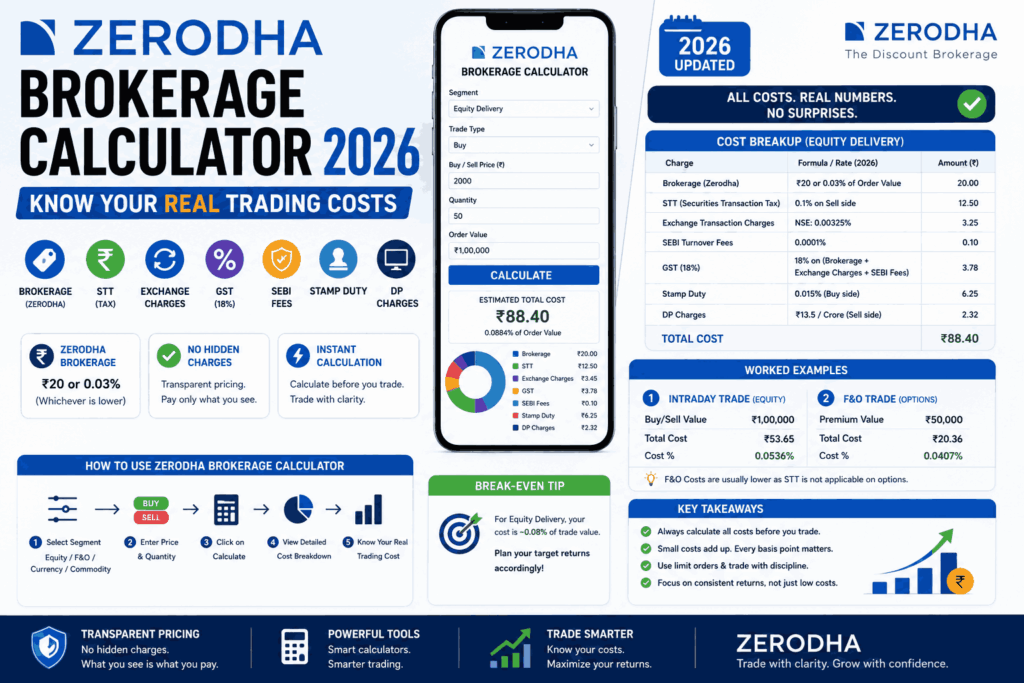
The Brokerage Calculator by Zerodha is a free online tool that estimates the complete cost of a trade on Zerodha — before you place it, or after, to check your numbers. Instead of manually working out half a dozen different charges, you enter your trade details and the calculator does the math instantly.
Crucially, it shows you the things that actually matter for your bottom line: the total of all charges, your net profit or loss after those charges, and your break-even price. It exists because Zerodha’s simple “₹0 and ₹20” pricing hides the statutory charges that every trader pays — and the calculator brings full transparency to that real, all-in cost.
Zerodha Brokerage Calculator
See the exact all-in cost of a trade — brokerage, taxes, GST and DP — before you place it.
Your trade
Equity delivery brokerage on Zerodha is ₹0 — but STT, stamp duty and a DP charge still apply on every trade.
Educational tool only — not investment advice. Verify current charges on zerodha.com/charges.
Why Use a Zerodha Brokerage Calculator?
A few minutes with the calculator can change how you trade. Here’s why it’s worth the habit:
- Know your costs upfront. See exactly what a trade will cost before you commit, so there are no nasty surprises on the contract note.
- Find your break-even. Know the precise price move needed just to cover charges — essential before entering any short-term trade.
- Compare segments. Instantly see how costs differ between delivery, intraday and F&O for the same idea.
- Size trades sensibly. Discover when a trade is too small to be cost-efficient (where charges eat most of the profit).
- Plan F&O and intraday. For high-frequency styles, where small costs repeat dozens of times, accurate cost planning protects your edge.
Zerodha’s Brokerage Structure (2026)
Before the calculator makes sense, it helps to know the rates it’s working with. Zerodha’s pricing has stayed remarkably stable since 2010:
| Segment | Brokerage | STT | Stamp duty (buy) |
| Equity delivery | ₹0 | 0.1% (buy + sell) | 0.015% |
| Equity intraday | ₹20 or 0.03%* | 0.025% (sell) | 0.003% |
| Futures | ₹20 or 0.03%* | 0.02% (sell) | 0.002% |
| Options | ₹20 flat / order | 0.1% of premium (sell) | 0.003% |
| Currency F&O | ₹20 (opt) / ₹20 or 0.03% (fut) | On sell side | As applicable |
* Whichever is lower; maximum ₹20 per order. Also applied to every trade: exchange transaction charges, 18% GST (on brokerage + transaction + SEBI charges), SEBI fee of ₹10 per crore, and — on delivery sells only — a DP charge of about ₹13.5 + GST per stock.
Account opening is free, and the demat AMC is ₹300 a year (₹75 per quarter) — now waived for the first year on resident individual accounts opened on or after 1 June 2026. Direct mutual funds are free.
The Charges a Zerodha Brokerage Calculator Computes
Here’s what each line in the breakdown actually means — understanding them is half the value of using the tool:
- Brokerage — Zerodha’s own fee: ₹0 on delivery, and ₹20 or 0.03% (whichever is lower) elsewhere, capped at ₹20 per order.
- STT (Securities Transaction Tax) — a government tax on transactions. It’s charged on both legs for delivery, but only on the sell side for intraday and F&O. Often the single biggest charge.
- Exchange transaction charges — fees the NSE or BSE levy for using their platform, charged as a tiny percentage of turnover (higher, as a share of premium, for options).
- GST — 18%, but only on the sum of brokerage, exchange transaction charges and SEBI fees — not on your whole trade value.
- SEBI charges — a nominal regulatory fee of ₹10 per crore of turnover.
- Stamp duty — a state levy charged on the buy side, varying by segment.
- DP charges — about ₹13.5 + GST per stock, charged by the depository when you sell delivery shares (not on intraday or F&O).
Hidden and Account-Level Charges to Remember
A brokerage calculator focuses on per-trade charges, so a few account-level and situational costs sit outside it. Keep these on your radar:
- Demat AMC — ₹300 a year (₹75 a quarter), waived in the first year for resident individual accounts opened on or after 1 June 2026.
- Auto square-off — ₹50 per order if the broker has to close your intraday position because you didn’t exit in time.
- Call & Trade — ₹50 per order if you place a trade by phoning the dealing desk instead of using the app.
- Pledge charges — around ₹30 + GST per stock if you pledge holdings to get margin.
- Payment gateway — about ₹9 per instant fund transfer from many banks (UPI transfers are usually free).
- Physical contract notes — ₹20 each plus courier, if you want paper copies (digital notes are free).
None of these are unique to Zerodha, and most are easy to avoid — but they explain the occasional charge a pure trade calculator won’t show.
How to Use the Zerodha Brokerage Calculator (Step by Step)
Using the tool takes seconds:
- Choose the segment — equity delivery, intraday, futures, options, currency or commodity.
- Select the exchange — NSE or BSE (this affects the exact transaction charge).
- Enter the buy price at which you bought or plan to buy.
- Enter the sell price at which you sold or plan to sell.
- Enter the quantity — number of shares, or number of lots for F&O.
- Add your state if prompted, so stamp duty is calculated correctly.
- Read the output — a full charge breakdown, your total cost, net profit or loss, and the break-even price.
Worked Examples: What a Trade Actually Costs on Zerodha
Numbers make this concrete. Below are three sample trades — a delivery trade, an intraday trade and an options trade — with their approximate charge breakdowns on Zerodha (NSE):
| Charge | Delivery | Intraday | Options |
| Brokerage | ₹0 | ₹30 | ₹40 |
| STT | ₹105 | ₹13 | ₹11 |
| Exchange transaction | ₹3 | ₹3 | ₹7 |
| SEBI fee | ₹0.11 | ₹0.10 | ₹0.02 |
| Stamp duty | ₹8 | ₹2 | ₹0.23 |
| GST (18%) | ₹0.58 | ₹6 | ₹8 |
| DP charge | ~₹16 | — | — |
| Total charges | ~₹132 | ~₹54 | ~₹66 |
| Gross profit | ₹5,000 | ₹500 | ₹3,750 |
| Net profit | ~₹4,868 | ~₹446 | ~₹3,684 |
Example trades — Delivery: buy 50 shares @ ₹1,000, sell @ ₹1,100. Intraday: buy 100 @ ₹500, sell @ ₹505. Options: 1 Nifty lot (75 units), buy @ ₹100, sell @ ₹150. NSE; figures approximate and rounded.
Look closely and a pattern emerges. On the delivery trade, Zerodha’s brokerage is ₹0 — yet the trade still costs about ₹132, almost entirely from STT (₹105) and the DP charge (₹16). On the intraday trade, brokerage is a modest ₹30 and total costs stay low. On the options trade, the flat ₹40 brokerage (two legs) is the largest single component. In every case, the calculator instantly reveals what you’d otherwise have to compute by hand.
Understanding the Break-Even Point
The break-even point is the price move your trade needs just to cover all charges — the level at which your profit is exactly zero. It’s one of the most useful outputs the calculator gives you, because it translates abstract “charges” into a concrete target.
The key insight is that fixed costs hurt small trades the most. A useful rule of thumb: for intraday trades on Zerodha, an order value of at least roughly ₹70,000 makes the ₹20 brokerage mathematically efficient — below that, charges form a larger slice of your trade. On a tiny ₹10,000 position, you might need a 1% move just to break even, whereas a larger position breaks even on a much smaller move. Checking break-even before you trade stops you from entering positions where the costs quietly swallow any realistic profit.
Zerodha Calculator vs Manual Calculation vs Other Brokers
Could you calculate all this by hand? Yes — but with seven different charges, each on a different base, it’s slow and error-prone. The calculator delivers the same result in seconds, which is why most active traders rely on one.
It’s also worth understanding what a broker-specific calculator does and doesn’t change. The statutory charges — STT, exchange fees, GST, SEBI fee and stamp duty — are identical across all brokers and, since SEBI’s October 2024 “true-to-label” rule, exchange charges are uniform too. So the Brokerage Calculator by Zerodha mainly reflects Zerodha’s specific brokerage and DP charges layered on top of those universal levies. If you compared the same trade on Zerodha versus, say, Groww or Angel One, only the brokerage, AMC and DP lines would differ — the tax stack would be the same.
Tips to Reduce Your Trading Costs on Zerodha
The calculator doesn’t just measure costs — it helps you cut them. A few practical habits:
- Trade efficient sizes. Very small intraday or F&O trades are disproportionately expensive; check the break-even before entering.
- Trade less, not more. Every order adds brokerage and statutory charges, so fewer, higher-conviction trades usually cost less overall.
- Use direct mutual funds. They’re free on Zerodha and cheaper than regular plans over the long run.
- Exit intraday positions yourself to avoid the ₹50 auto-square-off fee.
- Prefer app-based orders over call-and-trade to skip the ₹50 per-order charge.
- Fund your account via UPI where possible to avoid payment-gateway fees.
Pros and Cons of the Zerodha Brokerage Calculator
Pros
- Free to use, instant, and usually requires no login.
- Gives a clear, itemised breakdown of every charge.
- Shows net profit or loss and the break-even point at a glance.
- Helps with trade planning, position sizing and segment comparison.
- Brings full transparency to Zerodha’s real, all-in trading cost.
Cons
- Results are indicative — small rounding differences from the contract note are normal.
- Statutory rates change with policy, so an outdated calculator can mislead.
- It usually excludes account-level costs like AMC, auto-square-off and call-and-trade fees.
- It doesn’t calculate income tax on your profits — only trade charges.
- Accuracy depends entirely on you entering the correct trade details.
Accuracy, Security & Trust
A brokerage calculator is an estimate, not a substitute for your official records. Treat its output as a highly reliable forecast, then verify the exact figures against your Zerodha contract note, which is the final word on what you were charged. Because statutory charges change — the October 2024 STT hike is a recent example — always use a calculator that’s updated for the current year.
On the trust front, Zerodha is a SEBI-registered broker and a member of the NSE and BSE, with client securities held at the depositories (CDSL). When choosing a calculator, prefer Zerodha’s own official tool or a reputable, clearly-dated third-party version, and be wary of any site that asks for your trading login or sensitive credentials — a brokerage calculator never needs them.
Latest 2026 Updates Reflected in the Calculator
A few recent changes matter for getting accurate numbers in 2026. The October 2024 STT hike raised the tax on options (to 0.1% of premium on the sell side) and futures (to 0.02%), so any current calculator should reflect these higher rates. SEBI’s true-to-label rule standardised exchange transaction charges across brokers from the same date. And on the account side, Zerodha now waives the first-year AMC for resident individual accounts opened on or after 1 June 2026 — though AMC isn’t part of a per-trade calculation. Reassuringly, Zerodha’s core brokerage (₹0 delivery, flat ₹20 elsewhere) remains unchanged, so the tool’s brokerage logic is as simple as ever.
Test Your Trades Before You Calculate the Charges
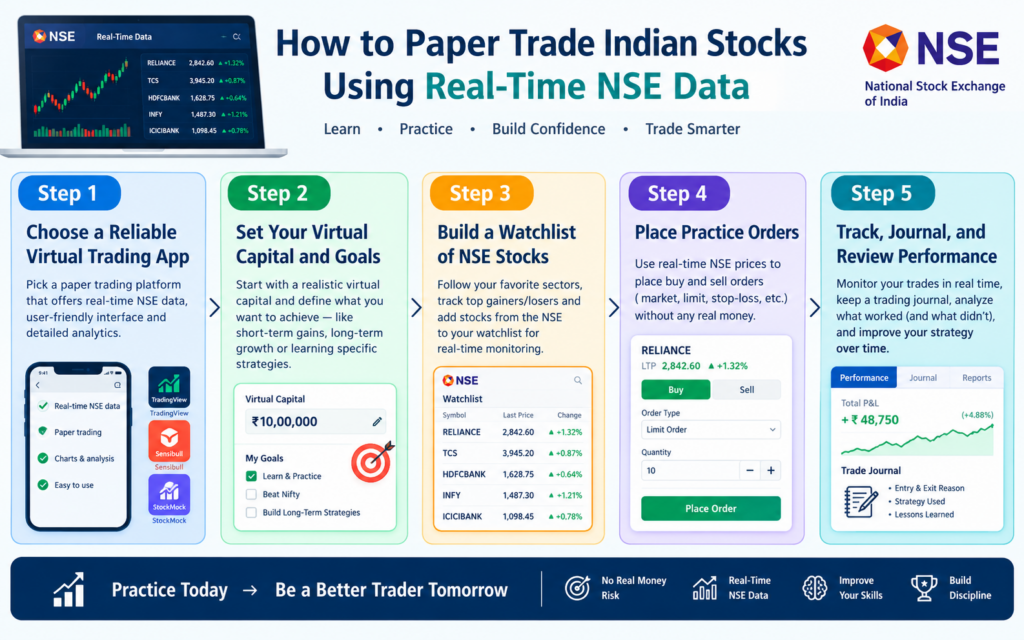
A Zerodha calculator is great for working out costs on paper, but the numbers only matter once you're sure the trade itself is worth taking. Before leaning on a brokerage calculator Zerodha to estimate charges on a live position, it helps to first test the same trade using virtual money, so you can judge your entry, exit, and position size without any real risk. Once the strategy proves itself in practice, you can turn to a zerodha charges calculator to work out the exact brokerage, taxes, and other costs — and trade with real capital only when you're genuinely confident. If you'd like to try this approach, explore our paper trading platform to practice first
Frequently Asked Questions
What is the Zerodha Brokerage Calculator?
It’s a free online tool that estimates the complete cost of a trade on Zerodha. You enter the segment, buy and sell prices and quantity, and it breaks down brokerage, STT, exchange transaction charges, GST, SEBI fees, stamp duty and (for delivery) DP charges, then shows your net profit or loss and break-even point.
Is the Brokerage Calculator by Zerodha free and accurate?
Yes, it’s free and needs no login. It’s highly accurate for estimating charges, but results are indicative — statutory rates change and small rounding differences are normal. Your Zerodha contract note is always the final, exact record.
Does Zerodha charge brokerage on equity delivery?
No. Zerodha charges ₹0 brokerage on equity delivery and on direct mutual funds. But you still pay STT (0.1% on both buy and sell) and a DP charge of about ₹13.5 plus GST per stock when you sell, so a delivery trade is never entirely free.
How is brokerage calculated on Zerodha?
Zerodha charges a flat ₹20 or 0.03% of turnover per executed order, whichever is lower, for intraday and futures, and a flat ₹20 per order for options. Equity delivery is free, and the maximum brokerage on any order is ₹20.
Why are my Zerodha charges more than ₹20?
Because brokerage is only one part of the bill. On top of it you pay statutory charges — STT, exchange transaction fees, 18% GST, SEBI fees and stamp duty — plus a DP charge on delivery sells. These are the same at every broker and often exceed the brokerage.
What are DP charges on Zerodha?
DP (Depository Participant) charges apply when you sell shares from your demat account — about ₹13.5 plus GST per stock per day, regardless of quantity. They apply only to delivery sells, not to intraday or F&O, and a calculator includes them for delivery trades.
What is the break-even point in a Zerodha trade?
It’s the price move needed for your trade to cover all charges and reach zero profit or loss — shown by the calculator. Smaller trades need larger percentage moves to break even, which is why checking break-even before trading helps you avoid trades where costs eat the profit.
Final Verdict: Make the Zerodha Brokerage Calculator a Habit
The Brokerage Calculator by Zerodha is one of the simplest, highest-value tools a trader can use. Zerodha’s costs are genuinely low — free delivery and a flat ₹20 elsewhere — but “low” isn’t “nothing,” and the statutory charges stacked on top can quietly reshape your returns, especially on small or frequent trades. Knowing your true, all-in cost and your break-even before you click ‘buy’ is exactly the kind of discipline that separates careful traders from the rest.
Build the habit: run the numbers, check your break-even, and only then take the trade. Use a calculator that’s current for 2026, remember that it’s an estimate to be confirmed against your contract note, and treat the few seconds it takes as an investment in trading more deliberately. Combine that with sound strategy and risk management, and you’ll always trade with your eyes open to what each trade really costs.