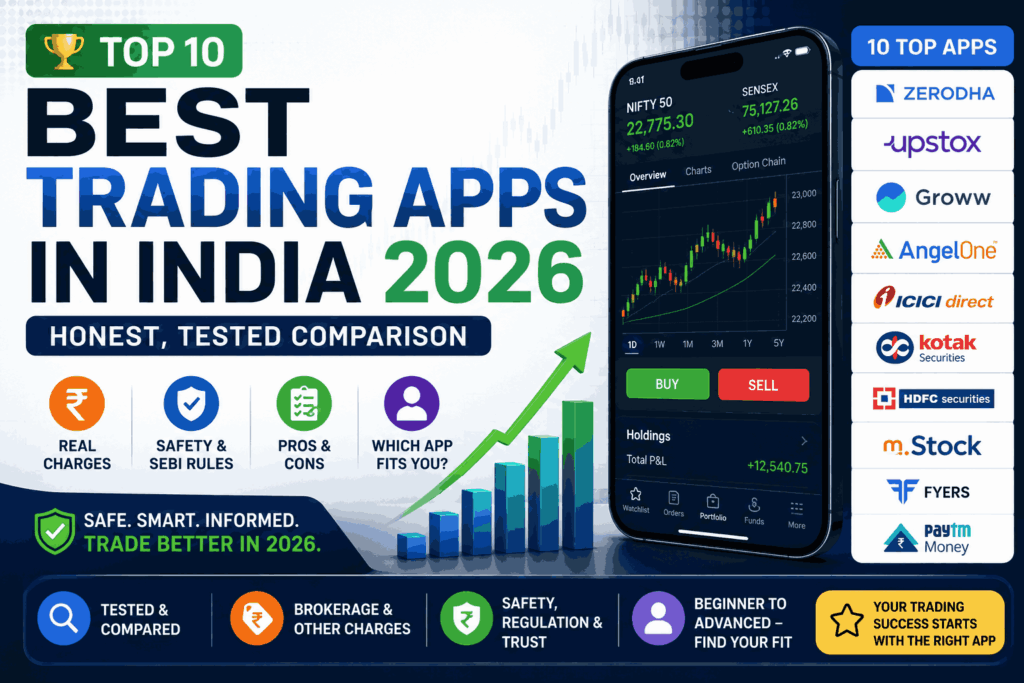
Search for the best trading apps in India and every list looks suspiciously alike — the same ten logos, the same glowing one-liners, and almost no honesty about what these apps actually cost or where they fall short. This guide takes a different approach. It is written from a trader’s seat, ranks the platforms on things that genuinely move the needle, and tells you the trade-offs upfront.
One number to sit with before you choose anything: SEBI’s own research shows roughly nine out of ten individual F&O traders lose money. The app you pick will not change that math — but the right one keeps your costs low, prevents fat-finger mistakes, and stays online when the market is moving fast.
Below are the top 10 best trading apps in India for 2026, compared on cost, platform reliability, features, safety, and — most importantly — who each one actually suits. We have also covered the big regulatory changes of the past year, because the rules of trading in India shifted meaningfully in 2024–25.
A Quick Reality Check Before You Pick a Trading App
A trading app is a tool, not a strategy. Three honest truths will save you more money than any feature comparison:
- “Free” is rarely free. Zero delivery brokerage is great, but statutory charges — STT, exchange fees, GST, stamp duty and depository (DP) charges — are identical across brokers and often cost more than the brokerage itself on small trades.
- Reliability beats rupees. Saving ₹300 a year in AMC is meaningless if your app freezes during a sharp move. For active traders, uptime and execution speed matter far more than the last rupee of brokerage.
- Only SEBI-registered apps. If an app lets Indian residents “trade” forex, CFDs or offshore crypto with leverage, treat it as a red flag. Legitimate Indian equity and F&O trading happens only through SEBI-registered brokers routing to the NSE and BSE.
If you are interested in reading more about trading concepts and market commentary, be sure to check out Cup of Glory. A finance and trading blog which provides information on the basics of the stock market, investing basics, and daily analysis of Nifty and Bank Nifty movements to help newer traders get a head start before they start investing real money. Can be a starting point for general education and market context.
How We Ranked the Best Trading Apps in India
This is a curated ranking, not a popularity contest. We weighed six factors:
- Cost transparency — real brokerage, AMC, and the charges brokers tend to bury.
- Platform reliability — stability and execution during high-volume sessions.
- Features and tools — charting, order types, APIs, research, and product range.
- Safety and regulation — SEBI registration, track record, and fund segregation.
- Ease of use and support — how friendly the app is and how reachable help is.
- Scale and trust — active-client base on the NSE as a proxy for real-world adoption.
A quick note on “largest” versus “best”: by active clients, Groww is currently India’s biggest broker, ahead of Zerodha and Angel One. Being the biggest is not the same as being the best for your needs — so we rank on overall value, and call out who each app truly fits.
Top 10 Best Trading Apps in India 2026 (At a Glance)
| App | Type | Best for | Equity delivery | Intraday / F&O | AMC (₹/yr) |
| Zerodha (Kite) | Discount | Overall / serious traders | ₹0 | ₹20 flat* | ₹300 |
| Groww | Discount | Beginners | Small fee* | ₹20 | ₹0 |
| Angel One | Hybrid | Low cost + research | Small fee* | ₹20 | ₹240 |
| Upstox | Discount | Fast execution | ₹20 | ₹20 | ₹0 |
| Dhan | Discount | F&O / active traders | ₹0 | ₹20 | ₹0 |
| ICICI Direct | Full-service | 3-in-1 + research | ~0.29%* | Plan / ₹20* | Varies* |
| Kotak Neo | Discount | Bank integration | ₹0* | ₹10–20* | ₹0* |
| HDFC Sky | Hybrid | Bank + global stocks | Flat / low* | ₹20* | Varies* |
| 5paisa | Discount | Budget / frequent | ₹0 / low* | ₹10–20* | ₹0 (yr 1)* |
| Paytm Money | Discount | Simple all-in-one | ₹0 | ₹10* | ₹0 |
*Important: pricing as of mid-2026 and brokers revise rate cards often. Zerodha and Dhan keep delivery genuinely free; Groww and Angel One levy a small brokerage on delivery (typically the lower of ₹20 or about 0.1%, minimum ₹5); Upstox charges ₹20 on delivery. Full-service and plan-based pricing varies by the plan you choose. F&O is never free at any broker, and a DP charge of roughly ₹12–₹20 + GST applies every time you sell shares. Always confirm the live rate card before opening an account.
The 10 Best Trading Apps in India, Reviewed
1. Zerodha (Kite) — Best Overall Trading App
Zerodha is the broker that started India’s discount-broking revolution back in 2010, and its Kite app is still the platform most experienced traders quietly recommend. It is fast, clean, refreshingly free of clutter, and reliable even when the market is whipsawing.
It remains India’s second-largest broker by active clients in 2026 (a shade under 70 lakh), and the wider ecosystem — Coin for mutual funds, Console for analytics, and the free Varsity learning library — is the most complete in the business.
Standout features
- Kite app with 100+ indicators, GTT (Good Till Triggered) and basket orders.
- Varsity — arguably the best free investing education in India.
- Coin for zero-commission direct mutual funds; Kite Connect API for algo traders.
Charges (mid-2026): ₹0 equity delivery and direct MF • ₹20 or 0.03% (lower) intraday/F&O • ₹300/yr AMC • free account opening.
Best for: Self-directed investors, intraday and technical traders, and anyone who wants to learn while they trade.
Pros
- Zero delivery brokerage and a famously stable, fast platform.
- Best-in-class education and a mature, trusted ecosystem.
- Powerful order types and proper algo/API support.
Cons
- ₹300 annual AMC, where Groww and Dhan charge nothing.
- No built-in research, tips or advisory — you are on your own.
- Support is ticket-based and can be slow; the trading API is paid.
2. Groww — Best Trading App for Beginners
Groww went from a mutual-fund app founded by ex-Flipkart engineers in 2017 to India’s largest stockbroker by active clients — and it got there by being genuinely easy to use. If a first-time investor opens one app and instantly understands it, it is usually this one.
Stocks, mutual funds, US equities, IPOs, F&O, gold and bonds all sit in one tidy interface, and there is zero AMC for life. The trade-off is depth: serious chartists and F&O specialists will outgrow it.
Standout features
- Clean, beginner-friendly interface with SIPs and stocks side by side.
- Zero lifetime AMC — the best in the industry.
- Wide product range including US stocks, IPOs and digital gold.
Charges (mid-2026): Small brokerage on delivery (lower of ₹20 or ~0.1%, min ₹5) • ₹20 F&O • ₹0 AMC • free account opening.
Best for: First-time investors and anyone who wants mutual funds and stocks in one simple app.
Pros
- The gentlest learning curve of any major app.
- No AMC, ever; everything investing in one place.
- Reliable and clean even during busy sessions.
Cons
- Equity delivery is NOT free — a small brokerage always applies.
- Charting and advanced order types lag behind Zerodha and Dhan.
- Thin research and derivatives tooling; mixed reviews on support.
3. Angel One — Best Low-Cost App With Research
Angel One is the elder statesman here, operating since 1996 and publicly listed, with a rare hybrid model: discount-broker pricing layered with full-service research, AI-driven stock ideas (ARQ), and an offline network of hundreds of branches.
For investors who want low costs but also a nudge on what to buy — and the comfort of a relationship manager or a branch to walk into — Angel One is often the most logical pick.
Standout features
- ARQ AI recommendations plus free research reports and stock tips.
- Free SmartAPI for algo traders (Zerodha charges for its API).
- 900+ branches and a large advisor network for offline support.
Charges (mid-2026): Small brokerage on delivery (lower of ₹20 or ~0.1%, min ₹5) • ₹20 flat intraday/F&O • ₹240/yr AMC • free account opening.
Best for: Investors who want low fees plus research, advisory and branch access in one app.
Pros
- Research and advisory bundled with discount-style pricing.
- Free trading API and strong offline presence.
- Long track record and publicly audited disclosures.
Cons
- Ended free delivery in late 2024 — delivery now carries a small fee.
- No GTT orders; the app can feel feature-heavy.
- Frequent tips and notifications can nudge over-trading.
4. Upstox — Best for Fast Execution
Backed by Ratan Tata and Tiger Global, Upstox built its reputation on speed. Day traders who care about snappy order execution and clean TradingView charts have long favoured it, and the app stays composed during volatile sessions.
Its active-client base eased in FY26, but it remains a polished, low-cost option — just note that, unlike Zerodha or Dhan, its equity delivery is not free.
Standout features
- Fast, low-latency order execution built for intraday.
- Integrated TradingView charting and algo/API access.
- Zero AMC and a clean, modern interface.
Charges (mid-2026): ₹20 equity delivery • ₹20 or 0.1% (lower) intraday/F&O • ₹0 AMC • free account opening.
Best for: Active day traders who prioritise execution speed and TradingView charts.
Pros
- Quick execution and stable performance under load.
- No AMC; professional charting out of the box.
- Simple, uncluttered app for newer traders too.
Cons
- Equity delivery costs ₹20 — not free.
- Narrower product range than Groww or Angel One.
- Customer support quality is hit or miss.
5. Dhan — Best App for F&O and Active Traders
Dhan is the newest name on this list (launched 2021) and the fastest-growing, and it was clearly built by people who trade. Everything from the Options Trader app to fast scanners and a free API is aimed at active and derivatives traders.
Delivery is genuinely free, AMC is zero, and the charting (TradingView plus ChartIQ) is excellent. The brand is younger and the research is light, but for hands-on traders that is a fair trade.
Standout features
- Dedicated Options Trader app, scanners and fast order placement.
- TradingView + ChartIQ charts and a free trading API.
- Zero delivery brokerage and zero AMC.
Charges (mid-2026): ₹0 equity delivery • ₹20 intraday/F&O • ₹0 AMC • free account opening.
Best for: F&O traders and active intraday traders who want pro tools without a premium price.
Pros
- Trader-first features at a discount-broker price.
- Free delivery, zero AMC and a free API.
- Excellent charting and options tooling.
Cons
- Younger, smaller brand with a shorter track record.
- Minimal research and limited offline/phone support.
- Feature density can overwhelm absolute beginners.
6. ICICI Direct — Best Full-Service / 3-in-1 App
If you bank with ICICI, ICICI Direct’s 3-in-1 account (bank + demat + trading) makes money movement seamless — funds flow in and out automatically, with no manual transfers. It leads the full-service category by active clients and is backed by deep, institutional-grade research.
The cost is the catch: default brokerage is far higher than discount brokers, though newer flat-fee plans narrow the gap for active users.
Standout features
- Seamless 3-in-1 integration with your ICICI bank account.
- Extensive research, advisory, IPOs, bonds and global investing.
- Flat-fee plans (e.g. Neo) for traders who want lower per-trade costs.
Charges (mid-2026): ~0.29% on default delivery (much lower on flat-fee plans) • plan-based or ₹20 F&O • AMC varies • free account opening.
Best for: ICICI bank customers and long-term investors who value research and convenience over rock-bottom fees.
Pros
- Effortless fund flow with the 3-in-1 setup.
- Strong research and a full product shelf.
- Trusted, bank-backed brand.
Cons
- Default brokerage is expensive for active, self-directed traders.
- Best rates require opting into specific plans.
- Heavier interface than lean discount apps.
7. Kotak Neo — Best Bank-Backed Discount App
Kotak Securities’ Neo app pairs the muscle of a major bank with discount-style pricing, including trade-free plans on equity delivery and low intraday/F&O fees. For Kotak customers, the bank integration is a real convenience.
The platform has improved a lot, though it is still maturing next to Zerodha’s Kite.
Standout features
- Trade-free delivery and low-cost F&O on Neo plans.
- Tight integration with Kotak bank accounts.
- Decent charting and margin trading options.
Charges (mid-2026): ₹0 delivery on Neo plan • ₹10–₹20 intraday/F&O • low/zero AMC • free account opening (plan-dependent).
Best for: Kotak bank customers who want low costs with bank-grade backing.
Pros
- Bank-backed reliability with discount pricing.
- Smooth fund flow for Kotak account holders.
- Competitive F&O costs on the right plan.
Cons
- Best value is tied to specific plans.
- App polish trails the category leaders.
- Support experience can be inconsistent.
8. HDFC Sky — Best for Bank Integration and Global Stocks
HDFC Sky is HDFC Securities’ modern, flat-priced app, built to win back cost-conscious investors while keeping the trust of India’s largest private bank. It offers 3-in-1 convenience with HDFC accounts, plus access to US and global stocks and solid research.
It is a strong fit for HDFC loyalists and passive investors who want bank integration and global exposure in one place.
Standout features
- Flat, transparent pricing on a clean app.
- 3-in-1 integration with HDFC Bank and access to global stocks.
- Research and curated investment ideas from HDFC Securities.
Charges (mid-2026): Flat / low delivery and ₹20 F&O (plan-dependent) • AMC varies • free account opening.
Best for: HDFC customers and long-term investors who want bank integration plus international investing.
Pros
- Bank-grade trust with modern, flat pricing.
- Seamless for HDFC account holders; global stock access.
- Useful research for buy-and-hold investors.
Cons
- Newer app still polishing its experience.
- Some plan and add-on charges to watch.
- Occasional lag reported during peak hours.
9. 5paisa — Best Budget / Ultra-Low-Cost App
Part of the IIFL group, 5paisa is built around one idea: keep it cheap. Per-order costs on intraday and F&O can drop to around ₹10 on its plans, which adds up for high-frequency traders, and it still covers a broad product range with optional research packs.
The interface feels a little dated and support gets mixed reviews, but for sheer cost efficiency it earns its spot.
Standout features
- Among the lowest per-order costs on its paid plans.
- Wide product range — stocks, F&O, mutual funds, insurance.
- Add-on research and advisory packs.
Charges (mid-2026): ₹0 / low delivery • ~₹10–₹20 intraday/F&O (plan-based) • ₹0 AMC first year • free account opening.
Best for: Budget-conscious, frequent traders who want the lowest possible per-trade cost.
Pros
- Very low per-order pricing for active traders.
- Broad product coverage in one app.
- Backed by the established IIFL group.
Cons
- Dated interface compared with newer apps.
- Best rates are plan-based, not default.
- Customer-support reputation is uneven.
10. Paytm Money — Best Simple All-in-One App
Paytm Money keeps investing approachable: stocks, mutual funds and NPS in one clean app, with zero delivery brokerage and low F&O costs. For someone who wants to start an SIP, buy a few stocks, and not be overwhelmed, it does the job neatly.
Advanced traders will find the tooling and derivatives depth limited, and the wider Paytm group has had its share of regulatory headlines — worth being aware of, though your shares sit safely in your own demat with the depositories.
Standout features
- Stocks, mutual funds and NPS together in a simple interface.
- Zero delivery brokerage and low intraday/F&O fees.
- Easy SIPs and goal-based investing for beginners.
Charges (mid-2026): ₹0 equity delivery • ~₹10 intraday/F&O • ₹0 AMC • free account opening.
Best for: Simple investors who want mutual funds, stocks and NPS in one easy app.
Pros
- Clean, beginner-friendly all-in-one experience.
- Zero delivery brokerage and low costs.
- NPS and mutual funds alongside equities.
Cons
- Limited tools for serious or F&O traders.
- Thin research and derivatives depth.
- Wider group has faced regulatory scrutiny — stay informed.
Discount Brokers vs Full-Service Brokers: Which Should You Choose?
Almost every app above is a discount broker; ICICI Direct and HDFC Sky lean full-service. The difference comes down to cost versus hand-holding.
| Factor | Discount brokers | Full-service brokers |
| Examples | Zerodha, Groww, Dhan, Upstox | ICICI Direct, HDFC, Motilal Oswal |
| Brokerage | ₹0 delivery; ~₹20 intraday/F&O | ~0.25–0.5% per trade, both sides |
| Research/advisory | Minimal — you self-research | In-depth research and stock ideas |
| Support | App/chat; few or no branches | Relationship managers and branches |
| Best for | Cost-conscious, self-directed traders | Beginners wanting guidance; HNIs; 3-in-1 users |
Rule of thumb: if you make your own decisions, a discount broker keeps far more of your money. If you genuinely want research, advice, and someone to call, the higher cost of a full-service broker can be worth it — just go in knowing those fees can eat a big slice of returns on small trades.
Understanding Trading App Charges (It’s Not Just Brokerage)
Brokers love to advertise “₹0 delivery,” but your real cost per trade is a stack of charges — and most of them are set by the government or exchanges, so they are identical no matter which app you use.
| Charge | What it is | Who sets it |
| Brokerage | The broker’s fee (₹0–₹20+ per order) | The broker |
| STT | Securities Transaction Tax on trades | Government |
| Exchange txn fee | Per-trade fee for using NSE/BSE | Exchange |
| GST | 18% on brokerage + exchange charges | Government |
| Stamp duty | Small state levy on buys | State govt |
| DP charge | ~₹12–₹20 + GST per sell of shares | Depository + broker |
The takeaway: on small trades, STT and the DP charge usually dwarf the brokerage. A “free” delivery trade still costs you a DP charge every time you sell. And note that STT on F&O was raised from October 2024, making frequent derivatives trading costlier than it used to be — one more reason brokerage alone is a poor way to choose an app.
Are Trading Apps Safe? Security, SEBI Regulation and Trust
For a SEBI-registered broker, the structural safety of Indian trading apps is genuinely strong — stronger than many first-timers assume.
- Your shares are not held by the app. They sit in your own demat account with CDSL or NSDL, the central depositories. Even if a broker fails, your holdings are yours.
- Client funds must be segregated. SEBI rules bar brokers from mixing your money with their own, and a true-to-label requirement (from October 2024) forces brokers to charge you the exact exchange fees, not a marked-up version.
- There is a grievance system. Complaints can be escalated to SEBI’s SCORES platform and the exchanges if a broker does not resolve them.
- Protect your own account. Use two-factor authentication, never share OTPs or login PINs, and be wary of “guaranteed return” tips from finfluencers.
The real danger zone: unregulated offshore apps. Forex, CFD and leveraged-crypto platforms advertised to Indians are largely outside SEBI’s remit and have been the source of repeated scams. If an app is not a SEBI-registered broker routing to the NSE/BSE, do not put your money there.
Latest 2026 Updates: What Changed for Indian Traders
The two years to 2026 reshaped Indian trading more than any period since discount broking arrived. If you traded a year ago, some of these will already have hit your screen.
- Mandatory loss warnings. Brokers must now show, at login, that about nine in ten individual F&O traders lose money — a direct result of SEBI’s study and the ~₹1 lakh crore that individual traders lost in F&O in a single year.
- Bigger F&O contracts. The minimum index derivatives contract size jumped from ₹5–10 lakh to ₹15–20 lakh (effective November 2024), pricing out many small punters.
- Fewer weekly expiries. Each exchange may now offer weekly options on just one benchmark index. Bank Nifty weekly options, once the most-traded retail contract, moved to monthly-only.
- Upfront option premiums. From February 2025, buyers must pay option premiums upfront, ending hidden intraday leverage.
- Tighter monitoring and higher expiry-day margins. Intraday position snapshots and extra risk coverage on expiry days were phased in through 2025.
- A cooling market. Partly as a result, the active retail trader base actually shrank in FY26 — the first real dip after years of breakneck growth.
Net effect: trading in India is now safer and better-regulated, but also more expensive and demanding for casual F&O players. The platforms that thrive in 2026 reward discipline, not gambling.
How to Choose the Best Trading App for You (Expert Tips)
Match the app to how you actually trade rather than to a leaderboard:
- Complete beginner: Groww or Zerodha — simple, trusted, with strong education (Varsity).
- Intraday trader: Zerodha, Dhan or Upstox — speed, charts and reliability under load.
- F&O / options trader: Dhan or Zerodha — the best derivatives tooling and order types.
- Long-term / 3-in-1 investor: ICICI Direct, HDFC Sky or Kotak Neo — seamless banking and research.
- Wants research and tips: Angel One or Motilal Oswal — advice bundled with trading.
- Lowest possible cost: Dhan, 5paisa, m.Stock or Paytm Money — minimal brokerage and AMC.
Two practical habits: open accounts only with SEBI-registered brokers, and if you are new, practise on a virtual trading simulator before risking real capital. It is completely legal to hold more than one account, so many traders keep a simple app for investing and a feature-rich one for active trading.
Pros and Cons of Using Trading Apps
Pros
- Trade and invest anytime, anywhere from your phone, with live NSE/BSE prices.
- Dramatically lower costs than the old broker-on-the-phone model.
- Direct control — no middleman between you and your orders.
- Built-in charts, alerts, IPOs, mutual funds and research in one place.
- Paperless, fast account opening and instant order execution.
Cons
- Frictionless access can encourage over-trading and impulsive bets.
- Apps can lag or freeze during extreme volatility — exactly when it hurts.
- Self-directed users get little hand-holding on discount platforms.
- “Free” headlines hide statutory charges that add up on small trades.
- Easy leverage in F&O magnifies losses for the under-prepared.
Why Paper Trading Should Be Your First Step Before Real Trading
When it comes to picking the best trading app in India, it’s not only about analysing the fees charged by the broker or the charting tools that they offer; it also involves determining if you’re genuinely prepared to trade with real money. Prior to investing money into one of the top 10 trading apps in India mentioned above, it would be a good idea to spend a couple of weeks on a paper trading app in India, where you can actually trade with virtual money and observe the real reaction of the market. It assists novices in staying away from the expensive errors that can take place when they’re in the market without a tried and tested trading approach, and it will also provide even seasoned traders a safe and secure location to attempt new plans without risking their capital. If you want to practise before selecting a live platform, opt for a paper trading platform such as FrontPage, Neostox, MoneyBhai and Sensibull, which suit your trading style.
Frequently Asked Questions
Which is the best trading app in India in 2026?
There is no single winner for everyone. Zerodha is the best overall for its reliable Kite platform and low costs; Groww is the largest broker and best for beginners; Angel One suits those who want research with low fees; and Dhan is excellent for F&O traders. Pick based on your trading style, costs and the tools you need.
Which trading app has the lowest brokerage in India?
Zerodha and Dhan offer genuinely zero delivery brokerage, and most discount brokers charge a flat ₹20 or less per order for intraday and F&O. m.Stock and Paytm Money go as low as ₹5–₹10 per order on their plans. No app is free on F&O, and statutory charges like STT are identical everywhere.
Are trading apps safe in India?
Yes, if the app belongs to a SEBI-registered broker. Your shares are held in your own demat account with CDSL or NSDL, not by the broker, and client funds must be kept separate. Use two-factor authentication and avoid unregulated offshore forex or CFD apps.
Is equity delivery free on all the best trading apps?
No. Zerodha and Dhan keep delivery free, but Groww and Angel One charge a small brokerage on delivery and Upstox charges ₹20. A depository (DP) charge also applies every time you sell shares, even on zero-brokerage apps.
Which is the best trading app for beginners?
Groww is the most beginner-friendly thanks to its simple interface and zero AMC, while Zerodha pairs an easy app with the excellent free Varsity learning platform. Both are SEBI-registered and widely trusted.
Which is the best trading app for F&O and intraday?
Dhan and Zerodha lead for F&O and intraday because of fast execution, advanced charting and strong order types. Upstox is also popular for execution speed. Remember that SEBI data shows most individual F&O traders lose money, so trade with strict risk management.
Can I open more than one trading account?
Yes. It is completely legal to hold multiple demat and trading accounts with different SEBI-registered brokers. Many people use one app for investing and another for active trading — just watch the AMC on each.
Do I need a demat account to use a trading app?
Yes, for delivery-based equity and most products you need a linked demat account, which these apps open for you digitally using PAN and Aadhaar. The demat holds your shares; the trading account places your orders.
What charges should I check before choosing a trading app?
Look beyond brokerage: compare AMC, delivery and F&O charges, DP (sell-side) charges, call-and-trade fees, and whether good pricing requires a paid plan. On small trades, STT and DP charges often cost more than the brokerage itself.
Which is the best trading app in India — discount or full-service?
If you make your own decisions, a discount broker like Zerodha, Groww or Dhan keeps far more of your money. If you want research, advice and branch support, a full-service broker like ICICI Direct can be worth the higher fees, especially with a 3-in-1 account.
Is there a trading app with zero brokerage for young or first-time investors?
Kotak Neo’s “Trade Free Youth” plan offers genuinely zero brokerage on equity and F&O trades for users under 30, making it one of the most cost-effective options for young investors just starting out. Once you turn 30, the standard flat ₹20-per-order model applies. It’s worth checking the age cutoff and whether the zero-brokerage benefit is time-limited or ongoing before choosing this as your primary app.
Final Verdict
Choosing from the top 10 best trading apps in India comes down to one honest question: what kind of trader are you? For most self-directed investors, Zerodha remains the best all-round trading app — fast, reliable, low-cost and backed by the best free education in the market. Beginners will be happiest on Groww, F&O and active traders on Dhan, and anyone who wants research with low fees on Angel One. If you bank with ICICI, HDFC or Kotak, their 3-in-1 apps add real convenience.
But keep perspective. The app is only the steering wheel; your discipline is the engine. With SEBI’s data showing the vast majority of active F&O traders lose money, the smartest move in 2026 is to pick a trusted, SEBI-registered app, understand every charge before you trade, start small, and treat trading as a serious craft rather than a shortcut to quick money.