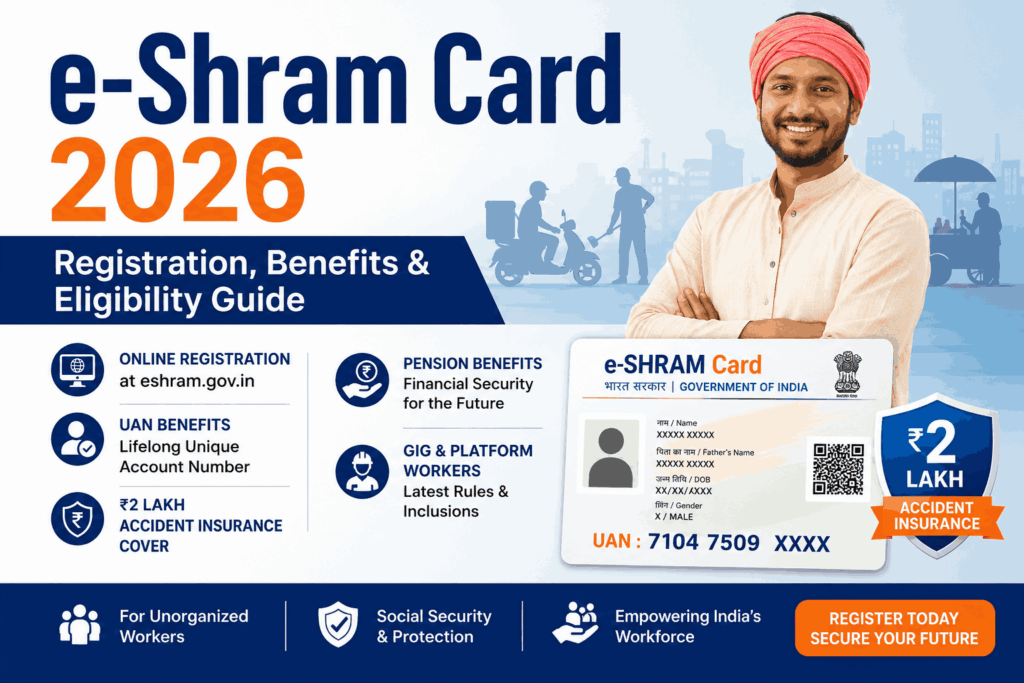
India runs on people who rarely show up on a payroll — the mason finishing a wall, the woman rolling beedis at home, the rider weaving through traffic with your dinner. For decades, none of them existed in any official record. No record meant no insurance, no pension, and no safety net when an accident or a lean month arrived. The e-Shram Card was built to change exactly that.
In plain terms, the e-Shram Card is a free government ID that places unorganised workers into a single national database and gives each of them a lifelong account number they can carry to any state in the country. Whether you are applying for yourself or helping a parent, a maid, or a delivery partner, this guide explains what the card is in 2026, who qualifies, what it actually unlocks (and what it does not), and the new rules that landed over the past year.
One promise up front: every figure here has been checked against official sources. When the subject is your money and your safety, half-remembered WhatsApp forwards are not good enough.
What Is the e-Shram Card?
The e-Shram Card is a 12-digit identity issued by the Ministry of Labour and Employment, Government of India, to workers in the unorganised sector. It was launched on 26 August 2021 to build the National Database of Unorganised Workers (NDUW) — the country’s first serious attempt to count and connect informal workers in one place.
When you register, you do not simply receive a card. You receive a Universal Account Number (UAN) that is seeded with your Aadhaar. That number is permanent. It does not expire, it does not change when you switch jobs, and it works the same in Patna as it does in Bengaluru.
The scale is enormous. By late 2025, more than 31 crore unorganised workers — including over five lakh gig and platform workers — had registered, making e-Shram one of the largest worker databases anywhere in the world.
What Exactly Is a UAN?
Your UAN is your portable identity inside the e-Shram system. Quote it once and the database already knows your age, occupation category, and bank details, which cuts down the paperwork when you apply for other schemes. A quick clarification that trips many people up: the e-Shram UAN is not the same as the EPF UAN that salaried employees get from EPFO. Same name, two completely different systems — and you cannot hold both at once, because EPFO members are not eligible for e-Shram in the first place.
Who Is Eligible for an e-Shram Card?
To register, you need to tick four boxes:
- You work in the unorganised sector — a job with no employer-provided provident fund or formal benefits.
- You are between 16 and 59 years old.
- You are not a member of EPFO, ESIC, or NPS (government).
- You are not an income-tax payer.
There is no minimum income requirement, and there is no fee to register. The card is designed for the people most likely to fall through the cracks — here is a snapshot of who it covers.
| Eligibility Criterion | Requirement |
|---|---|
| Age | 16 to 59 years |
| Employment type | Unorganised / informal sector worker |
| EPFO / ESIC / NPS membership | Must NOT be a member |
| Income tax | Must NOT be an income-tax payer (no income ceiling otherwise) |
| Citizenship & ID | Indian worker with a valid Aadhaar number |
| Cost | Free |
Workers who clearly qualify include construction and brick-kiln labourers, street and newspaper vendors, domestic workers, agricultural and landless farm labour, fishers, barbers, carpenters, beedi rollers, auto and truck drivers, and — increasingly — app-based delivery riders and cab drivers.
Who Cannot Apply
- Government employees and anyone covered by EPFO or ESIC.
- Income-tax payers, including most regular salaried professionals.
- Anyone outside the 16–59 age band.
Documents Required for e-Shram Registration
The online process is deliberately light on paperwork because it pulls most of your details straight from Aadhaar. Here is what to keep ready.
| Document | Why it is needed | Required? |
|---|---|---|
| Aadhaar number | Identity verification against UIDAI records | Yes |
| Aadhaar-linked mobile | To receive the OTP for online registration | Yes (or biometric at a CSC) |
| Bank account (number + IFSC) | To receive insurance payouts and direct benefit transfers | Strongly recommended |
Tip: if your mobile number is not linked to Aadhaar, you will not get the OTP for self-registration. Visit a Common Service Centre (CSC) and register using fingerprint (biometric) authentication instead.
e-Shram Card Benefits in 2026
Here is the single most useful thing to understand about the e-Shram Card: it is a key, not a cash machine. By itself it does not deposit money into your account every month, and anyone telling you otherwise is selling a fantasy. What the card does is unlock a set of protections and government schemes that informal workers were previously locked out of.
1. Accident Insurance Cover (PMSBY)
Every registered worker is brought under the Pradhan Mantri Suraksha Bima Yojana (PMSBY), which provides accidental death and disability cover. The payouts are straightforward:
| Event | Insurance Payout |
|---|---|
| Accidental death | ₹2,00,000 (to the nominee) |
| Permanent total disability (e.g. loss of both eyes / hands / feet) | ₹2,00,000 |
| Partial permanent disability (e.g. loss of one eye / hand / foot) | ₹1,00,000 |
Claims are processed through the linked bank account under the PMSBY rules. In an unfortunate event, the family should inform the bank quickly and keep the FIR or panchnama, the post-mortem or disability certificate, and a copy of the e-Shram UAN card ready.
2. Pension Through PM-SYM
The e-Shram Card is integrated with the Pradhan Mantri Shram Yogi Maan-dhan (PM-SYM) pension scheme. This one is opt-in, not automatic. If you are between 18 and 40 with a monthly income of ₹15,000 or less, you can join, contribute a small monthly amount that the government matches 50:50, and then draw a pension of ₹3,000 every month for life after you turn 60. You can enrol directly using your UAN.
Expert note: an official third-party evaluation has recommended raising the income ceiling from ₹15,000 to ₹18,000 and widening the entry age to 18–50. That is a recommendation under review, not yet the law — so do not assume the new limits until they are notified.
3. A Single Door to 14+ Welfare Schemes
On 21 October 2024 the government launched the e-Shram “One-Stop-Solution,” which links the portal to at least 14 central schemes so you can see and reach them from one place instead of chasing each separately. The headline ones:
| Scheme | What it offers |
|---|---|
| PMSBY | ₹2 lakh accidental death / disability insurance |
| PMJJBY | Life insurance cover |
| Ayushman Bharat (AB-PMJAY) | Health cover up to ₹5 lakh per family per year |
| PM-SYM | ₹3,000 monthly pension after age 60 (on enrolment) |
| PM-SVANidhi | Working-capital loans for street vendors |
| PMAY (Gramin & Urban) | Assistance towards building a pucca house |
| MGNREGA | Up to 100 days of guaranteed rural wage work |
| PM-KISAN | Income support for small and marginal farmers |
| One Nation One Ration Card | Subsidised ration from any fair-price shop, any state |
| National Career Service (NCS) | Job search using your UAN |
| Skill India Digital Hub | Free skill training and certificates |
| NPS / Atal Pension Yojana | Voluntary long-term pension options |
4. New in 2026: Real Benefits for Gig & Platform Workers
This is the biggest recent shift. The Code on Social Security, 2020 came into force on 21 November 2025 — the first central law to legally define a “gig worker” and a “platform worker.” It opens the door to accident, health, maternity, and old-age cover for app-based workers, partly funded by the aggregators themselves.
To make this work, an Aggregator module went live on the e-Shram portal on 12 December 2024. Twelve major platforms have already been onboarded: Swiggy, Zomato, Blinkit, Zepto, Uber, Ola, Rapido, Amazon, Urban Company, Porter, Ecom Express, and Uncle Delivery. The Union Budget 2025-26 went further, promising e-Shram registration, identity cards, and Ayushman Bharat health cover for platform workers, with a government target of bringing 2.35 crore gig workers under social security by 2029-30.
An honest caveat: the legal framework is now ahead of the payouts. Several specific gig-worker cash benefits are still being notified, which means the rights exist on paper even if every single benefit is not switched on yet. Registering now puts you first in line when they are.
Latest 2026 Updates at a Glance
| Update | Detail |
|---|---|
| Code on Social Security in force | From 21 Nov 2025; first central law to define gig & platform workers |
| Aggregator module live | Since 12 Dec 2024; 12 major platforms onboarded |
| Digital access | Download your UAN card on your phone, including via DigiLocker |
| Registrations | 31+ crore unorganised workers; 5 lakh+ gig & platform workers |
| Long-term target | 2.35 crore gig workers under social security by 2029-30 |
| Helpline | 14434 / 1800-889-6811 (9 AM–6 PM, daily) |
How to Register for an e-Shram Card Online (Step by Step)
- Go to the official portal eshram.gov.in and select “Register on e-Shram.”
- Enter your Aadhaar-linked mobile number with the captcha, then verify the OTP.
- Enter your Aadhaar number; after another OTP, the portal pulls your name, photo, and date of birth from UIDAI.
- Fill in your details — address, occupation and skill, education, and (importantly) your bank account number and IFSC.
- Review everything carefully and submit.
- Your e-Shram Card with its 12-digit UAN is generated instantly. Download the PDF and save it.
Start to finish, self-registration usually takes about 10–15 minutes.
No Aadhaar-Linked Mobile? Use a CSC
If your mobile is not linked to Aadhaar, the OTP route will not work. Walk into a Common Service Centre (CSC) or a State Seva Kendra (SSK) and register using biometric authentication. Registration itself remains free, though the centre may charge a small service fee for assistance.
How to Download or Update Your e-Shram Card
To download the card again later, log in at eshram.gov.in with your mobile number or UAN, verify the OTP, and choose “Download UAN Card.” To change your address, mobile number, bank details, or occupation, use the “Update Profile” option.
The single most important maintenance task: keep your bank details current. Outdated or wrong bank information is the number-one reason benefits and payouts fail to arrive. If you registered back in 2021 or 2022 and have since changed banks or moved, update your profile today.
How to Check Your e-Shram Card Balance and Benefit Status
Before answering the question, “how to do an e Shram card check balance“, it is crucial to understand what exactly the e-Shram Card is not. The problem with the e-Shram Card is that it is not a wallet and there is no cash stored inside the card to be checked. You can verify the status of your registration, PM-SYM contribution history, and any PM-SYM benefit associated with your UAN. Do an e Shram card check balance mobile number lookup by visiting eShram.gov.in with your Aadhaar Linked mobile number, enter the OTP, and then log in to your eShram dashboard to check your profile and check the status of the scheme to which you are affiliated. You can also check the balance of your e Shram card aadhar number search using your 12-digit Aadhaar number on the login page, which will then send an OTP to your mobile number that is registered with UIDAI, or you will be directed to a CSC for biometric verification. Either route provides the same information: whether you are a UAN or not, a history of your PM-SYM contributions (if you are enrolled), and if your bank account is properly connected for payouts.
e-Shram Card vs EPFO vs BoCW Card — Clearing the Confusion
These three are constantly mixed up because they all give workers some kind of number or card. They are not the same, and they serve very different people.
| Feature | e-Shram (UAN) | EPFO (EPF UAN) | BoCW Card |
|---|---|---|---|
| For whom | Unorganised / informal workers | Salaried, formal-sector employees | Construction workers (state boards) |
| Cost | Free | PF contributions (employer + employee) | Cess-funded; small registration fee |
| Core benefit | Database + scheme access + accident cover | Provident fund + EPS pension | Construction-worker welfare benefits |
| Can you also hold it? | Not if you are an EPFO member | — | Yes, alongside e-Shram |
Pros and Cons of the e-Shram Card
Pros
- Completely free and fast — you can register online in about 10–15 minutes.
- One portable, lifelong identity — your UAN follows you across every state.
- Real accident protection — it brings genuinely uninsured workers under ₹2 lakh accidental cover.
- A single doorway to 14+ schemes — instead of navigating each one separately.
- Legal footing for gig workers — for the first time, app-based workers are recognised in central law.
- Cleaner relief delivery — governments can send help directly to workers in emergencies, cutting out middlemen.
Cons & Limitations
- Not a salary or auto-pension — the card alone pays nothing monthly; pension needs separate PM-SYM enrolment.
- Law ahead of payouts — several gig-worker cash benefits are still being notified.
- Needs an Aadhaar-linked mobile — for the easy online route (otherwise a CSC visit).
- Benefits can stall — if your bank details are outdated or incorrect.
- Excludes formal workers — by design, EPFO members and taxpayers cannot join.
- State-level variation — some scheme rules differ by state, which can confuse applicants.
Security, Privacy & Trust — and How to Avoid Scams
The e-Shram database is run by the Ministry of Labour and Employment and seeded with Aadhaar, so identities are verified against UIDAI records. Registration works on a self-declaration basis, the only official portal is eshram.gov.in, and there is a formal grievance-redress system if something goes wrong.
Because the scheme reaches crores of low-income workers, it is also a magnet for fraud and misinformation. Knowing the red flags protects you more than any feature does.
Red Flags: How to Spot an e-Shram Scam
- “Pay ₹X to get your e-Shram card or benefits.” False. Registration is free. Anyone charging you for the card itself is cheating you.
- “₹6,000 / ₹1,000 a month is being credited to all e-Shram holders.” There is no universal central monthly cash payout tied to the card. Treat these forwards as rumours until you see them on eshram.gov.in or an official PIB release.
- “Click this link to claim your e-Shram money.” Don’t. Phishing links exist to harvest your Aadhaar and bank details. Use only eshram.gov.in or a verified CSC.
- Anyone asking for your OTP. Never share it. Check your own status by logging in yourself.
Official channels: helpline 14434 or 1800-889-6811 (9 AM–6 PM daily), email [email protected], and grievances at gms.eshram.gov.in.
A Practical Take: Is the e-Shram Card Worth It?
If you genuinely work in the unorganised sector, registering is close to a no-brainer. It is free, it is quick, and the downside is essentially zero. The real value is not a magic monthly cheque — it is being on the map. When the next relief package, insurance claim, or scheme rollout happens, you want to already be in the database with correct bank details, not scrambling to sign up in the middle of a crisis.
Consider a delivery rider in Pune. When the new labour code recognised platform workers in late 2025, the riders who had already registered were first in line for whatever followed — not the ones starting from scratch. That is the whole lesson in one sentence: register now, keep your details updated, and never wait for a benefit to be announced before you act.
Practice Smart Investing Before You Commit Real Money
Your e-Shram Card is a crucial initial step to take full control of your financial future, but it is not the only necessary measure to take to secure your finances. Like many workers, a person who begins saving small amounts wants to learn about the stock market, and not risk any money that she may not be able to afford to lose. This is where a free paper trading app India option comes into play: You can trade on the prices of NSE and BSE without any real money risk and see what would have happened with your trades. When comparing, PaperTradingApp is extensively utilized as a paper trading application India traders use to familiarize with order types, monitor a virtual portfolio and accumulate confidence prior to putting any genuine resources into the market — thus making it one of the best paper trading application India has for first-time investors. After getting comfortable with the process, one can go for live trading via a registered broker with SEBI. For starters, read our Best Trading App in India guide or check out our Paper Trading Platforms!
Frequently Asked Questions
What is the e-Shram Card?
The e-Shram Card is a free government ID with a 12-digit Universal Account Number (UAN), issued by the Ministry of Labour and Employment to unorganised-sector workers. It registers you in the National Database of Unorganised Workers and gives lifelong, nationwide access to social-security schemes.
Who is eligible for the e-Shram Card?
Any unorganised worker aged 16 to 59 who is not a member of EPFO, ESIC, or NPS and is not an income-tax payer. There is no minimum income and no registration fee.
Is the e-Shram Card really free?
Yes. Self-registration on eshram.gov.in is completely free. A CSC may charge a small service fee for assisted registration, but no one should charge you for the card itself.
Does the e-Shram Card give ₹1,000 or ₹3,000 every month automatically?
No. The card does not credit any amount on its own. A ₹3,000 monthly pension is available only if you separately enrol in PM-SYM and contribute until age 60. Claims of automatic monthly cash for all cardholders are not official.
What benefits does the e-Shram Card give in 2026?
₹2 lakh accidental insurance under PMSBY, a single window to 14+ schemes (Ayushman Bharat, PM-SYM pension, PM-SVANidhi, PMAY, MGNREGA, PM-KISAN, ONORC and more), job search via NCS, and — new this year — legal social-security recognition for gig and platform workers.
Can gig and delivery workers get an e-Shram Card?
Yes. Gig and platform workers can self-register, and major aggregators such as Swiggy, Zomato, Blinkit, Zepto, Uber, Ola, and Rapido have been onboarded. The Code on Social Security, 2020, in force since 21 November 2025, gives them legal recognition.
Is my e-Shram UAN the same as my EPF UAN?
No. They share the name but belong to different systems. The e-Shram UAN is for unorganised workers; the EPF UAN is for salaried EPFO members. EPFO members are not eligible for e-Shram.
How do I update my bank details on the e-Shram Card?
Log in at eshram.gov.in with your mobile number or UAN, verify the OTP, open “Update Profile,” and edit your bank account and IFSC. Keeping these current is essential, because wrong bank details are the top reason payouts fail.
How do I download my e-Shram Card?
Log in at eshram.gov.in with your Aadhaar-linked mobile number or UAN, verify the OTP, and select “Download UAN Card” to save the PDF. You can also access it through DigiLocker.
What is the official e-Shram helpline number?
Call 14434 or 1800-889-6811 (9 AM–6 PM, daily), email [email protected], or raise a complaint at gms.eshram.gov.in.
How do I do an e-Shram card check balance?
The e-Shram Card doesn’t hold a cash balance, so there’s nothing to check in a wallet sense. What you can check is your registration and scheme status by logging into eshram.gov.in with your mobile number or UAN and viewing your dashboard.
Can I check my e-Shram card balance using my mobile number?
Yes. Log in at eshram.gov.in with your Aadhaar-linked mobile number, verify the OTP sent to that number, and your dashboard will show your UAN status, PM-SYM contributions (if enrolled), and linked bank details.
Can I check my e-Shram card balance using my Aadhaar number?
Yes. On the eshram.gov.in login page, you can enter your 12-digit Aadhaar number instead of your mobile number. The OTP is sent to whichever mobile is linked to that Aadhaar in UIDAI records; if no mobile is linked, visit a CSC for biometric login.
Why does my e-Shram card show no balance or pension amount?
Because the e-Shram Card only shows a pension balance if you’ve separately enrolled in PM-SYM. If you haven’t opted into that scheme, there’s no pension contribution to display — registration alone doesn’t create one.
Final Verdict
The e-Shram Card in 2026 is one of the most worthwhile free documents an informal worker in India can hold. It will not make you rich and it will not drop money into your account every month — so anyone selling it that way is misleading you. What it does is quietly powerful: it gives you a permanent identity in the system, real ₹2 lakh accident protection, and a single doorway to more than a dozen welfare schemes.
The past year made the case stronger. With the Code on Social Security now in force and gig workers finally recognised in central law, the e-Shram Card has shifted from a simple registry into the backbone of India’s social-security push for informal labour. The framework is in place even if every payout is not yet switched on.