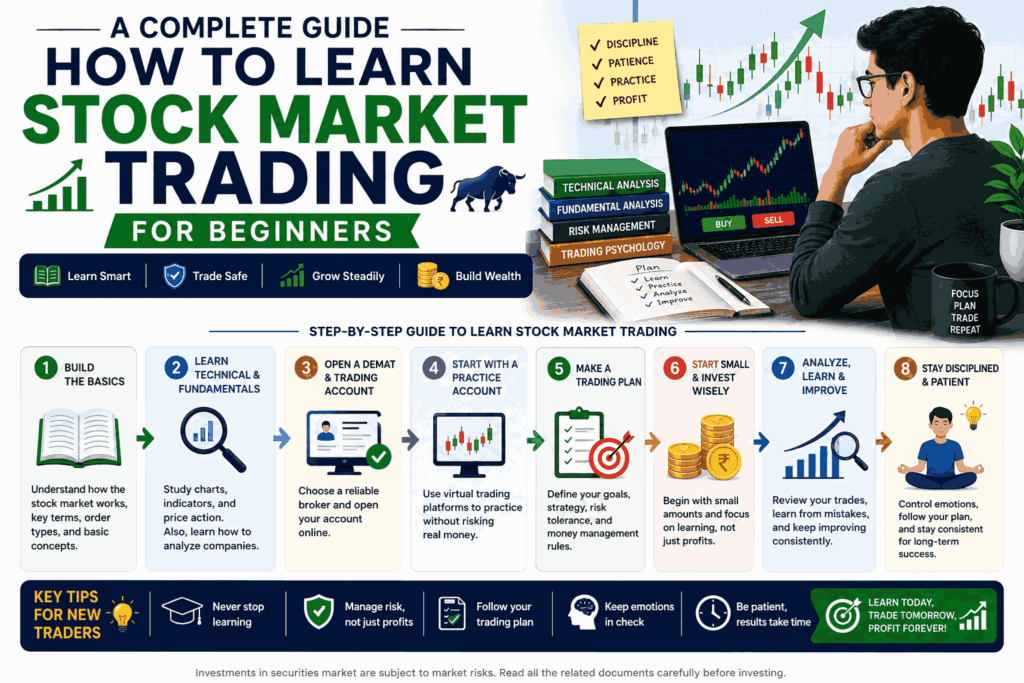
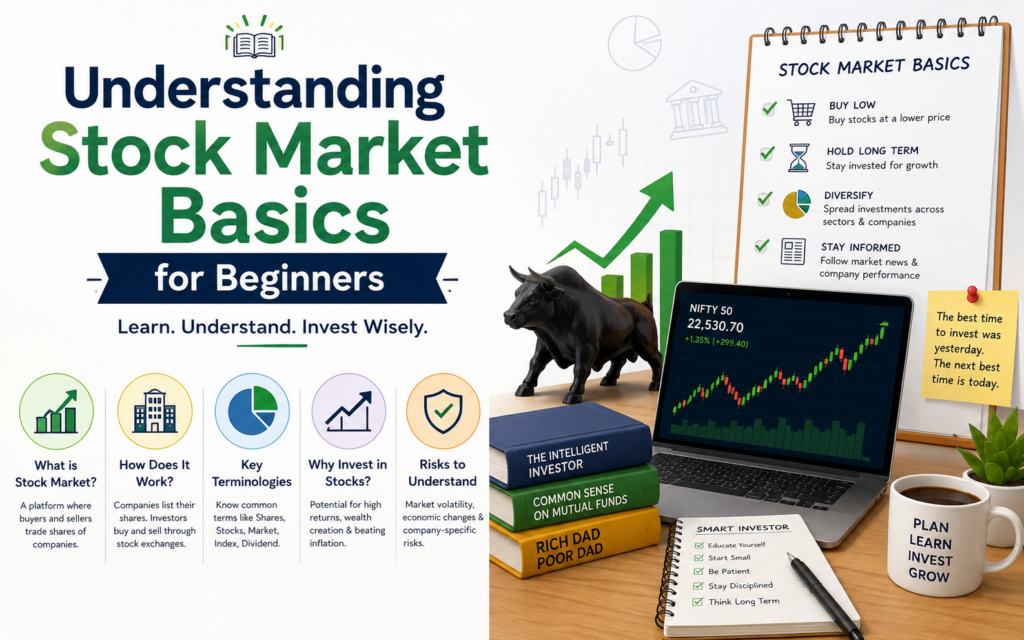
In the world of finance, the stock market may be the most viable means of constructing wealth in the long-term. Unfortunately, the process of building wealth through the stock market can be seen as convoluted and daunting, especially by those who are just getting started. For this reason, understanding the fundamentals is important before putting your hard-earned money at risk. The aim of this guide is to present clearly and build a solid foundation for stock market fundamentals.
What is Stock Market?
The stock market is the marketplace for buying and selling shares of publicly listed companies. The stock market consists of two major exchanges in India: National Stock Exchange (NSE) and Bombay Stock Exchange (BSE).
Purchasing a share means you are buying a small fraction of a company. If the company expands and generates revenue, the worth of what you own may go up.
How Does the Stock Market Work?
The stock market consists of a network of exchanges, brokers, and investors. The stock market in India is regulated by the Securities and Exchange Board of India (SEBI).
Here are the major components involved:
- Companies list their shares via an IPO (Initial Public Offering).
- Investors buy and sell shares through brokers.
- Prices fluctuate based on demand and supply.
- Trades are executed electronically within seconds.
Key Participants in the Stock Market
In the stock market ecosystem, the major participants are:
1. Investors
These can be individuals or institutions that buy shares in the stock market for a profit. Profits in the share market come through an increase in share prices or through dividends.
2. Traders
These are participants in the market for a short period of time. Traders seek to make a profit through changes in the price of a share.
3. Brokers
Brokers include Upstox and Zerodha, which are examples of operators that process stock transactions.
4. Regulators
Regulators are entities like SEBI that monitor and guard against fraudulent activities.
Types of Markets
Primary Market
In this market, companies first launch shares via IPOs.
Secondary Market
Here, investors buy and sell shares between each other after the listings. This is where most of your trading occurs.
Types of Financial Instruments
- Equity Shares: Ownership in a company
- Mutual Funds: Professionally managed investment pools
- Exchange-Traded Funds (ETFs): Index-based funds traded like stocks
- Bonds: Fixed-income instruments
- Derivatives: Advanced instruments like futures and options
Beginners should start with equities or mutual funds before exploring complex instruments.
What Influences Stock Pricing?
Factors that influence the pricing of stocks include the following.
- Company performance (profits, growth)
- Economic conditions (inflation, interest rates)
- Market sentiment
- Global events
For example, positive earnings reports often push stock prices higher, while negative news can lead to declines.
Common Stock Market Terminologies
Here are a few terms that every beginner must know:
- Bull Market: Rising market with increasing prices
- Bear Market: Falling market with declining prices
- Dividend: Profit distributed by a company to shareholders
- Market Capitalization: Total value of a company’s shares
- Portfolio: Collection of investments
How to Start Investing in the Stock Market
Step 1: Open a Demat and Trading Account
To invest in the stock market, you must first open a Demat account, which will allow you to hold shares, and a trading account, which will allow you to buy and sell shares.
Step 2: Complete KYC
Submit your PAN, Aadhaar and bank details.
Step 3: Select a Broker
Pick a trustworthy broker. Some examples include Zerodha, Groww, and Angel One.
Step 4: Start Investing
Invest small first, then increase your investment as your confidence grows.
Investment vs Trading
| Investing | Trading |
| Long-term approach | Short-term buying and selling |
| Focus on fundamentals | Requires technical analysis |
| Lower risk compared to trading | Higher risk and reward |
Beginners are generally advised to start with investing rather than trading.
Common Investment Strategies for Beginners
- Buy and Hold
Invest in solid companies and keep the investment for years.
- SIP (Systematic Investment Plan)
Invest a set variable amount at regular periods (this is popular in mutual funds).
- Index investing
Invest in Nifty 50 and similar indices using ETFs.
Risks in the Stock Market
While the stock market offers high returns, it also carries risks:
- Market volatility
- Company-specific risks
- Economic downturns
- Emotional decision-making
Risk management is crucial for long-term success.
Investment Tips for Beginners
- Start small, scale gradually
- Diversify your investments
- Avoid following market rumors
- Focus on long-term goals
- Keep learning continuously
Importance of Technology in Modern Investing
Investing has become less difficult with platforms like Groww and Zerodha, which provide easy mobile and web-based interfaces for investors. Integrated learning modules, webinars, and analytics dashboards provide users with the information needed to make decisions. Systematic Investment Plans (SIPs) and alerts for tracking your portfolio, etc., make the whole process a lot easier. Consequently, technology has reduced entry barriers and massively enhanced the participation of retail investors in India’s capital markets.
Importance of Discipline and Patience
Successful investing is based on simple principles of discipline and patience. Markets are always volatile and short-term price movements may cause emotional decisions. Investors who follow a sound strategy—based around financial aim, risk tolerance and time horizon—are likely to reap steady returns. Patience enables investments to compound, harnessing the benefits of long-term scalability. Controlling your emotions is arguably even more important; panic selling in downturns and momentum chasing in rallies often result in losses.
Common Mistakes to Avoid
Novice investors frequently make mistakes that are avoidable in the sense that they hurt returns. Lack of information can cause you to invest in poor stocks and lose your money. Not diversifying — putting all money in one stock, for instance — makes the portfolio very risky. Another common error is trying to time the market, because predicting short-term movements can be extremely challenging. Without considering longer-term financial goals, strategies become disparate and outcomes become less than optimal. Wanting to make easy money, overtrading leads to higher transaction costs and lower net returns. Being mindful of these mistakes can go a long way in improving investment performance over the longer run, through informed decisions and discipline!
Conclusion
Knowing how to invest in the stock market is a powerful way to build wealth but requires knowledge, discipline and patience. With a basic understanding of these areas — how the markets work, key participants, investment strategies and risks involved — you can confidently start your investing journey.
Start with easy investments, monitor the news, and develop your knowledge base steadily. The key is to invest wisely and stay the course long enough; ultimately, you will reach your financial goals and generate incredible wealth.
Frequently Asked Questions (FAQs)
- What is the stock market in simple terms?
The stock market is a platform where investors buy and sell shares of publicly listed companies. In India, trading primarily happens on exchanges like the National Stock Exchange and Bombay Stock Exchange.
- How can a beginner start investing in the stock market?
A beginner can start by opening a Demat and trading account with brokers like Zerodha or Groww, completing KYC, and investing small amounts in fundamentally strong companies or mutual funds.
- What is the minimum amount required to invest in stocks?
There is no fixed minimum amount. You can start investing with as little as ₹100, depending on the share price of the company or by investing in mutual funds through SIPs.
- Is stock market investing safe for beginners?
Stock market investing involves risk, but it can be relatively safe if you invest in diversified assets, follow a long-term strategy, and stay informed. Regulations by the Securities and Exchange Board of India ensure transparency and investor protection.
- What is the difference between investing and trading?
Investing focuses on long-term wealth creation by holding stocks for years, while trading involves short-term buying and selling to profit from price movements.
- What are the best stocks for beginners in India?
Beginners should look for fundamentally strong companies with consistent performance, such as blue-chip stocks. However, proper research or consulting a financial advisor is recommended before investing.
- Can I lose money in the stock market?
Yes, stock prices fluctuate based on market conditions, and losses are possible. However, disciplined investing and diversification can help reduce risks.
- What is a Demat account?
A Demat account stores your shares and securities in electronic form. It is mandatory for investing in the stock market and works along with a trading account.
- How do stock prices change?
Stock prices change due to demand and supply, company performance, economic conditions, and investor sentiment.
- What are common mistakes beginners should avoid?
Beginners should avoid investing without research, overtrading, putting all money in one stock, and trying to time the market.