Almost everyone who starts trading wants the same thing: to learn how the market works without losing money while they figure it out. A demo trading account is the tool built for exactly that. It lets you place real trades, on real prices, in real time — using virtual money instead of your own savings.
That matters more than it sounds. A SEBI study found that roughly 93% of individual traders lost money in equity futures and options between FY22 and FY24, with combined losses crossing ₹1.8 lakh crore; an updated study for FY25 showed losses widening further, with over 91% of individual traders still in the red. SEBI now even requires brokers to warn you at login that nine out of ten F&O traders lose money. A demo trading account won’t magically put you in the winning minority — but it lets you make your beginner mistakes for free, instead of paying for them with real capital.
This guide explains what a demo trading account is, how it works, its honest advantages and limitations, the best platforms available in India in 2026, and how to use one the right way so the practice actually translates into real-world skill.
What Is a Demo Investment Account?
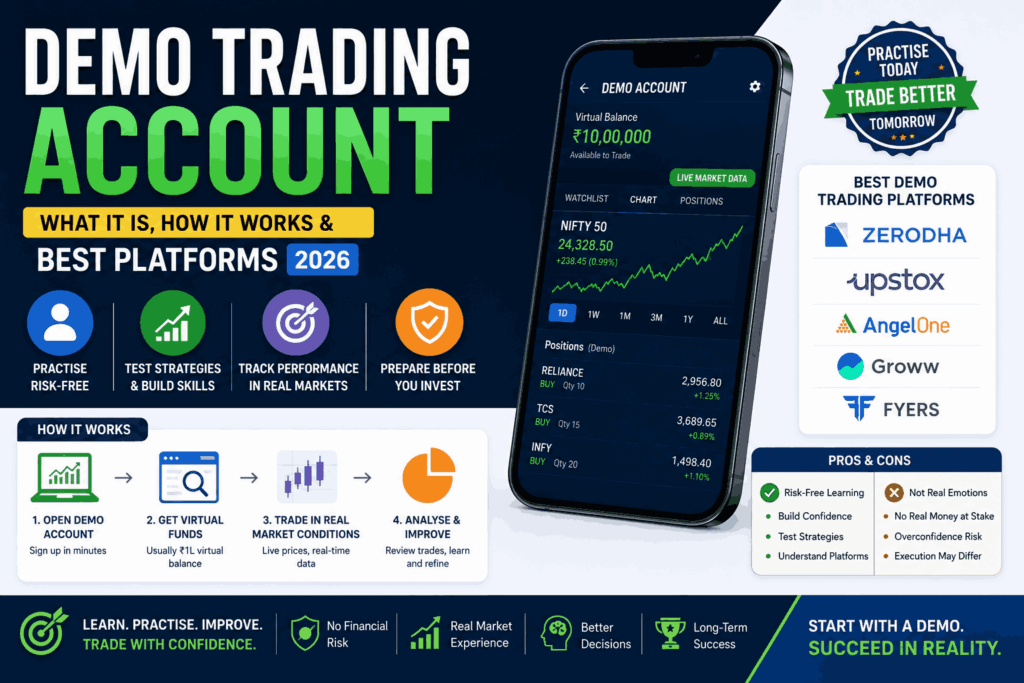
A demo trading account is a simulated trading environment that mirrors a live brokerage account — with one crucial difference: the money is fake. You get a virtual balance (commonly anywhere from ₹1 lakh to ₹10 lakh, sometimes far more), and you use it to buy and sell stocks, options, futures and other instruments at actual market prices. Your profits and losses are tracked exactly as they would be in a real account, but nothing can be withdrawn and nothing real is ever at stake.
Think of it less like a video game and more like a driving lesson in an empty parking lot. The car is real, the controls are real, and the skills carry over — but a mistake costs you nothing more than a bruised ego. That safe space to fail is the entire point.
Demo Trading vs Paper Trading vs Virtual Trading: Are They the Same?
In general, these terms can be used interchangeably. “Paper trading” derives from the traditional practice of logging them on paper and manually keeping track of trades. The concept of “virtual trading” or “simulated trading” translates to that same concept in a contemporary app. It’s just a digital, automatic version: It draws real data, executes your orders at market rates, and maintains your scorecard for you. In today’s world, most people looking to practise this way look for a paper trading app India which offers them a cleaner and more India-centric experience, with the prices being live prices from NSE/BSE, and order types being familiar — and they don’t have to rely on a foreign trading platform’s data feed to get that. The only difference that needs to be known between paper trading (test with real time data, no money), backtesting (test a strategy with historical data) and forward testing (test a strategy live before putting up any money).
How Does a Demo Trading Account Work?
The flow is deliberately close to the real thing, which is what makes it useful:
- Sign up on a paper trading platform or open the demo mode inside a broker’s app — usually with just an email or phone number, and no demat account required.
- Receive a virtual balance — your practice capital, which you can typically reset whenever you want to start fresh.
- Connect to live market data — good platforms stream real-time NSE and BSE prices, so your watchlists and charts behave exactly like a live terminal.
- Place simulated orders — market, limit, stop-loss and bracket orders across segments such as equity delivery, intraday and F&O. They “execute” at the prevailing market price.
- Track your performance — the platform maintains your positions, holdings and a running profit-and-loss statement, often with win-rate and trade-history analytics.
What’s genuinely real here are the prices, the charts, the order types and the mechanics. What’s simulated is only the money — and, as we’ll see, the emotions that come with putting real money on the line.
Why a Demo Trading Account Matters (The SEBI Reality Check)
It’s tempting to skip practice and “learn by doing” with real money. The data suggests that’s an expensive way to learn:
- 93% of individual F&O traders lost money between FY22 and FY24, per SEBI, with aggregate losses above ₹1.8 lakh crore. Only about 1% earned profits above ₹1 lakh after costs.
- In FY25, net F&O losses widened 41% to roughly ₹1.06 lakh crore, and over 91% of individual traders still finished in the red.
- Even in the cash market, SEBI found that more than 70% of individual intraday traders lost money in a single year.
- The pull is strongest among the young — the share of under-30 traders has risen sharply, and the vast majority of them lose.
A demo trading account is the cheapest tuition available for this game. It lets you discover how index options decay over a weekend, how a stop-loss feels when a stock gaps down, or how quickly costs eat into a high-frequency strategy — all before a single real rupee is on the line. It won’t guarantee success, but it removes the most avoidable losses: the ones that come from simply not knowing how things work.
Who Should Use a Demo Trading Account?
A demo trading account isn’t only for absolute beginners. It earns its place for several different kinds of trader:
- Complete beginners — learning what a stop-loss, lot size or options chain even is, in a zero-risk setting.
- Strategy testers — experienced traders trialling a new system before they put real capital behind it.
- Platform switchers — anyone moving to a new broker or app who wants to master the interface and shortcuts without costly misclicks.
- Returning traders — people coming back after a break who want to rebuild a feel for current market conditions.
- Systematic and algo traders — those forward-testing automated strategies on live data before deployment.
If you fall into any of these groups, even a few weeks of focused demo practice can save you real money and a great deal of avoidable frustration.
Key Features to Look for in a Demo Trading Account (2026)
Not all simulators are equally useful. A demo account that paints too rosy a picture can do more harm than good. Prioritise these:
- Live, real-time data. Real NSE/BSE feeds matter; delayed data teaches the wrong reflexes.
- A realistic virtual balance. A sensible ₹1–10 lakh mirrors how most people actually start. Eye-watering balances (some apps hand out crores) tend to breed reckless position sizing.
- Broad segment coverage. Equity delivery, intraday, and F&O with proper options chains — so you can practise what you actually intend to trade.
- Honest cost simulation. The best platforms factor in brokerage, STT, stamp duty and slippage. Many ignore costs entirely, which flatters your results.
- Charts, indicators and order types. Limit, stop-loss and bracket orders, plus the indicators you’ll rely on live.
- Analytics and a journal. Profit-and-loss reports, win-rate, and trade history turn random practice into measurable improvement.
- A reset option, and a free tier. The ability to wipe the slate clean, without paying, keeps practice low-pressure.
Best Demo Trading Account Platforms in India (2026)
There are a few solid choices in 2026, each of which is a little bit different in strength. Below is a quick orientation, but it is not an endorsement as features and balances are constantly changing — please check the latest details before signing up. PaperTradingApp is a truly free paper trading app for India traders that provides real time NSE/BSE live feeds and complete P&L tracking, among the options that have been built specifically for the Indian traders. While deciding the platform according to realism and cost, it is also important to take into account the segment coverage i.e equity, intraday and F&O with regards to the best paper trading app india rather than only the one that has the flashiest interface.
| Platform | Best for | Virtual balance | Segments | Notes |
| TradingView | Charting & strategy practice | ~$100,000 (resets) | Stocks, F&O, global | Best-in-class charts; global markets |
| Moomoo | Feature-rich simulation | Very large | Stocks, ETFs, options | Deep tools; huge balance can mislead |
| Sensibull | Options practice | Virtual | Options (multi-leg) | Strong strategy & risk-profile tools |
| Neostox | AI-enabled live sim | Virtual | Stocks, F&O | Backtesting & analytics; large user base |
| AlgoTest | Systematic options testing | Virtual | Options | Backtest + forward test focus |
| FrontPage | Community + practice | ~₹10 lakh | Stocks, options, crypto | Social, community-driven features |
| StockGro | Gamified learning | Virtual | Stocks | Beginner-friendly, gamified |
| Upstox Dartstock | Broker demo (F&O) | Virtual | F&O | F&O practice tools |
| PaperTradingApp | India-focused simulator | ₹10 lakh | Equity, intraday, F&O, options | Live NSE/BSE feeds; P&L reports; free |
Details are indicative and change over time; confirm current features, balances and data sources on each platform before relying on them.
Demo Account vs Real Trading Account: The Honest Differences
A demo trading account is a rehearsal, not the performance. Understanding exactly where the two diverge is what stops over-confidence:
| Aspect | Demo Trading Account | Real Trading Account |
| Money at risk | None — fully virtual | Your real capital |
| Profits & losses | Virtual; can’t be withdrawn | Real; withdrawable |
| Market data | Usually live, real prices | Live, real prices |
| Emotions | Minimal — no real fear or greed | High — fear, greed, FOMO |
| Costs (brokerage, STT, slippage) | Often ignored or simplified | Fully borne; reduce returns |
| Order execution | Idealised, instant fills | Subject to liquidity & slippage |
| Demat / KYC | Not required | Mandatory, via SEBI-registered broker |
| Best for | Learning and testing | Actual wealth-building |
The single biggest gap is psychological. In a demo, a ₹50,000 virtual loss is a shrug; with real money, the same loss triggers stress, second-guessing and revenge trading — the exact behaviours that wreck accounts. No simulator can fully recreate that, which is why the jump to live trading should always start small.
Pros and Cons of a Demo Trading Account
Pros
- Completely risk-free — you learn without losing real money.
- A safe lab to test and refine strategies before committing capital.
- You learn the platform — order types, charts, shortcuts — so you don’t fumble live.
- Builds familiarity and confidence with how markets and instruments behave.
- No demat account needed, and most platforms are free.
Cons
- No real emotional pressure, so it can’t teach discipline under fear and greed.
- It can breed over-confidence — demo winners often struggle when real money is involved.
- Many simulators ignore real costs and slippage, flattering your results.
- Execution is idealised; live markets have gaps, illiquidity and partial fills.
- Unrealistically large virtual balances can encourage reckless position sizing.
- Endless practising can become a comfortable excuse to never start for real.
How to Use a Demo Trading Account Effectively
The difference between practice that helps and practice that misleads comes down to how seriously you treat it. A few expert habits:
- Treat virtual money like real money. Pick a balance close to what you’ll actually trade with, not the maximum on offer.
- Trade the way you’ll trade live. Same position sizes (as a percentage), same segments, same hours — not 50-lot punts you’d never take with real cash.
- Keep a trading journal. Log every trade, your reason for it, and the outcome. A trading journal app makes this easier, and you can review your win rate and risk-reward weekly; this is where real learning happens.
- Mentally add costs. If your platform ignores brokerage and taxes, subtract them yourself so your results stay honest.
- Test one strategy at a time. Backtest it on history, then forward-test it in the demo before risking money. Resist the urge to switch approaches after every losing trade.
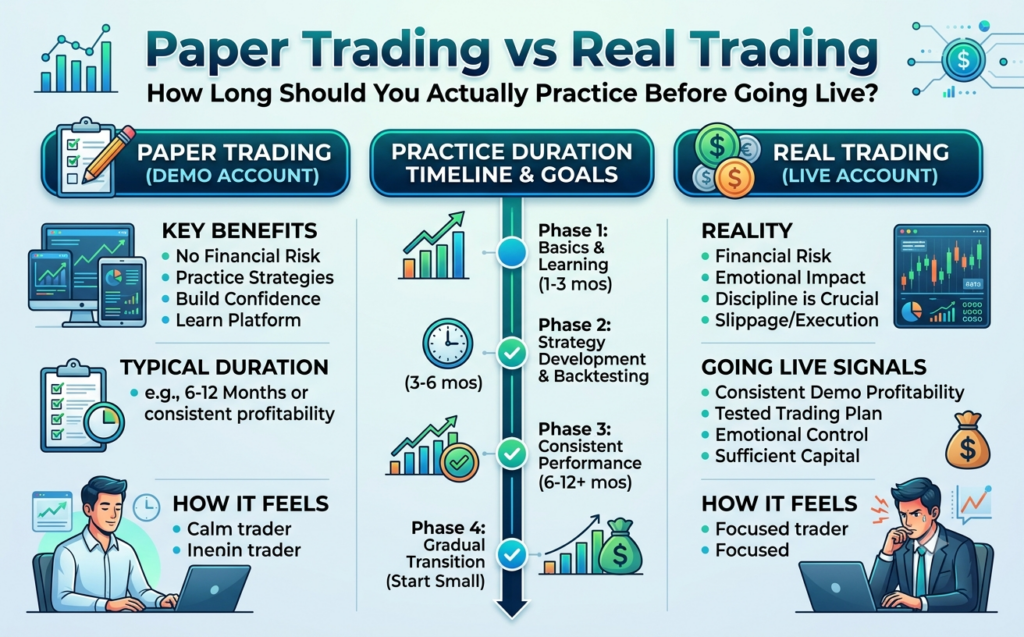
- Set a graduation goal. Aim for consistency over roughly three to six months, then move to live trading with small capital — don’t practise forever, and don’t chase a high virtual score.
Common Mistakes to Avoid
- Trading huge fake size you’d never risk in real life — it teaches habits that will blow up a real account.
- Ignoring costs, then being shocked when live returns are far lower.
- Skipping the journal, so months of practice produce no measurable learning.
- Demo trading indefinitely as a way to avoid the discomfort of going live.
- Strategy-hopping after every loss instead of giving one approach a fair test.
- Treating it as a game to win, rather than a rehearsal to learn from.
How to Move From a Demo Account to Live Trading
The hand-off from virtual to real money is where many traders stumble, because real capital changes everything. A measured, phased transition helps the skill survive:
- Confirm consistency first. Only graduate once your journal shows a repeatable edge over a meaningful number of trades — not a single lucky streak.
- Open an account with a SEBI-registered broker and complete KYC, verifying the registration details before you fund it.
- Start small. Trade with money you can genuinely afford to lose — a fraction of what you eventually intend to deploy.
- Shrink your position sizes at first; real emotions make even a familiar strategy feel very different.
- Keep journaling and compare your live results against your demo numbers — the gap shows exactly where psychology and costs are hurting you.
- Scale up gradually, and only as your live results stay consistent and your discipline holds.
Treating the switch as a careful step-down in size, rather than a leap, is the surest way to carry your demo skill into the real market.
Security, Regulation & Trust: What You Should Know
Because no real money or securities are involved, a demo trading account itself isn’t something SEBI registers or regulates — you don’t need any licence or demat account to practise. But that freedom means a little due diligence is on you:
- For live trading, use only SEBI-registered brokers. When you graduate to real money, verify the broker’s SEBI registration number and exchange membership before funding an account.
- Know the forex caveat. Indian residents may legally trade only permitted INR currency pairs on Indian exchanges. A forex demo on an offshore MetaTrader platform is fine for learning, but going live there with a foreign broker can breach FEMA rules — the RBI has repeatedly cautioned against unauthorised forex platforms.
- Don’t confuse a demo with a ‘gaming’ app. Genuine demo trading uses virtual money with zero risk. Some real-money “opinion trading” or fantasy-style apps mimic the look of trading but risk actual cash and may be unregistered — a very different thing.
- Mind your data. Prefer platforms that use legitimate real-time exchange feeds, and be cautious about handing over sensitive personal or financial details to a simulator that doesn’t need them.
The 2026 Landscape: What’s New
Two forces have made the humble demo trading account more relevant in 2026 than ever. First, regulation: SEBI’s mandatory login warnings (the “nine out of ten lose” message) and its tighter F&O rules — limited weekly expiries, larger contract sizes and upfront premium collection since late 2024 — mean live trading now demands more capital and more skill, raising the payoff from practising first.
Second, the tools have leapt forward. AI-enabled simulators now offer backtesting, forward testing and analytics; gamified apps have made practice approachable for first-timers; and mainstream charting platforms bundle increasingly realistic paper-trading modes. The one caution worth repeating is the trend toward enormous virtual balances — impressive marketing, but a poor teacher of disciplined position sizing. With India now home to more than 21 crore demat accounts, the appetite for safe, structured practice has never been higher — and the quality of free demo options has risen to meet it.
Frequently Asked Questions
What is a demo trading account?
A demo trading account (also called a paper trading or virtual trading account) lets you practise buying and selling shares, options and other instruments using virtual money instead of real cash. Trades execute against real, live market prices, so you learn how trading works and test strategies without risking any actual money.
Is a demo trading account free?
The majority of demo trading accounts in India are complimentary. TradingView, Sensibull, Neostox, StockGro and other platform-specific paper trading apps provide virtual trading for free except for a few high-end features or premium data that you will have to pay for. If you’re looking for a paper trading app india option, one that offers no additional cost, make sure that the platform you choose declares the word “free” early in the process — not after a few transactions.
Do I need a demat account for demo trading?
No. Because no real securities change hands, you don’t need a demat or trading account for a demo trading account. You only need a demat and trading account with a SEBI-registered broker when you move to live trading with real money.
Can you make or lose real money in a demo trading account?
No. All gains and losses in a demo trading account are virtual and cannot be withdrawn or lost. Just be careful not to confuse genuine demo accounts with real-money gaming or opinion-trading apps, which do risk actual cash.
How long should I use a demo trading account before going live?
There’s no fixed rule, but many experienced traders suggest about three to six months — until you can follow a consistent, written strategy and manage risk calmly. Aim for competence, not a high virtual score, and start live trading with small capital you can afford to lose.
Is demo or paper trading legal in India?
Yes. Practising with virtual money is completely legal, since no real securities or money are involved. For live trading you must use a SEBI-registered broker, and remember that trading forex pairs on offshore platforms is restricted for Indian residents.
Is demo trading the same as real trading?
Not quite. The mechanics and prices are the same, but the psychology isn’t. With virtual money there’s no real fear, greed or pressure, and many demos ignore costs like brokerage, taxes and slippage — which is why demo results are usually better than real-world results for the same person.
Final Verdict: Is a Demo Trading Account Worth It?
For anyone new to the markets — and for experienced traders testing a fresh idea — a demo trading account is one of the smartest first moves you can make. In a world where the large majority of individual traders lose money, the ability to learn the platform, understand how instruments behave, and pressure-test a strategy without risking a rupee is genuinely valuable. It is the rehearsal that makes the real performance less terrifying.
Just keep its limits in mind. A demo can’t teach you how you’ll behave when real money is on the line, and a flattering simulator can lull you into over-confidence. Use one that streams live data and respects realistic costs, treat the virtual money like your own, keep a journal, and set a clear point at which you’ll graduate to live trading — with small capital and a SEBI-registered broker. Practised that way, a demo trading account doesn’t just teach you to trade; it teaches you to trade responsibly.