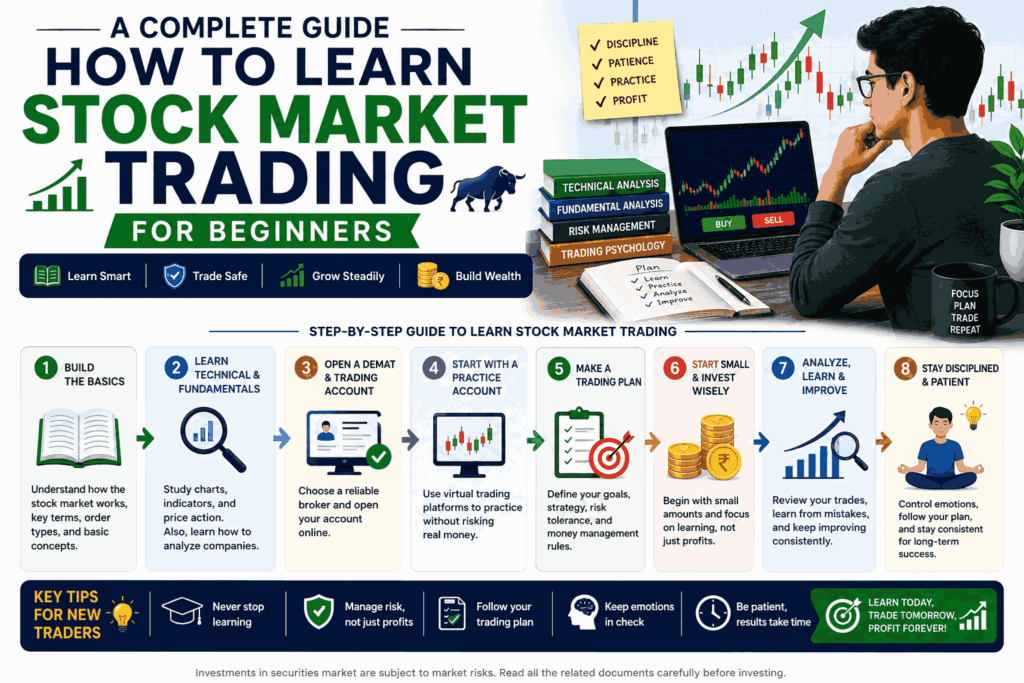

You can set up a brokerage account and start investing for the price of one share of stock. Certain brokerages also provide paper trading which allows you to simulate trading in stocks with the help of online stock trading simulators. In addition, it may be more advantageous for beginners to use a dedicated app for paper trading in comparison to using the trading platform’s demo version, since such apps are best suited for practicing with NSE & BSE live quotes.
Guide to stock market investment 2026: how to start investing money in the right place to feel secure about the future. With prices rising and things feeling uncertain, investing helps you prepare for future expenses more quickly. The main goal of investing money is to make it grow over time.
According to experts, one should start investing as early as possible, preferably in a tool that offers better returns. This is where investing in stocks emerges as the best choice. Let’s get to know some salient points about how to invest in the stock market.
- Stock investment simply means buying shares of a public company to gain ownership. These shares are called stocks.
- When the price of a company’s shares goes up, the shareholder accrues a profit that can be realized by selling those shares to another person.
- One can invest in stocks through a stockbroker. Stockbrokers help stock investors buy and sell shares on a stock exchange.
- Since share prices can rise or fall quite quickly, stock investment is considered to offer better returns than other investment tools.
- Mutual funds are also a way to invest in stocks.
When you buy stocks, you are betting on the company’s long-term success and growth.
Depositing cash into an online investing account, which can later be used to purchase shares of stock or stock mutual funds, is one of the greatest methods for novices to learn how to invest in stocks.
You may open a brokerage account and begin investing for the cost of one share of stock. Some brokers also offer paper trading, which lets you practise buying and selling stocks using stock market simulators before making a real-money investment.
How To Start Investing in Stocks In 2026? (6 Step-by-Step Guide)
How to invest in the stock market in India for beginners. There is no one-for-all approach to stock market investing. Hence, here is a 5-step procedure that might help you make a promising start. You can choose your unique approach to starting stock market trading based on your existing knowledge and investment objectives. Open a bank account, decide on your investment strategy, set a spending limit, keep your eyes on the long term, and adjust your portfolio as needed over time. Do keep in mind that one proven step is to build a diverse portfolio and then maintain the investment, even in a dwindling market.
1. Decide Your Investment Objectives
Before you open a Demat account and explore different ways to invest, think about what you want to achieve with your investments. Do you want to earn money regularly from your investments, or are you planning to invest for a long time? Knowing this will narrow down your choices and make it easier for you to invest.
Think about your long-term objectives for this money: are you saving for retirement, a down payment for a home within the next five years, or something else?
Knowing your objectives and when they must be accomplished will help you decide how much risk you can afford to accept and which investment accounts should be given top priority.
2. Find Your Risk-bearing Capability
The next step is to determine your risk-taking capability which is also known as risk tolerance. There are different types of stock: large cap, mid cap, small cap, aggressive, and value stocks. Each of them carries its own risk. So, determine how much risk you can choose to take over a period of time, and then choose the most appropriate types of stocks based on the same.
3. Determine Your Investment Style
Some investors want to invest in stocks completely on their own, while others seek professional support. Your investment style depends on the approach you take.
- If you want to manage your stock market investment on your own, you can choose to work with a conventional or full-service stockbroker. A full-service stockbroker offers a wide range of services to help investors get deeply involved in the stock market. They allow investors to invest in stocks, mutual funds, ETFs, IPOs, and others. A full-service stockbroker also provides stock advisory services that help investors conduct thorough market analysis and choose the best stocks to invest in. These brokers may levy high brokerage.
- On the other hand, if you just want to invest in profitable stocks without worrying about high brokerage fees, you can choose a discount stockbroker in India. Some of them even offer zero brokerage stock investments or competitive brokerage.
- One fast-emerging option these days is algo trading. An algo trading platform is an automated, hands-off alternative to dealing with a broker or financial advisor. They are frequently less expensive. Your goals, degree of risk tolerance, and other information are collected by a algo trading program, which then automatically invests for you.
4. Create Your Portfolio
It’s time to start building your portfolio once you’ve decided on your objectives, evaluated your risk tolerance, calculated how much money you have to invest, and chosen the sort of investor you want to be. Choosing a combination of assets that will best help you achieve your goals is the process of building a portfolio.
Some of the commonly preferred investment instruments you can choose to have in your portfolio.
Stocks: This type of asset represents ownership in a certain business. Value tends to increase when a firm does well, but the inverse is also true when a company struggles.
Bonds: These loans to a business or government are guaranteed repayment, including interest. Although they have historically not offered returns as high as those of the stock market, bonds may still offer a reliable source of income.
Mutual funds are financial instruments designed to aggregate the resources of their owners to invest in a variety of equities and/or bonds. Instead of trying to acquire each stock individually, investors may hold significant portions of the market with a single fund. Mutual funds can be managed either actively or passively.
Exchange-traded funds (ETFs) are very similar to mutual funds in that they offer the same advantages, but often at lower costs and with more trading options.
5. Diversify Your Portfolio
Understanding diversification in investments is crucial. Simply put, investing in a variety of assets, or diversification, lowers the risk that the performance of any single investment would materially impair the return on your entire investment portfolio. It might be interpreted as slang for avoiding putting all your eggs in one basket.
6. Stock Investment Costs
Any investor, at any moment, needs guts, grit, and a decent amount of cash to invest in the stock market. Stockbrokers and traders must devote a lot of time and effort since investing in stocks for beginners is not a simple task. Everyone believes that you must also spend a considerable sum of money. Well, that depends on your investment goals and the business stock you choose. However, there are certain broad perspectives on how much money you could need to invest in the markets.
Each company’s stock is valued differently. It is dependent on a number of factors. For instance, you could have to pay more for a single share of a large-cap, blue-chip stock if you purchase a sizable amount of the stock. That is because these stocks come from businesses with a strong reputation for success and profitability.
It is wise to allocate a substantial sum to such stocks for long-term investing (given your specific investment objective) and reap substantial benefits down the road. On the other hand, if you invest in a stock through a forthcoming IPO, you may pay less per share, as you would be purchasing stock from a private firm making its first public offering.
In addition to the costs associated with investing in the stock market, which vary based on the equities you purchase, there are certain brokerage fees you could have to pay. When you purchase and sell stocks, as well as when you move stocks from your Demat account to your Broking account (trading account), transaction fees are charged.
As you begin trading, you should be informed of the charges associated with opening a Demat account. Another option is to subscribe to an impending IPO, which also has a charge. You may learn how to trade stocks and buy and sell shares with associated charges if you work with a reputable brokerage.
Best Investments and Stocks for Beginners To Buy
By the way, before you start using real money, you may want to practice with a free paper trade app first. After all, you are using fake money while learning lessons. Make sure to find the best paper trading app for Indian stock market that won’t charge hidden fees and will provide you with live prices. To truly be ready for the potential trades when you start using your own money, make sure you read and follow news related to trading and investment market without getting overwhelmed by the amount of information. The key is to get started.
Let’s talk blue-chip stocks first. You know – the big dogs like TCS, Infosys, HDFC Bank, Reliance. These companies aren’t going bankrupt tomorrow. They pay dividends, they’ve got their act together, and while you’re not gonna wake up a millionaire overnight, your money’s probably safer than under your mattress. Basically, they’re the sturdy old boots of your portfolio.
Now, if picking individual stocks makes you break out in hives, check out ETFs or index funds. These things just follow the big indexes like Nifty 50 or Sensex. So you’re not betting on one horse, you’re betting on the whole race. Plus, the fees are pretty chill, and you’re not stuck checking stock prices every five minutes. Much less drama.
Got just a little cash to spare? SIPs in mutual funds are your friend. You toss in a fixed amount every month and, over time, magic happens – well, compounding and rupee cost averaging, but still, it feels like magic if you stick with it.
Don’t sleep on government-backed stuff either. PPF, NPS – not the most glamorous, but they’re reliable, and your future self will thank you when you’re not eating instant noodles at seventy.
And hey, before you go tossing real money around, maybe mess around with a paper trading app. Fake money, real learning, zero regrets. Read up, follow the news, but don’t drown in it. The trick? Just start. Doesn’t have to be big or fancy.
Bottom line: safe bets, keep it spread out, don’t pay stupid fees, and stick with it. Investing’s a long game, not a lottery ticket. Keep at it, and let those gains do their thing.
Types of Stock Brokers In India
There are mainly two types of stock brokers – Full-service and Discount.
Full-Service Brokers
Full-service brokers offer a wide range of traditional brokerage services. They can help with things like planning for your future, such as managing your money for retirement, saving for college, or dealing with important life events. They charge more than other brokers because they give you personalized help. This might mean taking a portion of the money you spend on transactions, a portion of the money you have invested with them, or a yearly fee.
Discount Brokers
A discount broker offers low-cost transactions, online account administration, research tools, and instructional materials, as the name implies. For investors who manage their own investment portfolios, it is quite advantageous.
A discount broker is a type of brokerage that offers online trading services at lower prices than traditional full-service brokers. Customers of low-cost brokers often have access to a basic, no-frills trading interface and limited research and advisory services. They can provide full-service brokers with lower brokerage fees and commissions.
Top 10 Full-Service Stockbrokers in India
You must select the greatest stock broker in India if you want to receive top-notch stock broking and other relevant services. We have selected the top 10 full-service share brokers in India for your reference. You may learn more about them below, evaluate their costs and offerings, and make an informed choice.
| S.No | Broker Name | Client Base | Rating |
|---|---|---|---|
| 1 | Angel One | 40 lakh | 9.6 |
| 2 | IIFL Securities | 12 lakh | 9.5 |
| 3 | Nuvama (Edelweiss) | 12 lakh | 9.3 |
| 4 | HDFC Securities | 18 lakh | 9 |
| 5 | ICICIdirect | 30 lakh | 8.8 |
| 6 | SBI Securities | 6.5 lakh | 8.6 |
| 7 | Kotak Securities | 10 lakh | 8.6 |
| 8 | Sharekhan | 7.5 Lakh | 8.4 |
| 9 | Geojit | 2.5 lakh | 8.1 |
| 10 | Motilal Oswal | 9 lakh | 8 |
Top 10 Discount Stockbrokers in India
For those who don’t want to splurge on heavy brokerage and want just basic buying and selling of stocks, discount stockbrokers in India are the best choice. Though they don’t offer full-fledged stockbroking services, they have become a big hit these days thanks to their competitive brokerage rates.
| S.no. | Broker Name | Ratings |
|---|---|---|
| 1 | Zerodha | 9.6/10 |
| 2 | mStock | 9.0/10 |
| 3 | Paytm Money | 8.8/10 |
| 4 | Groww | 8.4/10 |
| 5 | Upstox | 8.2/10 |
| 6 | 5paisa | 8.0/10 |
| 7 | Angel One | 7.8/10 |
| 8 | Fyers | 7.5/10 |
| 9 | Alice Blue | 7.3/10 |
| 10 | Dhan | 7.2/10 |
Different Types Of Charges Associated With Stock Investment
There are different types of costs involved with share trading. They include trading fees, service taxes, stamp duties, and security transaction taxes (STT). The brokerage fee and STT are the two most prevalent fees. We can purchase and sell shares, futures, options, and other financial products through brokers. Brokerage is the fee a broker charges for the services they provide.
Brokerage – A brokerage refers to an amount that is paid on every trade order which means this is paid whenever you buy or sell shares. Full-service stockbrokers may charge higher fees than discount brokers, which even allow users to trade at zero cost. Brokerage is charged either as a flat fee or a percentage of the trade value.
Transaction Charges – The stock exchanges impose transaction fees on both parties to the trade. The fee for both intraday and delivery trading is the same.
Demat Account Opening and Maintenance Charges – When you open a Demat account with a stockbroker, an account opening charge is levied by the broker. Most brokers either provide zero-cost account opening or a first-year maintenance-free. Do check these charges before opening a Demat account.
Depository Participant (DP) Charges –The National Securities Depository Limited and the Central Depository Services Limited are the two stock depositories in India. Each time you sell a share, a flat transaction charge is levied by the depository participant irrespective of the quantity sold.
The depository participant is the one who is charged by the depositories rather than the traders or investors directly. The depository participant (DP) in this instance is the brokerage business or the provider of your demat account.
Goods & Services Tax (GST) – GST, the government’s obligatory tax on services supplied, is equal to 18% of all brokerage and transaction fees.
What Are The Risks Associated With Stock Investment?
Investing in the stock market always has risks. But if you invest wisely, you can make a lot of money compared to other investment options. There are different types of investment risks, and some are riskier than others. Risk is part of investing.
Conclusion
If you’re new to investing and have some money to spare, you can consider putting it into stocks. To figure out what you want to achieve with your investments, how much risk you’re okay with, and how much it’ll cost you to invest in stocks and mutual funds, you’ll need to do some research. Also, it’s a good idea to check out different brokers to find the one that best fits your needs and understand what they require.
FAQs on Stock Investment
1. Is it simple to invest in stocks?
Yes, if you take your investment decision sensibly. In today’s world, there are different types of tools and a huge amount of information available that would help you at each step of your stock investment journey.
2. Which instruments are traded in a stock market?
Equity shares of various publicly traded corporations can be traded on the stock market. Additionally, the markets also deal in other financial products including futures & options, index futures, and index options. In stock markets, both equities and derivatives are traded.
3. What factors determine the price of a stock?
Typically, the company’s profitability and growth potential influence the stock price. The market assigns a P/E ratio based on how appealing the stock is. In addition to supply and demand, news flow also affects stock prices.
4. When is the best time to buy or sell stock to make the best returns?
Since it depends on your trading or investing perspective, there is no such thing as the ideal moment to purchase a share. Investors must purchase when upward potential is greatest, and traders must buy when downside risk is lowest.
5. What is the role of SEBI?
The Securities & Exchange Board of India (SEBI) is the primary overseer of India’s financial markets is Exchanges, brokers, investment bankers, investors, sub-brokers, analysts, distributors, rating agencies, publicly traded corporations, and other entities are all governed by SEBI. The interests of retail investors are safeguarded by SEBI, which guarantees that market integrity is not compromised.
6. Can I trade in stocks when the market is closed?
For the convenience of office workers, most brokers today allow you to place orders during market closing. The actual deal, however, will be placed in a queue and executed on the next trading day.
8. Should I invest in IPOs?
The results of the bull market are IPOs. Companies typically go public when conditions are favorable, such as when consumers are upbeat and the economy is performing well, in order to generate listing gains. A company’s ability to survive in a declining market is really put to the test during a bear market.
9. What is a stockbroker?
A stockbroker acts as an intermediary between an investor and the stock market. Its primary job is to help investors open a Demat account, a trading account and let them buy and sell stocks. Apart from this, several other services offered by a stockbroker help with stock trading.
10. What kind of stocks must be avoided while investing?
Investors should avoid equities with limited liquidity. Trading in these equities is challenging due to the limited liquidity. Additionally, it may be challenging to locate the data needed to analyze these businesses because it is typically difficult to access information on open platforms. Therefore, a lack of investigation might lead to investments that lose money. Additionally, investment in penny stocks should be avoided.
11. When the market is booming, should I invest in stocks?
Start compiling a watchlist of stocks if the market is strong. Observe the stocks with strong fundamentals. Avoid lump-sum investments if the investor finds attractive stocks and is ready to invest. By averaging out the stocks, the likelihood of buying them at a high price is reduced.