Almost everyone hunting for the lowest brokerage charges in India fixates on a single number — the “₹20 per order” or “₹0 delivery” splashed across a broker’s homepage. It’s an understandable instinct, but it’s also the fastest way to pick the wrong account. The headline brokerage is just one slice of what you actually pay.
Your real cost per trade is an all-in figure: brokerage plus Securities Transaction Tax (STT), exchange fees, GST, SEBI charges, stamp duty, and the depository (DP) charge that hits every time you sell delivery shares. On many trades, the tax bill quietly dwarfs the brokerage — which means the “cheapest” broker on paper can end up costing you more than a rival, depending on how you trade.
This guide cuts through the marketing. We’ll compare the lowest brokerage charges in India across the leading discount brokers in 2026, break down the statutory costs nobody advertises, explain the October 2024 rule changes that reshaped broker pricing, and show you how to find the genuinely cheapest option for your own style — whether you’re a long-term investor, an intraday trader, or an F&O participant.
A quick note: this article is for educational purposes only and is not investment advice. Brokerage rates and charges change frequently, so treat every figure here as an indicative mid-2026 snapshot and verify the latest charges on the broker’s official website before you act.
What Are Brokerage Charges, Really?
Brokerage is the fee your broker charges for executing a buy or sell order. In India it comes in two broad shapes: a flat fee (a fixed amount such as ₹20 per order, regardless of trade size) or a percentage of your trade value (common with traditional full-service brokers). Discount brokers popularised the flat-fee model, and it’s why costs have fallen so dramatically for retail traders.
But brokerage is only the first line on your contract note. Every trade also carries statutory and regulatory charges that are identical across all brokers, plus account-level costs like the annual maintenance charge (AMC). To compare brokers honestly, you have to look at the total landed cost, not the advertised rate — a point we’ll keep returning to.
Discount Brokers vs Full-Service Brokers
The first fork in the road is what kind of broker you want:
- Discount brokers (Zerodha, Groww, Angel One, Upstox, Dhan, 5paisa, Paytm Money, m.Stock and others) are digital-first and strip out research and branches to keep costs low — typically a flat ₹20 or less per order, often with free equity delivery. Roughly three-quarters of active retail traders now use them.
- Full-service brokers (ICICI Direct, HDFC Securities, Kotak Securities, Sharekhan, Motilal Oswal) charge percentage-based brokerage — often 0.25% to 0.50% on delivery — but bundle in research reports, relationship managers and physical branches. Many now also offer flat-fee plans to compete.
The math is simple: if you do your own research and trade with any regularity, a discount broker almost always wins on cost. If you genuinely value hand-holding and research, a full-service broker may justify its premium. For the rest of this guide, the focus is on the discount brokers that dominate the search for the lowest brokerage charges in India.
Lowest Brokerage Charges in India 2026: Broker Comparison
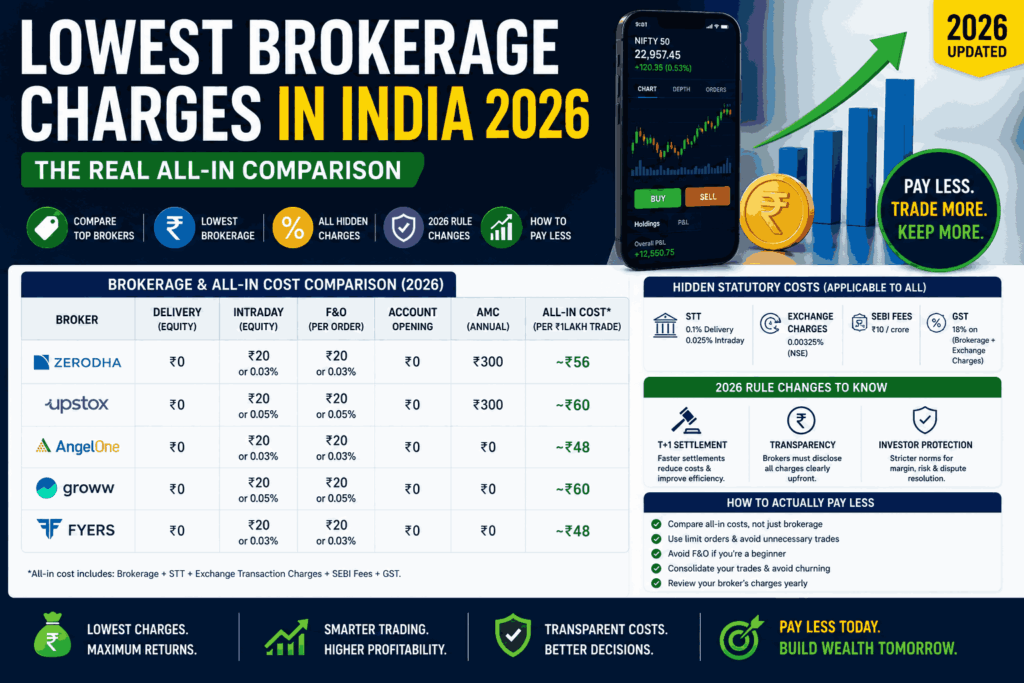
Here’s how the leading discount brokers stack up on brokerage in 2026. All offer free or near-free account opening. Figures are indicative and change often — verify on each broker’s official charges page before deciding.
| Broker | Delivery | Intraday | Futures | Options | AMC (₹/yr) |
| Zerodha | ₹0 | ₹20 / 0.03% | ₹20 / 0.03% | ₹20 | ₹300 * |
| Angel One | ₹0 | ₹20 | ₹20 | ₹20 | ₹240 |
| Groww | ₹20 / 0.1% | ₹20 / 0.1% | ₹20 | ₹20 | ₹0 |
| Upstox | ₹20 | ₹20 / 0.05% | ₹20 / 0.05% | ₹20 | ₹300 † |
| Dhan | ₹0 | ₹20 / 0.03% | ₹20 / 0.03% | ₹20 | ₹0 |
| 5paisa | ₹0 | ₹10 | ₹10 | ₹10 | ₹0 ‡ |
| Paytm Money | ₹0 | ₹10 | ₹10 | ₹10 | ₹0 |
| m.Stock (Mirae) | ₹0 | ₹5 | ₹5 | ₹5 | ₹0 § |
Where two figures are shown (e.g. ₹20 / 0.03%), the broker charges whichever is lower. * Zerodha’s first-year AMC is being waived for new accounts from June 2026. † Upstox waives AMC in year one. ‡ 5paisa waives AMC in year one. § m.Stock’s ₹5-per-order rate applies on its one-time-fee lifetime plan (around ₹1,299), with zero AMC.
For context, full-service brokers are far costlier on delivery — roughly 0.29% at ICICI Direct, around 0.50% at HDFC Securities, and 0.25% or ₹20 at Kotak Securities — though each also offers cheaper flat-fee or youth plans.
Quick Takeaways From the Table
- Lowest per-order brokerage: m.Stock leads at about ₹5 per order, with Paytm Money and 5paisa at ₹10 — meaningfully below the ₹20 norm for very active traders.
- Best for free delivery: Zerodha, Angel One, Dhan, 5paisa, Paytm Money and m.Stock all charge ₹0 on equity delivery. Groww and Upstox do not.
- Best on AMC: Groww, Dhan, Paytm Money and m.Stock carry ₹0 maintenance, while Zerodha’s ₹300 is its main cost drag (now waived in year one).
- The Groww catch: despite being India’s largest broker by active clients, Groww does charge on delivery — the lower of ₹20 or about 0.1% — a detail many users miss.
The Charges That Aren’t Brokerage (and Often Cost More)
This is the part most “cheapest broker” articles skip — and it’s the part that actually determines your bill. These statutory and regulatory charges are set by the government and exchanges, so they are the same at every broker:
| Charge | Delivery | Intraday | Futures | Options |
| STT (Securities Transaction Tax) | 0.1% buy + sell | 0.025% on sell | 0.02% on sell | 0.1% of premium on sell |
| Exchange transaction fee | ~0.003% | ~0.003% | ~0.002% | ~0.035% of premium |
| SEBI turnover fee | ₹10 / crore | ₹10 / crore | ₹10 / crore | ₹10 / crore |
| Stamp duty (buy side) | 0.015% | 0.003% | 0.002% | 0.003% |
| GST | 18% on broker + exch + SEBI | 18% | 18% | 18% |
| DP charge (on sell) | ~₹10–20 per stock | — | — | — |
Rates are approximate and change with government and exchange policy; verify current figures before trading.
Two realities jump out. First, STT often exceeds your brokerage. On a ₹1 lakh delivery trade (buy and sell), STT alone is around ₹200 — dwarfing the ₹0–20 you paid in brokerage. Second, the DP charge applies even at “zero-brokerage” brokers. Every time you sell delivery shares, the depository levies roughly ₹10–20 per stock, no matter how “free” the broker claims to be. The lesson: brokerage is the lever you can control, but it’s rarely the biggest number on your contract note.
A Worked Example: What a ₹1 Lakh Trade Actually Costs
To see why the headline rate is misleading, here’s the all-in cost of a ₹1,00,000 equity delivery round-trip (buy and then sell) on a zero-brokerage broker like Zerodha:
| Charge component | Approx. amount |
| Brokerage (delivery) | ₹0 |
| STT (0.1% on buy + sell) | ₹200 |
| Stamp duty (0.015% on buy) | ₹15 |
| DP charge on sell (+ GST) | ~₹16 |
| Exchange + SEBI fees | ~₹6 |
| GST (18% on applicable charges) | ~₹1 |
| Total all-in cost | ~₹238 |
Illustrative only; exact figures vary by broker and change with policy.
Look at what that reveals. Despite ₹0 brokerage, the trade still costs about ₹238 — and a rival broker charging ₹20 per order would land near ₹258. The broker controls barely a tenth of your total cost; taxes and statutory charges account for the rest. That’s precisely why chasing the lowest headline brokerage, while ignoring AMC, DP charges and your own trading frequency, is the wrong way to choose.
Which Broker Is Cheapest for Your Trading Style?
Because the charges fall differently across segments, the cheapest broker genuinely depends on how you trade:
Long-Term / Delivery Investors
If you buy and hold, prioritise free delivery and a low (or zero) AMC. Zerodha, Angel One and Dhan give you free delivery; Dhan, Paytm Money and 5paisa add zero AMC. If you trade only occasionally, a zero-AMC broker like Groww or Dhan can be cheapest overall — even Groww’s small delivery fee is outweighed by saving ₹300 a year in maintenance. Don’t forget the per-sell DP charge, which every delivery investor pays.
Intraday Traders
Here the per-order rate matters, because you place many trades. m.Stock (around ₹5) and Paytm Money or 5paisa (around ₹10) beat the ₹20 standard. But run the break-even math: on a ₹1 lakh intraday trade, total charges are roughly ₹200, so the stock needs to move about 0.2% just to cover costs. On a small ₹10,000 trade, the same fixed charges mean you need a 1% move to break even — a reminder that tiny positions are disproportionately expensive.
F&O Traders
For options, nearly every discount broker charges a flat ₹20 per order (less at m.Stock, Paytm Money and 5paisa), so brokerage differences are small. What changed everything is the October 2024 STT hike: with options STT now at 0.1% of premium on the sell side and futures at 0.02%, statutory taxes — not brokerage — are now the dominant cost for active derivatives traders. Choose on platform stability and margins as much as headline fees.
The 2026 Updates You Should Know
The brokerage landscape shifted meaningfully in the last couple of years, and the effects are still playing out in 2026:
- SEBI’s ‘true-to-label’ rule (effective 1 October 2024). Exchanges and depositories must now charge brokers uniform transaction fees, ending the old slab system where high-volume brokers got rebates and pocketed the difference. It made pricing more transparent but squeezed discount-broker margins — one reason some brokers have tweaked their charges.
- Higher F&O taxes (from 1 October 2024, continued in Budget 2026-27). STT on options sales rose to 0.1% of premium and on futures to 0.02%, raising the real cost of active derivatives trading regardless of which broker you use.
- A move toward ASBA-style settlement. SEBI is phasing in a UPI-block mechanism for the secondary market, where your money stays in your bank account until a trade settles — changing margin economics across brokers.
- Zero-brokerage is allowed — with disclosure. SEBI permits genuine zero-brokerage plans as long as brokers transparently pass through exchange, STT and GST charges under true-to-label rules.
The net effect for you: the gap between discount brokers has narrowed, and the headline rate matters less than it used to. Platform reliability, all-in cost and safety now deserve more weight than a one-rupee difference in brokerage.
Security, Regulation & Trust: Choosing a Safe Low-Cost Broker
A cheap broker is no bargain if your money or shares aren’t safe. The good news is that India’s regulatory framework applies equally to every registered broker, discount or full-service:
- SEBI registration is non-negotiable. Every legitimate broker holds a SEBI registration number and is a member of the stock exchanges (NSE and/or BSE). You can verify this on SEBI’s and the exchanges’ websites.
- Your shares sit with the depositories. Demat holdings are held at NSDL or CDSL, not with the broker itself, which protects you even if a broker runs into trouble.
- Client funds must be segregated. Brokers are required to keep client money separate from their own, with regular reporting to exchanges.
- Investor protection exists. Exchanges maintain investor protection funds, and grievances can be escalated through SEBI’s SCORES platform.
In short, low cost does not mean low safety — the leading discount brokers follow the same rules as the biggest banks’ broking arms. Still, do your due diligence: check the broker’s registration, track record, platform uptime and complaint-resolution record before committing.
How to Actually Minimise Your Brokerage Costs
- Match the broker to your style. Free delivery for investors; the lowest per-order rate for intraday and F&O traders. There is no single “cheapest” broker for everyone.
- Mind the AMC and DP charges. A zero-AMC broker can save more over a year than a one-rupee brokerage edge, and DP charges quietly add up for active delivery sellers.
- Trade fewer, larger orders. Each order triggers a flat fee and fixed costs, so consolidating trades reduces how often you pay them.
- Use direct mutual funds. Most discount brokers charge ₹0 for direct mutual fund investments — cheaper than regular plans over time.
- Always check the all-in cost first. Use a brokerage calculator to see your true landed cost — brokerage plus every statutory charge — before placing a trade.
- Don’t let ‘cheap’ tempt you into overtrading. Low costs are only an advantage if your strategy is sound; frequent trading multiplies charges and, as SEBI data on F&O losses shows, rarely ends well.
Pros and Cons of Low and Zero-Brokerage Brokers
Pros
- Dramatically lower trading costs than traditional full-service brokers — a real edge for active traders.
- Modern, fast apps with clean interfaces and quick order execution.
- Zero-AMC and free-delivery options keep costs down for buy-and-hold investors.
- Transparent, flat pricing that’s easy to understand and compare.
- Free direct mutual funds and low-cost access to IPOs, bonds and more.
Cons
- Little to no research, advisory or relationship-manager support — you’re largely on your own.
- “Free” can be misleading: statutory charges, DP fees and AMC may still apply.
- Customer support can be thinner than at full-service brokers.
- Ultra-low costs can psychologically encourage overtrading, which erodes returns.
- Add-on fees — call-and-trade, payment-gateway, physical statements — can surprise the unwary.
Test Your Strategy Before Chasing the Lowest Brokerage
The other half of finding the cheapest brokerage fees is finding a broker who is willing to offer you the lowest amount of fees. But having the lowest brokerage fee in India won’t help you make a profit if you aren’t a good trader. It’s sound business logic to try out your strategy first with virtual money on a paper trading platform before just moving all your money to go with the lower brokerage fees. This gives you the opportunity to test entry and exit points, position sizing and risk management without any real money risk and ensures that you aren’t losing money through low brokerage fees adding to your profit. PaperTradingApp is an easy solution — simulate trading, then choose the broker who is suitable for your trading style.
Frequently Asked Questions
Which broker has the lowest brokerage charges in India in 2026?
On per-order brokerage, m.Stock is among the lowest at around ₹5 for intraday and F&O on its one-time-fee plan, followed by Paytm Money and 5paisa at about ₹10. Zerodha, Angel One and Dhan charge ₹0 on delivery and a flat ₹20 elsewhere. The truly cheapest broker for you depends on your style and all-in cost, not just the headline rate.
Is zero brokerage trading really free in India?
No. “Zero brokerage” usually applies only to equity delivery, and statutory charges always apply — STT, exchange fees, GST, SEBI fees, stamp duty and DP charges on every sell. On a ₹1 lakh delivery trade, STT alone is around ₹200, far more than the brokerage you saved.
Is Zerodha or Groww cheaper?
It depends. Zerodha offers free delivery but charges ₹300 a year AMC. Groww charges a small delivery fee (₹20 or about 0.1%, whichever is lower) but has ₹0 lifetime AMC. For a rare trader, Groww’s zero AMC can be cheaper overall; for a buy-and-hold investor with large delivery positions, Zerodha’s free delivery may win.
Are discount brokers with low brokerage safe?
Yes, provided they are SEBI-registered, are members of NSE/BSE, and hold your demat at NSDL or CDSL. Such brokers follow the same safeguards — fund segregation, investor protection — as any large broker. Low cost doesn’t mean low safety, but always verify registration and track record first.
What are the lowest brokerage charges for F&O and intraday trading?
For options, most discount brokers charge a flat ₹20 per order, while m.Stock (around ₹5) and Paytm Money and 5paisa (around ₹10) are lower. For futures, Zerodha and Dhan charge ₹20 or 0.03% (whichever is lower). After the October 2024 STT hike, statutory taxes now form the bulk of F&O costs.
Do statutory charges differ from one broker to another?
No. STT, exchange charges, SEBI fees, GST and stamp duty are set by the government and exchanges and are identical at every broker — and since SEBI’s October 2024 true-to-label rule, exchange charges are uniform too. Only brokerage, AMC and DP charges vary, so compare those.
What hidden charges should I watch for beyond brokerage?
Watch the demat AMC, DP charges on every delivery sell (around ₹10–20 per stock), call-and-trade fees, payment-gateway charges and physical-statement fees. These small, recurring costs often matter more than the headline brokerage, especially for infrequent traders.
Final Verdict: Finding the Lowest Brokerage Charges in India
The lowest brokerage charges in India in 2026 come from a tight cluster of discount brokers — m.Stock at roughly ₹5 per order, Paytm Money and 5paisa at ₹10, and the likes of Zerodha, Angel One and Dhan offering free delivery with a flat ₹20 elsewhere. But the headline rate is the wrong place to stop. Once you factor in AMC, DP charges and the statutory taxes that often outweigh brokerage entirely, the genuinely cheapest broker becomes a personal answer that depends on whether you invest, trade intraday, or play F&O.
Since SEBI’s October 2024 reforms levelled exchange charges and raised F&O taxes, the cost gap between brokers has shrunk — which is good news, because it frees you to weigh platform reliability, safety and service alongside price. Pick the broker whose all-in cost suits how you actually trade, confirm its charges and SEBI registration directly before opening an account, and use a brokerage calculator to know your true cost per trade. Keep your costs low and your trading disciplined, and you’ll have done the two things that matter most.