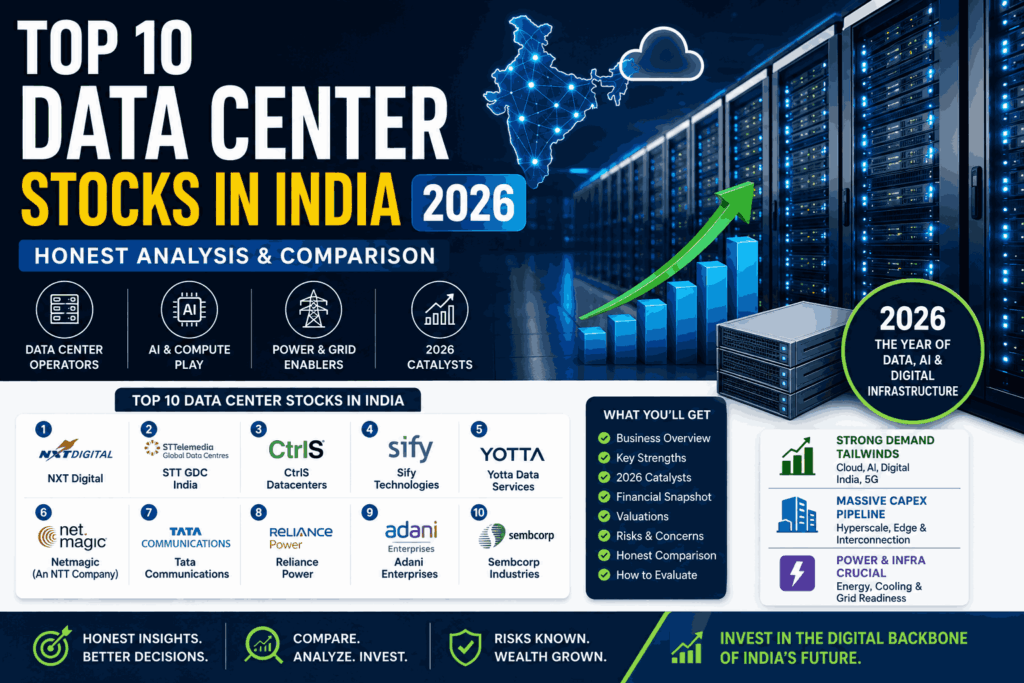
If you have gone looking for the top 10 data center stocks in India, you have probably run into a frustrating wall: there isn’t a single clean, listed “data centre company” on the NSE the way there is in the United States. What India offers instead is a fast-growing, slightly messy basket of companies that either build and run data centres, or supply the servers, power, cooling and fibre that make them work.
That messiness is exactly why this theme is worth understanding properly. India’s data centre capacity is set to multiply over the next five years as artificial intelligence, cloud computing, 5G and data localisation collide — and the listed companies riding that wave span everything from giant conglomerates to a single, hard-charging AI-server maker. This guide walks through the ten names investors are tracking most closely in 2026, what each actually brings to the table, the latest catalysts, and — just as importantly — the honest risks behind the headlines.
What Are Data Center Stocks?
A data centre is a highly secure, power-hungry building full of servers, storage and networking gear that stores and processes the data behind apps, websites, cloud platforms, payments and AI. Data center stocks are simply shares of listed companies that profit from this infrastructure — and in India, they fall into distinct layers of a value chain that behave very differently:
- Operators — companies that build, own and run the facilities (e.g. Adani Enterprises via AdaniConneX, Bharti Airtel via Nxtra, Reliance, Tata Communications, Anant Raj).
- Compute and cloud — makers of servers, GPUs and AI systems, and cloud providers (e.g. Netweb Technologies, E2E Networks).
- Power and electrical — switchgear, transformers and power-management gear (e.g. Schneider Electric Infrastructure, ABB India).
- Cooling — precision cooling and thermal management (e.g. Blue Star, Voltas, MTAR Technologies).
- Connectivity — optical fibre, cables and network equipment (e.g. Sterlite Technologies, HFCL, Tejas Networks).
The crucial insight, which most listicles gloss over, is this: for the largest operators, data centres are only a small slice of a much bigger business, so the share price barely reflects the theme. The “picks-and-shovels” suppliers often give you more direct — if more cyclical — exposure to the data centre boom in India.
Why Data Center Stocks Are Booming in India (2026)
Several powerful forces are converging at once, which is why data center stocks in India have moved from a niche idea to a mainstream theme:
- The AI surge. Training and running AI models is enormously compute- and power-intensive, and that demand lands directly on data centres.
- Cloud, 5G and digital India. More streaming, payments, enterprise cloud and 5G traffic all need local capacity close to users.
- Data localisation. Rules that require Indian data to be stored in India — reinforced by the Digital Personal Data Protection framework — push global firms to build domestic facilities.
- Explosive forecast growth. India’s operational data centre capacity was roughly 1,530 MW in 2025, and colocation capacity is projected to reach about 1.7 GW by end-2026. A widely cited Jefferies estimate sees capacity rising around fivefold to roughly 8 GW by 2030, needing about US$30 billion of investment and lifting leasing revenue several times over.
- Geographic concentration. Mumbai (MMR) and Chennai together account for nearly 70% of India’s colocation capacity today, with Pune, Delhi-NCR, Hyderabad and Bengaluru growing fast.
That is a genuinely compelling structural story. But “structural” is not the same as “smooth” — and as the next section shows, 2026 has already delivered both big catalysts and a sharp reality check.
The 2026 Updates Every Investor Should Know
Budget 2026-27 put data centres on the policy map
The Union Budget 2026-27 introduced targeted data centre incentives, including a proposed tax holiday running to 2047 for eligible foreign cloud-service companies that use Indian data centre services — a clear attempt to make India a global hosting hub. The accompanying Finance Bill, 2026, even formally defined terms such as “data centre,” “data centre services” and “specified data centre,” a sign of how seriously policymakers now treat the sector.
Marquee deals and expansions
The headlines kept coming through 2026. In February, Tata Communications’ data centre business signed up OpenAI as a customer — a notable validation of Indian infrastructure for global AI workloads. In June, Anant Raj signed an MoU with the Haryana government for a ₹25,000 crore data centre and cloud investment and set up a Singapore cloud subsidiary. Netweb Technologies bagged a ₹1,734 crore order to power India’s sovereign AI infrastructure, while Sterlite Technologies landed a US$1.1 billion multi-year optical-fibre deal with a US hyperscaler.
The June 2026 reality check
Then came the reminder that this theme cuts both ways. In June 2026, several Indian AI and data centre stocks — including Sterlite Technologies, HFCL and precision-cooling supplier MTAR Technologies — hit their lower circuits after a sharp global AI sell-off. The trigger was overseas: the Nasdaq fell more than 4.5% after US chipmaker Broadcom’s outlook disappointed investors. Because many of these stocks had already multiplied in value and trade at rich valuations, they swing hard whenever global AI sentiment wobbles. It is the single most important behavioural lesson for anyone buying into this theme.
A cleaner play may be coming
Airtel’s Nxtra — India’s largest data centre network — has filed draft IPO papers. If it lists, it would give Indian investors one of the first relatively clean, listed exposures to the colocation market, rather than buying it as a sliver of a larger company.
Top 10 Data Center Stocks in India 2026
Below are ten widely tracked listed names spanning the full value chain — operators first, then the enablers. Figures are approximate mid-2026 snapshots and will change quickly; always verify live data. None of this is a recommendation.
1. Reliance Industries — The Gigawatt-Scale Ambition
India’s most valuable listed company is building what could become the country’s largest AI data centre at Jamnagar, Gujarat, with gigawatt-scale ambitions and a partnership with NVIDIA for advanced AI chips. Reliance’s scale, balance sheet, captive power and Jio’s vast digital ecosystem make it a serious long-term contender in AI infrastructure. The obvious caveat: data centres are a tiny fraction of a sprawling conglomerate spanning energy, retail and telecom, so the stock is not a focused way to play the theme — it is a bet on Reliance as a whole.
2. Bharti Airtel — The Largest Data Centre Network (Nxtra)
Through its subsidiary Nxtra, Bharti Airtel runs India’s largest data centre network — a mix of large core facilities and 120-plus edge sites, backed by the Carlyle Group, with a strong enterprise and hyperscaler base and a commitment to renewable power (RE100). Nxtra has been expanding aggressively, aiming to roughly double capacity, and its filed IPO is one of the most closely watched in the infrastructure space. For now, you get exposure via Airtel’s consolidated business, where the data centre arm is still a modest part of a large, cash-generative telecom.
3. Adani Enterprises — The Hyperscale Builder (AdaniConneX)
Adani Enterprises is the most prominent listed name directly linked to data centres, through AdaniConneX, its joint venture with EdgeConneX. The JV is developing hyperscale campuses across Mumbai, Chennai, Noida, Hyderabad and Pune, with a stated target of around 1 GW of capacity and access to the group’s land and power resources. As an incubator-style conglomerate, Adani Enterprises gives thematic exposure, but the data centre business sits inside a JV with limited standalone disclosure, and the group carries its own governance and leverage debates that investors should weigh.
4. Tata Communications — Global Reach Plus AI Cloud
Tata Communications (formerly VSNL) is a global digital-infrastructure player that carries a large share of the world’s internet routes and operates dozens of data centres worldwide with around a million square feet of colocation space. Its Vayu cloud platform bundles IaaS, PaaS and NVIDIA-GPU AI services, and in 2026 its data centre business signed up OpenAI as a customer. With a market cap around ₹54,000 crore, it is a large-cap, but profit is modest relative to revenue (keeping its P/E high near 70), and growth has been steady rather than spectacular.
5. Anant Raj — The Real-Estate-to-Data-Centre Pivot
Anant Raj has transformed from a Delhi-NCR real-estate developer into one of the more talked-about data centre stories, via Anant Raj Cloud (co-location, cloud and AI services). FY26 revenue was around ₹2,512 crore with profit near ₹557 crore, and in June 2026 it announced a ₹25,000 crore data centre MoU with Haryana and a Singapore subsidiary. The other side of the ledger: it is a high-valuation small-cap (P/E in the mid-30s) whose shares fell roughly 34% from their 52-week high, and it drew a headline when the Enforcement Directorate sought information on a past associate-company transaction (the company said it cooperated and that operations were unaffected). A genuine growth pivot, but not a low-risk one.
6. Netweb Technologies — India’s Listed AI-Compute Play
Netweb is the closest thing to a listed pure-play on AI computing hardware — a Make-in-India OEM building supercomputers, AI systems (in partnership with NVIDIA and AMD), data centre servers, private cloud and high-performance storage under its Tyrone brand. FY26 revenue jumped around 90% to roughly ₹2,184 crore with profit up about 81%, and its AI segment’s revenue share surged from 15% to over 40%, helped by orders including a ₹1,734 crore sovereign-AI contract. The catch is valuation: the stock has traded at a price-to-earnings multiple anywhere from the mid-70s into triple digits, leaving little room for any stumble.
7. E2E Networks — GPU Cloud for the AI Era
E2E Networks runs a cloud platform focused on AI and machine-learning workloads, offering NVIDIA GPU-based cloud servers (including H100/A100-class hardware) to startups, enterprises and developers, and it has been associated with India’s national AI mission. It is a smaller, more speculative name (a small-to-mid-cap that has done a stock split and raised capital via a QIP), and it is highly volatile — it has repeatedly hit upper and lower circuits on AI news. Verify its current size and financials carefully before considering it.
8. Schneider Electric Infrastructure — Powering the Racks
Every data centre needs robust electrical infrastructure, and Schneider Electric Infrastructure supplies exactly that — medium- and low-voltage switchgear, transformers, and power-management systems from nine plants across India. Rising data centre and grid investment has driven the stock up sharply (roughly 64% over the past year to a market cap near ₹28,000 crore). But it is one of the most expensive names on this list, with a P/E around 130-plus and a low free float, so the price already bakes in a lot of optimism.
9. Sterlite Technologies (STL) — The Fibre Backbone
Optical fibre is the nervous system that connects data centres, and Sterlite Technologies — backed by the Vedanta group — is a leading Indian maker of optical fibre and network solutions, including high-density cables (such as its Celesta IBR range) built for AI and cloud campuses. A US$1.1 billion multi-year deal with a US hyperscaler supercharged sentiment, and the stock rocketed several hundred percent in 2026. Two cautions: such a vertical move is inherently risky, and the share trades in the BSE’s trade-to-trade (T2T) segment, meaning delivery-only, no intraday.
10. HFCL — Fibre, Telecom Gear and a Record Order Book
HFCL designs and manufactures optical fibre cables, telecom equipment and network solutions for telecom, defence, railways and broadband, and is a clear beneficiary of the global optical-fibre upcycle driven by hyperscale data centres and AI. It reported a record optical-fibre-cable order book and a large overall order pipeline, and is expanding data-centre-related capacity through its subsidiary HTL. Like its peers, the stock rallied strongly in 2026 — which also makes it vulnerable to the kind of sharp pullback seen during the June AI sell-off.
Other Names Worth Watching
Beyond the ten above, the data centre value chain includes ABB India (electrification and power), Blue Star and Voltas (cooling and HVAC), MTAR Technologies (precision cooling and power components), Tejas Networks (networking gear), Black Box (digital infrastructure and integration), Techno Electric & Engineering and L&T (data centre construction and EPC), and IT-infrastructure names such as Kaynes Technology, Dixon Technologies and Orient Technologies. Many are small- or mid-caps that have rallied hard on the theme, so the same valuation and volatility cautions apply.
Top 10 Data Center Stocks in India: Comparison Table (2026)
A side-by-side snapshot. Market caps are approximate and as of mid-2026; verify live figures before acting. This is for information only, not a recommendation.
| Company | Role | Mkt cap (approx.) | Data centre angle | Key watch-point |
| Reliance Industries | Operator (Jio AI DCs) | Largest in India | Gigawatt-scale AI DC at Jamnagar; NVIDIA tie-up | DC is a tiny part of a giant |
| Bharti Airtel | Operator (Nxtra) | Large-cap | India’s largest DC network; doubling capacity | DC a small part; Nxtra IPO awaited |
| Adani Enterprises | Operator (AdaniConneX) | Large-cap | AdaniConneX JV (EdgeConneX); ~1 GW target | DC via JV; group leverage/governance |
| Tata Communications | Operator + connectivity | ~₹54,000 Cr | 44 global DCs, Vayu Cloud; signed OpenAI | Modest profit; high P/E (~70) |
| Anant Raj | Operator / RE pivot | ~₹19,000 Cr | Anant Raj Cloud; ₹25,000 cr Haryana MoU | Small-cap; high P/E; ED-visit headline |
| Netweb Technologies | AI compute / HPC | ~₹28,000 Cr | AI servers (NVIDIA/AMD); ₹1,734 cr order | Extreme valuation (P/E ~75–135) |
| E2E Networks | GPU cloud | Small/mid-cap | NVIDIA GPU cloud; India AI mission | Very volatile; verify size/split |
| Schneider Electric Infra | Power & electrical | ~₹28,000 Cr | Switchgear & power systems for DCs | Very high P/E (~130+); low free float |
| Sterlite Technologies | Optical fibre | Mid-cap (Vedanta) | US$1.1B hyperscaler deal; AI fibre | Up several-fold in 2026; T2T segment |
| HFCL | Fibre & telecom gear | Mid-cap | Record OFC order book; hyperscale demand | Up 200%+ in 2026; cyclical |
Figures are indicative mid-2026 snapshots and change daily. This table is for information only and is not a recommendation to buy or sell any security.
How the Data Center Value Chain Breaks Down
Because each layer of the value chain carries a different risk and reward, it helps to see them side by side rather than lumping all “data center stocks” together:
| Layer | Role in a data centre | Example listed stocks | Key risk |
| Operators | Build, own & run the facilities | Adani Ent., Bharti Airtel, Reliance, Tata Comm, Anant Raj | High capex, long payback, occupancy |
| Compute & cloud | Servers, GPUs, AI systems, cloud | Netweb Technologies, E2E Networks | Tech cycles, client concentration |
| Power & electrical | Switchgear, transformers, UPS | Schneider Electric Infra, ABB India | Rich valuations, order timing |
| Cooling | Precision cooling, HVAC, thermal | Blue Star, Voltas, MTAR Technologies | Competition, margins |
| Connectivity | Optical fibre, cables, network gear | Sterlite Technologies, HFCL, Tejas Networks | Cyclical, lumpy orders |
A practical takeaway many analysts share: because data centres are a small part of the giant operators, the ancillary suppliers — power, cooling, fibre and compute — often deliver more direct exposure to the theme. The trade-off is that those names are more cyclical and, in 2026, frequently more expensive.
Pros and Cons of Investing in Data Center Stocks
Pros
- A powerful, multi-year structural tailwind from AI, cloud, 5G, digital payments and data localisation.
- A long runway — capacity is projected to grow several times over by 2030, backed by roughly US$30 billion of expected investment.
- Real government support, including Budget 2026-27 incentives and a proposed long tax holiday for foreign cloud firms.
- Many ways to play it — operators plus an entire ancillary value chain of compute, power, cooling and fibre.
- Some operators enjoy annuity-like revenue from long-term colocation and leasing contracts.
Cons
- No clean large pure-play — for the biggest operators, data centres are only a small slice of the business.
- Stretched valuations — several names trade at very high P/E multiples and are priced for near-perfect execution.
- High sensitivity to global AI sentiment, as the June 2026 sell-off and lower circuits showed.
- Heavy capital intensity, long payback periods, and power-cost and availability pressures.
- Oversupply risk after 2028 if capacity additions outpace demand growth.
- Small-cap volatility and the occasional governance or regulatory headline.
Key Risks and Red Flags to Check Before You Invest
This is a theme where excitement can outrun fundamentals, so run through this checklist honestly:
- Valuation discipline. When a stock trades at a P/E in the triple digits, even strong growth may already be priced in — ask what happens if growth merely meets, rather than beats, expectations.
- Commissioned versus announced capacity. Only live, commissioned megawatts generate revenue; large “pipeline” or MoU numbers are intentions, not earnings.
- Utilisation. Industry occupancy averages roughly 65–75%; empty capacity is expensive to build and idle.
- Client concentration. Heavy reliance on one or two hyperscalers is a risk if a contract is delayed or lost.
- Capex funding and debt. Building data centres is hugely capital-intensive; check how expansion is being financed.
- Conglomerate dilution. For Reliance, Adani and Airtel, the data centre is a small part of the whole — you are buying the entire company, not the theme.
- Global AI cycle. As June 2026 proved, Indian names can fall on overseas AI news regardless of their own fundamentals.
- Governance and regulation. Watch promoter actions, any regulatory scrutiny, and shifts in data-protection or localisation rules.
How to Evaluate a Data Center Stock
A practical framework that looks past the hype:
- Work out how much of the company’s revenue and profit actually comes from data centres — not just the press releases.
- Separate commissioned capacity (earning) from announced capacity (aspirational), and track utilisation.
- Check the client mix and how concentrated revenue is among a few large customers.
- Study the balance sheet — debt, capex plans and how growth is funded.
- Assess energy strategy — power cost, efficiency (PUE) and access to renewable or captive power.
- Judge the valuation against realistic growth, and compare within the same layer of the value chain.
How to Invest in Data Center Stocks in India
Mechanically, it is the same as buying any share: open a demat and trading account with a SEBI-registered broker, finish your KYC, and you can buy these stocks on the NSE or BSE. Given how sharply this theme moves, a few habits help — diversify across the value chain instead of betting on one name, stagger your entry rather than buying everything at a single price, size positions to the volatility you can tolerate, and treat it as a multi-year hold. Keep an eye on the Nxtra IPO too, since it may eventually offer a cleaner, more focused way to own the theme. None of this removes risk; it simply manages it.
Practice Trading Data Center Stocks Before You Invest
The data center stocks are a relatively new investment theme in India and have seen a surge in growth due to increased cloud adoption, the demand for AI infrastructure and digital transformation across industries. This is a developing market and many novice investors want to get a feel for the fluctuations and investment values before investing serious cash. This is where a paper trading app in India can be beneficial, as it allows you to practice trading these stocks without any real money, helping you to test your strategy and understand the behaviour of the sector in response to news, earnings and market cycles. Many of the newbies in this area begin their journey by using a free paper trading app in India like PaperTradingApp that allows them to master a sector while they have no risk of losing any real money. A paper trading app that is the best paper trading app in India can help you avoid all the early pitfalls and mistakes you might make at that stage.
Frequently Asked Questions
Which are the top 10 data center stocks in India in 2026?
Widely tracked listed names include Reliance Industries, Bharti Airtel, Adani Enterprises, Tata Communications and Anant Raj among operators, and Netweb Technologies, E2E Networks, Schneider Electric Infrastructure, Sterlite Technologies and HFCL among the enablers (compute, power and connectivity). There is no single best stock, and this is educational information, not a recommendation.
Is there a pure-play data center stock listed in India?
Not a clean large one. The closest large operator exposure is Adani Enterprises via its AdaniConneX joint venture, while Netweb Technologies is the nearest listed pure-play on AI computing hardware. Most big operators such as Nxtra, CtrlS and Yotta are unlisted, though Airtel’s Nxtra has filed for an IPO.
Are data center stocks a good investment in India?
The sector has very strong long-term tailwinds from AI, cloud, 5G and data localisation, but many data centre stocks trade at high valuations and are volatile. They can suit long-term, risk-tolerant investors who research carefully and consult a SEBI-registered adviser.
Why did Indian data center stocks fall in 2026?
In June 2026, several Indian AI and data centre stocks hit lower circuits after a global AI sell-off, triggered when US chipmaker Broadcom’s outlook disappointed and the Nasdaq fell over 4.5%. After huge rallies and at rich valuations, these stocks are highly sensitive to shifts in global AI sentiment.
What is the difference between operator and ancillary data center stocks?
Operators build, own and run data centres themselves, and for large conglomerates the data centre is often a small part of the whole. Ancillary or picks-and-shovels stocks supply the building blocks — servers and GPUs, power and electrical gear, cooling, and optical fibre — and often give more direct, if more cyclical, exposure to the theme.
How can I invest in data center stocks in India?
Through a demat and trading account with a SEBI-registered broker, like any other share. Given the volatility, many investors diversify across the value chain, stagger their entry and hold for the long term. Consider speaking to a SEBI-registered investment adviser first.
How big is India’s data center market in 2026?
India’s operational data centre capacity was roughly 1,530 MW in 2025, and colocation capacity is projected to reach about 1.7 GW by end-2026. A Jefferies estimate suggests it could rise around fivefold to about 8 GW by 2030, requiring roughly US$30 billion of investment.
Final Verdict: Are the Top 10 Data Center Stocks in India Worth It?
India’s data centre theme is one of the strongest structural growth stories in the market — powered by AI, cloud, 5G, data localisation and real government support. But it is also one of the trickiest to invest in well. There is no clean large pure-play; for the biggest operators the data centre is a small part of the whole; and — most importantly — many of the top 10 data center stocks in India now trade at demanding valuations and swing hard on global AI sentiment, as June 2026 made painfully clear.
The sensible way to approach it is as a long-term, diversified, value-chain play rather than a quick trade. Spread exposure across operators and enablers, respect the rich valuations, separate real commissioned capacity from announced ambitions, verify every figure live, and — above all — consult a SEBI-registered adviser before acting. The opportunity is real; the price you pay and your patience will decide your outcome.