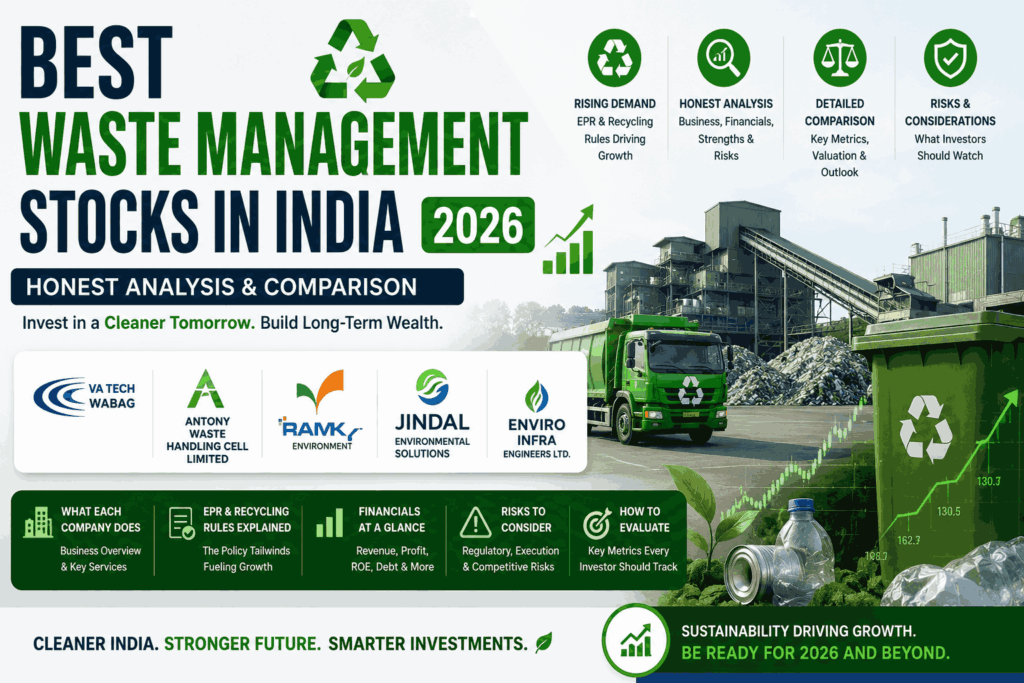
“Best waste management stocks in India” is one of those search terms that has quietly exploded over the last two years — and for good reason. As the country races to clean up its cities, formalise recycling and meet tightening environmental rules, a small but growing set of listed companies is turning India’s enormous waste problem into a genuine business opportunity.
Here’s the honest truth most listicles skip: this is still an early, lumpy and volatile corner of the market. Several of the names below have fallen 25–35% from their 2024–25 highs, a few trade at rich valuations, and some are tiny, thinly traded companies where the risks are very real. This guide is written to give you the full picture — what each company actually does, how the 2026 regulations are reshaping demand, the genuine pros and cons, and the red flags to check before you invest a rupee.
Important note up front: this article is for education and research only. It is not stock advice or a recommendation to buy any share. Stock prices and company financials change constantly — every figure here is a mid-2026 snapshot you should verify live — and you should consult a SEBI-registered investment adviser before making any decision.
What Are Waste Management Stocks?
Waste management stocks are shares of listed companies that earn money from collecting, transporting, treating, recycling or disposing of waste — or from the equipment, chemicals and technology that make those processes work. In India, the listed universe is more diverse than the label suggests, and it helps to split it into sub-sectors, because each behaves very differently:
- Water and wastewater treatment — the largest and most established slice (e.g. VA Tech Wabag, Ion Exchange).
- Metal recycling — lead, aluminium and other non-ferrous scrap (e.g. Gravita India, Pondy Oxides).
- Plastic and PET recycling — turning used bottles into fibre and food-grade granules (e.g. Ganesha Ecosphere).
- E-waste and battery recycling — recovering metals from electronics and batteries (e.g. Eco Recycling).
- Municipal solid waste (MSW) services — city-scale collection, processing and waste-to-energy (e.g. Antony Waste Handling Cell).
Lumping these together as “waste management” hides an important fact: a lead recycler’s fortunes track metal prices, an MSW contractor lives and dies by municipal contracts, and a PET recycler depends on how fast recycled-content rules are enforced. Mixing them up is the single most common mistake new investors make in this space.
Why Waste Management Stocks Are Drawing Investor Attention in 2026
Several structural forces are converging at once, which is why this once-ignored theme now appears in so many screens for recycling stocks in India:
- Sheer scale. India generates roughly 62 million tonnes of municipal solid waste a year, a figure widely projected to climb toward 165 million tonnes by 2030 as cities and consumption grow.
- Rising e-waste and plastic. More smartphones, appliances and packaging mean fast-growing, high-value waste streams — and recovered metals and food-grade rPET can earn premium margins.
- The circular-economy push. Policy, corporate ESG commitments and investor capital are all flowing toward companies that recover value rather than dump it.
- Formalisation. Organised, listed players are slowly taking share from India’s vast informal waste sector, which improves revenue visibility for compliant companies.
- Annuity-like contracts. Long-term municipal and operations-and-maintenance contracts can give some players relatively predictable, recession-resilient revenue.
That’s the bull case — and it is a real one. But it is a thesis, not a guarantee. Execution, commodity cycles and the timing of policy enforcement all matter enormously, as the past year’s share-price falls demonstrate.
The 2026 Regulatory Shifts Every Investor Should Understand
Unlike many hot themes, this sector’s demand is driven by hard regulation, not just sentiment — which is exactly why understanding the 2026 rule changes matters so much.
Plastic Waste Management (Amendment) Rules, 2026
Notified on 31 March 2026, these rules build on the 2016 framework and the 2022 EPR regime, and they tilt the system decisively toward a circular model:
- Mandatory recycled content in plastic packaging for producers, importers and brand owners (PIBOs), with percentages set to rise progressively through 2025–29 — a direct, regulation-driven demand pull for recyclers.
- Recycled-content labelling, requiring companies to disclose the share of recycled material they use.
- First-ever reuse targets for rigid plastic packaging (for example, higher obligations on large water packaging).
- Wider EPR accountability, now extending to raw-material suppliers such as resin and pellet makers.
- A mandatory digital tracking system under a centralised EPR portal, monitored by the Central Pollution Control Board — aimed at fixing the data and fake-certificate problems that dogged the system in 2023.
- Carry-forward flexibility: firms that missed FY2025–26 recycling targets can carry the deficit forward for up to three years, clearing at least a third each year.
Why this matters for stocks: the recycled-content mandate creates structural demand for recycled PET and plastics — a tailwind for the likes of Ganesha Ecosphere and Gravita India. But the same carry-forward flexibility helps explain why rPET demand was softer than hoped during FY26: when enforcement is eased, near-term demand can lag the long-term promise. It is a powerful illustration of how policy timing, not just policy direction, moves these companies.
E-Waste, Battery and Broader EPR Rules
Under the E-Waste Management Rules, collection targets have been rising toward 80% by 2025–26, with EPR certificates generated by registered recyclers and traded on a portal — a structural positive for organised e-waste players such as Eco Recycling. A broader EPR expansion that also brings household packaging and non-ferrous metals deeper into the net took effect from 1 April 2026, alongside existing Battery Waste and tyre and used-oil rules. India’s NITI Aayog circular-economy push and the National Critical Mineral Mission have also opened a new door: recovering critical minerals and lithium from used batteries and electronics.
The Honest Caveats
Good analysis means acknowledging the gaps. EPR compliance still relies heavily on self-reporting, with limited third-party verification, and India’s waste data is famously unreliable. Waste-to-energy — a revenue stream for some MSW players — is environmentally contested, since incineration can release dioxins and furans and competes economically with recycling. In short, the regulatory tailwind is real, but its benefits are uneven and depend on enforcement that has repeatedly been softened.
Best Waste Management Stocks in India 2026: Company-by-Company
Below are six widely tracked listed companies spanning every major sub-sector. Figures are approximate mid-2026 snapshots and will change — always check live data before acting. None of this is a recommendation.
1. VA Tech Wabag — The Listed Heavyweight in Water
VA Tech Wabag is the closest India has to a large, established pure-play on water. It designs, builds and operates drinking-water, wastewater and industrial-water treatment plants, plus desalination and water-reuse projects, for municipal and industrial clients in India and across the Middle East and Africa. Its model leans on engineering, procurement and construction (EPC) work plus longer-term operations-and-maintenance contracts. FY26 revenue was roughly ₹3,900 crore with net profit near ₹370 crore, and the stock traded around ₹1,600 in mid-2026 (market cap roughly ₹11,000 crore). In June 2026 it won a large 60 MLD sewage-biorefinery contract in Ajman, UAE, underlining its growing overseas order book. Points to watch: promoter holding is relatively low (around 19%), and like all EPC firms, revenue can be lumpy and working-capital heavy.
2. Gravita India — The Scaled Recycler
Gravita is India’s largest lead recycler and one of its most diversified recycling companies, organised across four verticals — lead (the flagship), aluminium, plastic and rubber — plus turnkey recycling projects and EPR compliance services. It runs global facilities and exports widely. Revenue on a trailing basis was around ₹4,265 crore, and management targets a 20–25% volume CAGR, with a new rubber-recycling project slated for commissioning in Q1 FY27. In June 2026, its Mundra plant secured an LME brand listing for its lead metal (branded “GRAVITA M”), a credibility marker in global metal markets. The stock traded near ₹1,730 in mid-2026 (market cap roughly ₹12,000–13,000 crore), with promoter holding around 56%. The key risk is straightforward: margins move with lead and aluminium prices, so commodity volatility flows straight to earnings, and the valuation (P/E in the mid-30s) leaves little room for disappointment.
3. Ion Exchange (India) — The Water Veteran
Founded in 1964, Ion Exchange is one of India’s oldest water-treatment companies and covers the entire water cycle — pre-treatment, process water, wastewater, zero-liquid-discharge (ZLD), sewage treatment and desalination — across three segments: Engineering, Chemicals (resins and specialty chemicals) and Consumer Products (including packaged drinking water). With more than 100,000 installations worldwide and a steady flow of EPC order wins, it is a mid-cap (market cap roughly ₹5,300 crore in mid-2026). That said, the stock fell around a third over the past year, a reminder that even established players in this space are not immune to lumpy project revenue and competitive EPC margins.
4. Ganesha Ecosphere — India’s PET Recycling Leader
Ganesha Ecosphere is the country’s largest PET-bottle recycler, processing an estimated 16–18% of India’s PET bottle waste, with 150,000-plus tonnes of annual capacity and over 8 billion bottles recycled in FY25. It makes recycled polyester staple fibre (RPSF), specialty yarns and — importantly — food-grade, bottle-to-bottle rPET granules certified by the US-FDA, EFSA and FSSAI. FY26 revenue was around ₹1,483 crore with profit near ₹103 crore, but earnings were lumpy: a weak Q3 FY26 (net profit down roughly 84% year-on-year) reflected rPET demand lagging the timing of regulatory enforcement, before a Q4 recovery. It is the most direct beneficiary of the 2026 recycled-content mandate — but the timing of that benefit is uncertain. Two genuine red flags: promoters have pledged around 32% of their holding, and three-year return on equity has been low (around 6%).
5. Antony Waste Handling Cell — The Municipal-Waste Pure-Play
If you want direct exposure to Indian urban waste, Antony Waste is the closest listed option. A top-five municipal solid-waste operator with roughly 20 years’ track record, it handles collection and transportation, mechanised sweeping, processing and landfill management for cities including Mumbai (BMC), Navi Mumbai, Greater Noida, Nagpur, Varanasi and Delhi, and it runs an integrated waste-to-energy plant at Pimpri-Chinchwad. Q4 FY26 was a record quarter, with waste tonnage up around 20% year-on-year. The caution: it is a small-cap (market cap roughly ₹1,300 crore) whose shares fell about 27% over the past year, it carries meaningful contract-concentration risk, and it pays little dividend. Its revenue is annuity-like, but its earnings can still surprise in either direction.
6. Eco Recycling (Ecoreco) — The E-Waste Pioneer
Eco Recycling is India’s first listed e-waste company, operating since 2005, with end-to-end services spanning reverse logistics, data destruction, IT asset disposition (ITAD), precious-metal recovery, EPR implementation and a mobile “Recycling on Wheels” model. It is almost debt-free, with promoter holding around 73%. But the numbers are small — FY26 revenue near ₹48 crore and profit around ₹23 crore — and it is a volatile micro-cap (its 52-week range spanned roughly ₹225 to ₹724). It is actively pivoting into lithium-ion battery and critical-minerals recycling, aligned with the National Critical Mineral Mission. Watch its tiny scale, a stretched working-capital cycle (rising debtor days) and a rich price-to-book multiple.
Other Names That Appear in Waste and Recycling Screens
Beyond the six above, several other companies show up in recycling and waste-management lists: Pondy Oxides & Chemicals (lead recycling), Jain Resource Recycling (non-ferrous metals; a recent high-profile listing), Concord Enviro Systems (water treatment and zero-liquid-discharge; listed in late 2024) and EMS Ltd (water and sewerage infrastructure). Be especially careful with SME-platform listings such as Hi-Green Carbon (tyre and carbon-black recycling), Namo eWaste and Baheti Recycling — SME and micro-cap shares are thinly traded, far more volatile than mainboard stocks, and carry higher governance and liquidity risk. Verify current financials and trading volumes before considering any of them.
Best Waste Management Stocks in India: Comparison Table (2026)
A side-by-side snapshot of the six companies above. Market caps are approximate and as of mid-2026; verify live figures before acting.
| Company | Focus area | Mkt cap (approx.) | What it does | Key watch-point |
| VA Tech Wabag | Water & wastewater | ~₹11,000 Cr | Water/wastewater treatment, desalination, reuse (India + overseas) | Lumpy EPC revenue; low promoter holding |
| Gravita India | Metal & plastic recycling | ~₹12,000–13,000 Cr | Lead, aluminium, plastic & rubber recycling + EPR | Commodity-linked margins; rich valuation |
| Ion Exchange | Water & environment | ~₹5,300 Cr | Full water cycle, resins, ZLD, packaged water | Project lumpiness; competitive margins |
| Ganesha Ecosphere | Plastic / PET recycling | ~₹2,400 Cr | rPET, RPSF, food-grade bottle-to-bottle granules | Promoter pledge (~32%); rPET demand timing |
| Antony Waste | Municipal solid waste | ~₹1,300 Cr | MSW collection, processing, landfill, waste-to-energy | Small-cap; contract concentration |
| Eco Recycling | E-waste & batteries | ~₹830 Cr | E-waste, ITAD, precious-metal & Li-ion recovery | Micro-cap; working-capital stretch |
Figures are indicative mid-2026 snapshots and change daily. This table is for information only and is not a recommendation to buy or sell any security.
How the Sub-Sectors Differ (and Why It Matters)
Because each slice of the sector responds to different forces, comparing companies across sub-sectors on the same yardstick is misleading. Here’s a simple map:
| Sub-sector | Main revenue driver | Cyclicality | Key risk | Example stocks |
| Water & wastewater | EPC orders + O&M contracts | Medium | Order timing, working capital | VA Tech Wabag, Ion Exchange |
| Metal recycling | Volumes × metal spreads | High (commodity-linked) | Lead/aluminium price swings | Gravita, Pondy Oxides |
| Plastic / PET recycling | rPET demand + spreads | Medium-high | Regulatory timing, input cost | Ganesha Ecosphere |
| E-waste & batteries | Volumes + recovered metal value | Medium | Small scale, working capital | Eco Recycling |
| Municipal solid waste | Long-term municipal contracts | Low (annuity-like) | Contract concentration, receivables | Antony Waste, EMS |
Pros and Cons of Investing in Waste Management Stocks
Pros
- Structural, policy-backed demand from EPR, recycled-content mandates and Swachh Bharat-led infrastructure spending.
- A long runway: waste volumes are rising steadily with economic growth and urbanisation.
- Some players enjoy annuity-like revenue from multi-year municipal and O&M contracts.
- A genuine ESG tailwind that is attracting institutional and long-term capital.
- High-value recovery — recovered metals and food-grade rPET can command premium margins.
Cons
- An early, fragmented sector with very few large, proven, consistently profitable pure-plays.
- High volatility — several leading names have fallen 25–35% over the past year.
- Commodity exposure: recyclers’ margins swing with lead, aluminium and polyester-chain prices.
- Policy execution risk — targets have been eased and carried forward, so demand timing is uncertain.
- Small-cap and SME liquidity and governance risks, including promoter pledges and stretched working capital.
- Valuations can look rich relative to current earnings, leaving little margin for error.
Key Risks and Red Flags to Check Before You Invest
Before buying any waste management or recycling stock, run through this honest checklist — it is exactly where retail investors tend to get hurt:
- Promoter pledge. A high pledge (Ganesha Ecosphere’s ~32% is an example) can signal financial stress and amplify downside.
- Working capital and receivables. Rising debtor days or long working-capital cycles — common with government-contract businesses — can quietly erode returns.
- Contract concentration. MSW players that depend on a handful of municipal contracts face real revenue risk if one is lost or disputed.
- Commodity sensitivity. For metal and plastic recyclers, a swing in scrap or metal prices can flip a good quarter into a poor one.
- SME and liquidity risk. Thinly traded shares can be hard to exit and are prone to sharp, sentiment-driven moves.
- Regulatory dependence. Much of the demand story rests on enforcement that relies on self-reporting and has repeatedly been softened.
- Valuation versus earnings. A compelling story does not justify any price; check what you are paying for current profits and realistic growth.
How to Evaluate a Waste Management Stock
A practical framework an experienced investor would use, rather than buying on theme alone:
- Check what share of revenue actually comes from waste or recycling — avoid “story stocks” that merely sound green.
- Look at the margin and return-on-equity trend over several years, not a single quarter.
- Study the balance sheet — debt, promoter pledge, and the working-capital cycle.
- Assess revenue visibility — order book for EPC firms, contract pipeline for MSW players.
- Weigh the valuation against realistic growth, and compare within the same sub-sector.
- Read management commentary on capacity expansion and how they expect regulation to play out.
How to Start Investing in Waste Management Stocks in India
Mechanically, it is no different from buying any other share: open a demat and trading account with a SEBI-registered broker, complete your KYC, and you can buy these stocks on the NSE or BSE. Given the volatility, a few sensible habits help — stagger your entry rather than buying all at once, diversify across sub-sectors instead of betting everything on a single micro-cap, size positions to the risk you can stomach, and treat the theme as a multi-year hold rather than a quick trade. None of this removes risk; it simply manages it.
Practice Before You Invest in Waste Management Stocks
This market has been very dynamic and erratic, with some giants dropping 25-35% in the course of the past year, so don’t just believe a few investors if you’re not sure about the outlook. That is where a paper trading app comes into play: it allows you to create and monitor a virtual portfolio of names such as Gravita India, Ganesha Ecosphere or Antony Waste, observe the actual performance of those stocks with news of earnings and policy changes, and learn the timing and position sizing without putting a single rupee at risk. In the case of comparison, search for the best trading application that will offer the option of realistic paper trading instead of only live orders – and in the case of simulators, the best paper trading app is that which replicates real NSE/BSE price movements. PaperTradingApp is designed just for that: A free, India-centred paper trading simulator to test out a waste management idea with virtual funds before investing real money in it.
Frequently Asked Questions
Which are the best waste management stocks in India in 2026?
Widely tracked listed names include VA Tech Wabag and Ion Exchange (water and wastewater), Gravita India (metal and plastic recycling), Ganesha Ecosphere (PET recycling), Antony Waste Handling Cell (municipal solid waste) and Eco Recycling (e-waste). There is no single best stock — it depends on the sub-sector, company financials and your risk appetite. This is educational information, not a recommendation.
Are waste management stocks a good investment?
The sector has strong long-term tailwinds from regulation, urbanisation and rising waste volumes, but it is still early, fragmented and volatile — several stocks have fallen sharply, and many are small-caps. It can suit long-term, risk-tolerant investors who research thoroughly and consult a SEBI-registered adviser.
What is the largest listed waste management company in India?
By market capitalisation, Gravita India and VA Tech Wabag are among the largest listed companies linked to recycling and water or wastewater management. Antony Waste Handling Cell is the closest thing to a pure-play on municipal solid waste, though it is much smaller.
What is the difference between recycling stocks and waste management stocks?
Recycling stocks are a subset of waste management stocks. Recyclers recover value from waste — metals, plastics or e-waste — while the broader waste-management universe also includes water and wastewater treatment and municipal solid-waste service contractors.
How do the 2026 plastic waste rules and EPR affect these stocks?
The Plastic Waste Management (Amendment) Rules 2026 make recycled content in packaging mandatory and widen EPR, creating structural demand for recyclers such as Ganesha Ecosphere and Gravita India. But the rules also allow companies to carry forward unmet targets, which can delay the demand benefit in the near term.
Are SME or penny waste management stocks safe?
SME-platform and micro-cap stocks are high-risk — thinly traded, far more volatile than mainboard shares, and sometimes carrying governance or liquidity issues. Extra caution and independent verification of financials are essential.
How can I invest in waste management stocks in India?
Through a demat and trading account with a SEBI-registered broker, just like any other share. Given the volatility, many investors diversify across sub-sectors, stagger entry and hold long term. Consider speaking to a SEBI-registered investment adviser first.
Final Verdict: Are the Best Waste Management Stocks in India Worth It?
India’s waste-management and recycling theme is one of the more compelling long-term structural stories in the market — and crucially, it is backed by hard regulation, not just sentiment. But “structural” does not mean “smooth.” The best waste management stocks in India today are a mix of established water players (VA Tech Wabag, Ion Exchange), a scaled recycler (Gravita India), and smaller, higher-risk specialists (Ganesha Ecosphere, Antony Waste, Eco Recycling) — each with a different driver and a different risk.
If the theme interests you, treat it as a multi-year, diversified, do-your-homework play rather than a quick trade. Focus on companies that genuinely earn from waste rather than green branding, match position sizes to the real volatility, verify every figure live, and — above all — speak to a SEBI-registered adviser before acting. The opportunity is real; so is the risk of overpaying for it.