
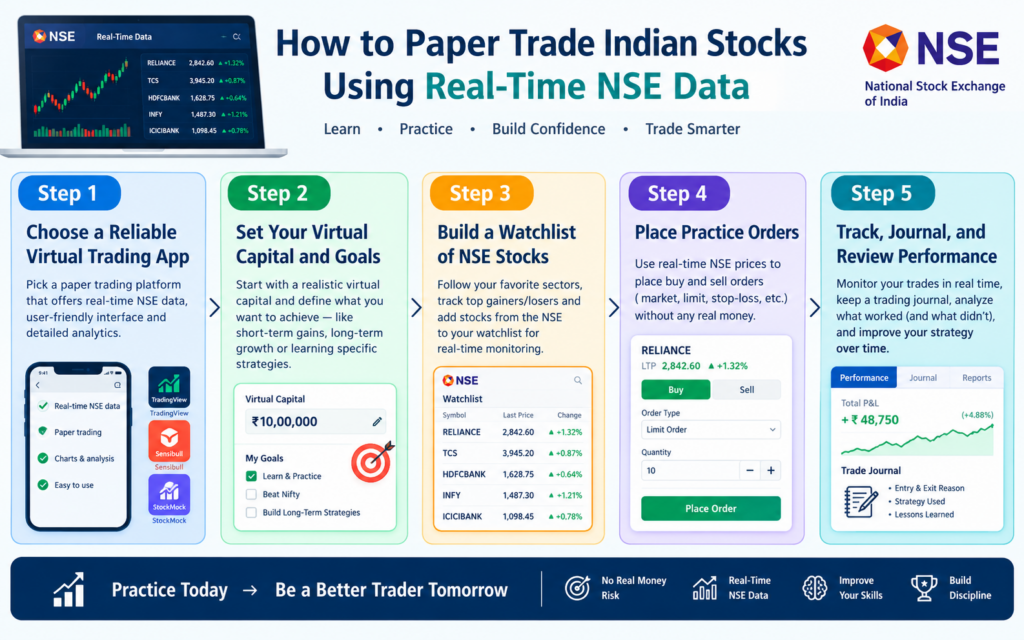
The majority of new traders find out how to trade the market the hard way. They make a purchase on a tip, don’t pay attention to a stop-loss, and see their hard earned money disappear before they realize what they’ve done. Paper trading is a more intelligent method. You’re dealing with virtual currency, so there’s no harm in making mistakes – you learn a tremendous amount. With real-time NSE data, all price movements, gaps up and sudden reversals is like it’s happening in the real world. This guide will detail the concept of paper trading and how to begin, the features you should seek in a platform, and some pitfalls to avoid.
What Is Paper Trading and How Does It Work in India?
Paper trading involves trading stocks and bonds for paper money rather than real money. You’re assigned a simulated account with a preset amount of money and make trades just as you would on a real broker platform. The system monitors your positions, profit/loss and return.
Having a good simulator with India that imitates the NSE and BSE environment. That’s when markets open from 9:15 AM until 3:30 PM, as well as price changes and order types. It is used by beginners to learn the basics, for students to get to know the markets, and for experienced traders to test new strategies without putting their money at risk.
The best thing is the absence of any financial risk and most platforms don’t ask for any demat account.
Why Real-Time NSE Data Matters for Paper Trading
There is no point in practicing if it’s not a true representation of reality. If data is delayed, then you’ll have false entry and exit prices, and you’ll feel good about your trading decisions. This trade would appear profitable when looking at a 15 minute delay, but might not have been profitable when trading live.
With real-time NSE data you can practise:
- Intraday setups, where prices change every second
- Volatility at open and close, when spreads widen and moves are sharp
- Circuit limits, which can freeze a stock you are holding
- Slippage, the gap between the price you expect and the price you get
If your simulator mimics real trading then the habits you build are transferrable to real trading.
Step-by-Step: How to Paper Trade Indian Stocks
Step 1: Choose a Reliable Virtual Trading App
The first thing you’ll need to choose is the platform. The ideal virtual trading app should provide real-time NSE quotes, emulate order execution, and provide precise performance analytics. Register, confirm the information, and check out the interface prior to trading. Take a few minutes to get familiar with the order window, watch list and portfolio tabs.
Step 2: Set Your Virtual Capital and Goals
The amount of investment you make is what you should choose from the starting balance, for example, ₹1 lakh to ₹5 lakh. Don’t give in to temptation and end up spending ₹1 crore just because the app says they can. Unrealistic capital results to unrealistic position sizes and bad habits. Set a target that you don’t just want to try to achieve, but you intend to achieve, such as learning the intraday discipline, or testing a swing strategy.
Step 3: Build a Watchlist of NSE Stocks
Begin with the Nifty 50 stocks or other large caps that are easily traded. They are less volatile and have less “noise” making them easier to learn. Then add 10 to 15 equities from different sectors and then observe their trend for the day before trading them.
Step 4: Place Practice Orders
Try each order type:
- Market orders placed to buy/sell immediately or soon.
- Place price-limited orders: Buy or sell at a specific price
- Stop loss orders to limit your losses
Treat each trade as it is. Make sure you have your Entry, Target and Stop Loss points determined before you place your buy order.
Step 5: Track, Journal, and Review Performance
Note down each trade, why you are entering, why you are exiting and the outcome of each trade. Look back at your journal every day. Seek out patterns, e.g., early cutting of winners and late cutting of losers. Most learning takes place during this review step!
How to tell which is the best Paper Trading App in India?
The best paper trading app in india is one that has essential features. That’s the one that provides you with realistic conditions and helpful feedback. When considering options, check this list:
- Real-time NSE and BSE data
- Support for equity, intraday, and F&O trading
- Realistic order execution and good charting tools
- Portfolio analytics and P&L reports
- Beginner-friendly learning resources
- Mobile app plus web access
- Free to use, or a transparent pricing model
A quick comparison of platforms is:
| Feature | What to look for |
| Data speed | Live NSE prices, not delayed feeds |
| Instruments | Stocks, futures, and options |
| Order types | Market, limit, stop-loss, bracket |
| Analytics | Win rate, drawdown, trade history |
| Cost | Free tier or clear pricing |
| Access | Android, iOS, and web |
Try out 2-3 platforms over the course of a week to determine which to choose. See how quickly prices are updated, as well as the ability to check on previous trades.
Common Paper Trading Mistakes to Avoid
- Using unrealistic capital. Oversized virtual balances create habits that fail with real money.
- Ignoring costs. Brokerage, STT, and slippage reduce real returns, so account for them.
- Over-trading. With no real risk, it is tempting to trade constantly. Stick to your plan.
- Skipping the journal. Without records, you cannot learn from your trades.
- Going to live too early. Move to real money only after consistent, disciplined results.
Conclusion
You can build skills, test strategies and make mistakes without any cost by using paper trading with real time data from NSE. Select the best paper trading app in India for yourself, match it with a disciplined trading journal and utilize a reliable virtual trading app to practice until your trading process is consistent.
Is paper trading legal in India?
Yes, it is fully legal because no real money or securities are involved.
Do I need a demat account to paper trade?
No, most virtual trading apps only need a sign-up.
Is paper trading data real-time?
It depends on the app, so choose one that offers live NSE prices.
Can I paper trade F&O and intraday in India?
Yes, many platforms support equity, futures, and options simulation.
How long should I paper trade before going live?
Most beginners practise for 2 to 3 months or until their results are consistently disciplined.
Can I earn real money from paper trading?
No, it is for practice only and earns no real profits.
Is paper trading the same as real trading?
Not entirely, because it lacks the emotional pressure and real order-fill conditions.