A paper trading app is an ideal way to get started with investing if you are new to the concept, but do not want to invest your own funds. It allows you to create a virtual portfolio, conduct tests and learn the actual functioning of the Indian stock market without any monetary risk. Let’s go over the steps to take to get started.
What Is a Virtual Portfolio?
A virtual portfolio is a group of stocks, ETFs, or other securities that you “buy” with fake money rather than real money and then “sell” with fake money. It works just like a real portfolio by tracking gains, losses and performance — with the only exception being that no real money is involved.
How Virtual Portfolios Differ from Real Trading Accounts
The real trading account consists of real capital, brokerage fee, and tax for every trade made. All that friction is eliminated with a virtual portfolio. The same market exposure and price changes but no more than a learning experience for mistakes.
Why Beginners in India Use Virtual Portfolios
The stock market can be intimidating for an individual who is new to NSE and BSE stocks. A virtual portfolio offers novices a secure environment to learn about the types of orders, fluctuations in the market and portfolio diversification without risking their own savings.
What Is a Paper Trading App?
The virtual portfolio is made possible by a paper trading app. It replicates actual market conditions (actual or close to actual NSE/BSE data) and your practice trades are as close to reality as possible.
How Paper Trading Apps Simulate Real Market Conditions
Most paper trading apps replicate the stock prices, market depth and even order delay while trading in stocks. This means that a stock’s response to news and volume in your virtual portfolio mirrors real-life situations.
Paper Trading vs Demo Trading Account — Is There a Difference?
Both terms are frequently used interchangeably, but there is a slight difference between them. A paper trading account is generally a broker’s platform feature and a “demo trading account” is typically a manual simulation of trading that follows through a dedicated app. In terms of use, both are similar in that they allow you to practice with fake currency.
Benefits of Building a Virtual Portfolio in India
- Safe learning for students who are new to learning. You can lose or win a single rupee, make mistakes, misjudge entries and exits and even panic-sell without losing one single rupee.
- Investigating strategies prior to investing real money. A virtual portfolio allows you to test out your strategy before you start investing, whether you are using value investing, momentum trading or an options strategy.
- Knowing the functioning of the NSE/BSE market. Repeatedly practicing will get you used to the behaviors of Indian markets during earnings season, budget announcements and global cues.
How to Build a Virtual Portfolio in India (Step-by-Step)
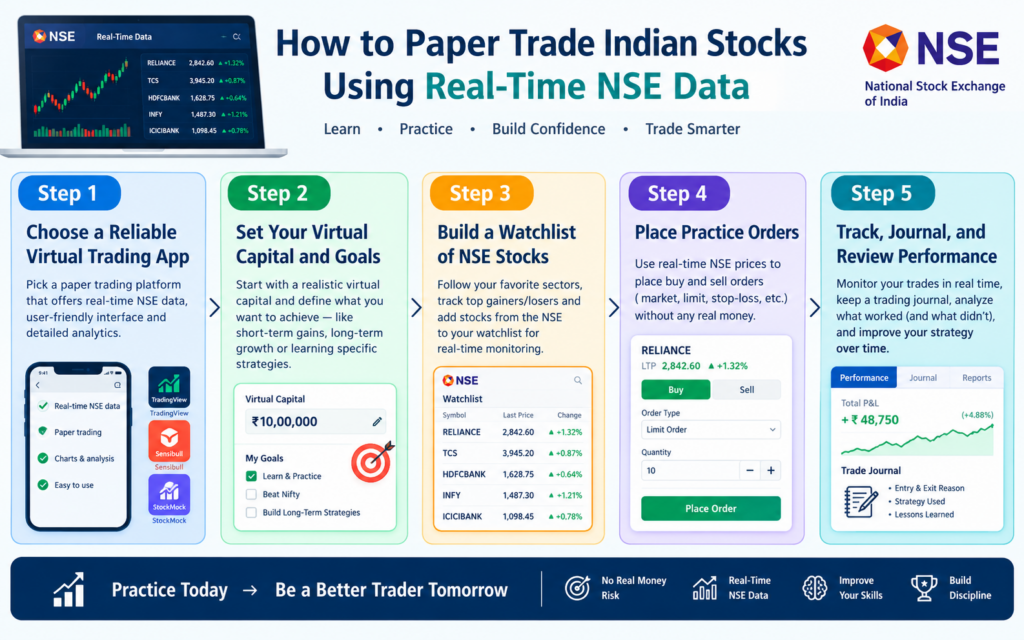
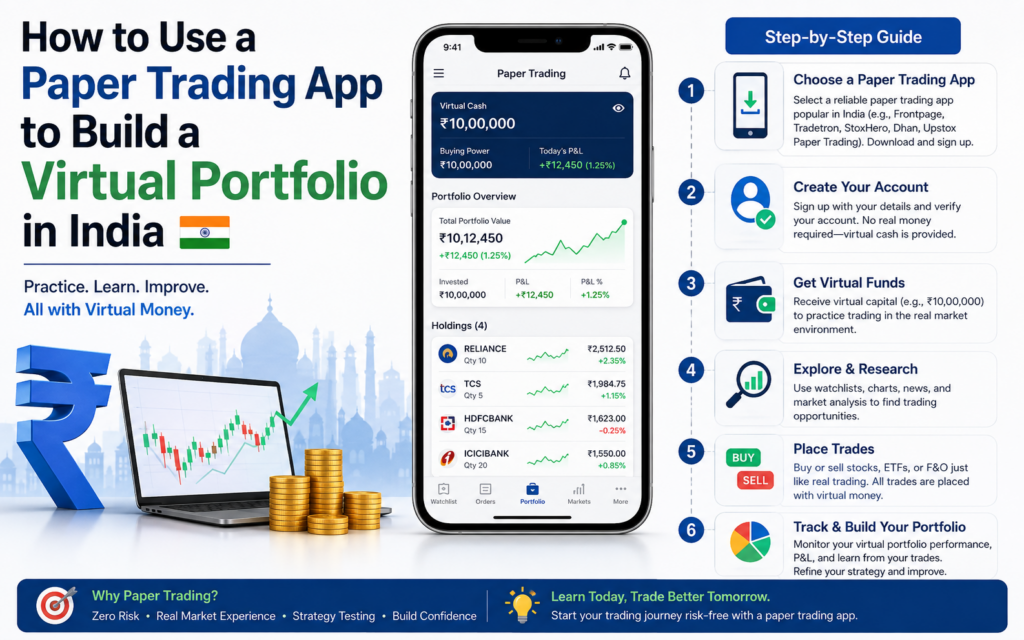
Step 1 – Select a paper trading app. Search for one that includes stocks from the NSE and BSE and is capable of providing real-time data; if you are thinking of going for derivatives in the future, it is best to find one that supports F&O (futures and options).
Step 2 — Determine the virtual capital. Most of the apps allow you to play with an already fixed up virtual money (usually ₹1,00,000 or higher). Don’t take this amount lightly, it should be based on what you could reasonably invest.
Step 3 – Research & pick stocks. Select a variety of stocks from all the sectors trading on NSE and BSE. Follow the same research process you would follow if you were using real money (including checking on fundamentals, news and price trends).
Step 4 – Monitor performance and rebalanced. Regularly check your virtual portfolio. Re-balance as per actual investment portfolio based upon performance.
Step 5 — When ready go to real trading and review. After you have become used to the process of taking your decision making and risk management, you can switch to a real demat account and begin investing with real money.
Best Paper Trading Apps in India
When looking back at paper trading apps, here are the key features to look out for:
- Real-time or near real-time NSE/BSE data for accurate price simulation
- F&O and options support, if you want to practice derivatives trading
- Portfolio tracking and analytics to review your virtual performance over time
- No hidden restrictions on the free tier for basic stock trading
Some apps provide this for free, and others may only have more advanced features, such as live options data or in-depth analytics, that are available for a fee. For the beginning traders, a free app covering substantial NSE/BSE coverage is generally adequate.
Common Mistakes to Avoid When Practicing Virtual Trading
Treat Virtual Money as if it were Real Money. In the virtual world, taking risks is easy, since no harm comes from it. Don’t do this — try to develop habits that you will use when you actually begin trading.
Neither identifying nor adhering to good risk management practices early on. Without stop-losses or size limits in your virtual portfolio, you will not be ready to use them when you’re ready to make your money count.
Virtual Portfolio vs Real Portfolio: Key Differences
| Aspect | Virtual Portfolio | Real Portfolio |
| Capital at risk | None | Real money |
| Emotional impact | Low | High |
| Brokerage/fees | None | Applicable |
| Demat account needed | No | Yes |
| Learning value | High for beginners | Requires prior practice |
You can also read: Paper Trading App in India for Options – Beginner’s Learning Guide
FAQs
In India, is paper trading free?
In India, most of the paper trading apps are free of cost with virtual money and some premium ones charge for real-time F&O data.
In India can I trade in options with a paper trading app?
Yes, there are some apps that allow for simulated options and futures trading with real or delayed data from NSE/BSE.
When is the right time to invest money in a virtual portfolio?
It’s not a set schedule, but most novice traders engage in trading for weeks to months until they have a good understanding of strategy and risk management.
Are used real time prices on virtual portfolios?
Most reliable applications will use real time or slightly delayed NSE/BSE data to make the simulation as realistic as possible.
Do you need a demat account for using a paper trading app?
No, there is no need to do paper trading as it involves no actual shares or money.
Ready to Start?
One of the best ways to get your hands dirty in the Indian Stock Market without losing your savings is to build a virtual portfolio. Get going with the free tier of a paper trading app today, create your first virtual portfolio and begin forming good investing habits that will help you when you’re ready to invest real money.