Most new traders find out about the risk of the market once they have actually lost money. What was something that was “just obvious” falls 15% — and all the confidence is lost. Instead, make thos mistakes in practice trading using fake cash. Most importantly, it allows you to see if your selections are based on skill, or luck, and develops the habits of consistent investors versus impulsive investors.
Why Stock-Picking Skills Need Testing Before Real Money
Confidence is not a competency. When the market is going up, it’s a good idea to take almost every pick and when a beginner wins a few games, he or she believes they have a system, but they do not.
By trying out the picks first, a regular game becomes a regular game and not a lucky one. SEBI’s research on individual traders has always revealed that majority of the participants in derivatives trading who are retail investors end up losing money, a significant factor in favour of practicing before risking real money.
How Paper Trading Works
Paper Trading is a trading method using fake money at market prices. You can trade stocks, set orders, monitor a portfolio and observe a profit and loss statement as if the trades were real. So there’s nothing at stake, apart from the fact that it’s a game.
A simulator should accurately simulate real market conditions, including live charts, order types, and trade history and portfolio tracking. That’s the reason why it’s a testing ground for your decisions, rather than a game.
Using a Virtual Trading App to Build Core Investing Skills
A virtual trading app serves multiple purposes of developing multiple skills in one. Below are the ones that are most important.
Fundamental and Technical Analysis
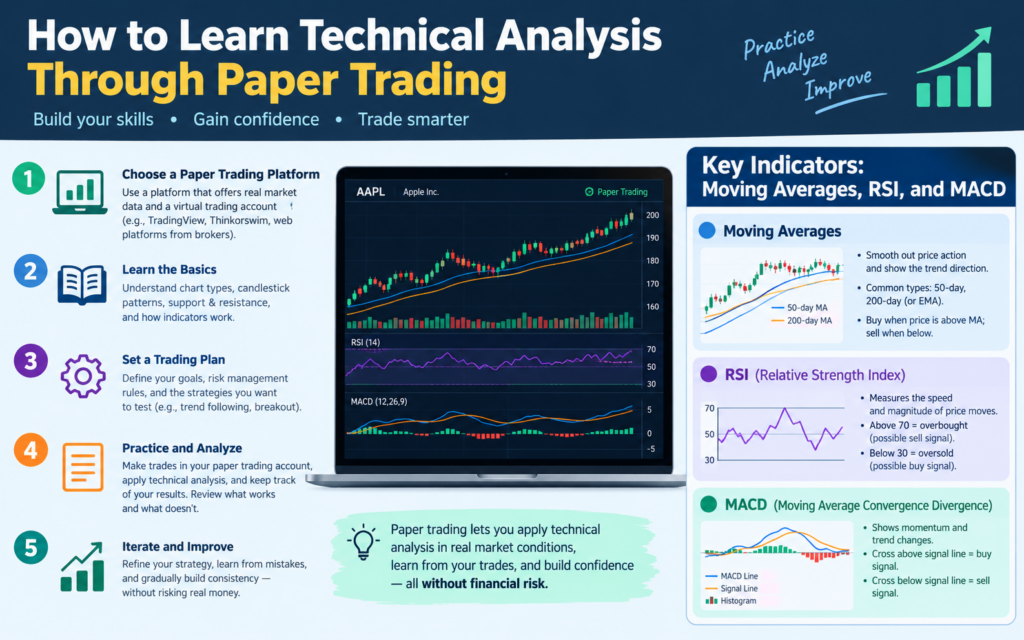
Initiate and follow up on reading balance sheets and reviewing ratios, such as P/E, ROE and debt to equity. Then, try and see if your analysis actually foretells price movement. Technically, work on reading support/resistance, moving averages and volume. You’ll discover at the end of the few weeks, which approach is more effective for you.
Risk Management and Position Sizing
Establish a rule for your virtual portfolio, for instance, no more than 10% should be allocated to a single company. Try to take on a minimum risk-reward ratio of 1:2 i.e. you take a risk of ₹1 and you stand to gain ₹2. This skill is more beneficial to your actual investment as far as future gains, than any stock tip you can get.
Emotional Discipline
The same feeling that occurs with real cash still occurs with fake money. Be aware of the times to average down a declining stock, to chase a rally or panic sell during a down move. Volatility plays requires the adherence to a written plan, and when losses are not painful, building the skill is easier.
Entry and Exit Timing
Understand the difference between limit, market and stop orders. Then look at your trades objectively – are you getting out of winners too early and holding on to losers for too long? Once you have 20 or more trades to study on the timing pattern, they become evident.
Portfolio Diversification
Make sure your picks are spread across different sectors like IT, banking, FMCG and pharma, as well as large-cap and mid-cap stocks. Experience in the real world is the best way to learn about a diversified portfolio than reading it in a textbook on a red day.
Choosing a Free Paper Trading App in India
The ideal free paper trading app in India should replicate the trading atmosphere as much as possible. Look for:
- Real-time or near-real-time NSE/BSE data so your results reflect actual market behavior
- Support for equity, intraday, F&O and index orders if you plan to trade them later
- Performance analytics and trade history to measure win rate and drawdown
- No hidden fees and no mandatory KYC for the simulator
- A clean mobile interface you will actually open every day
- Leaderboards or challenges (optional) if competition keeps you motivated
But consistency is more important than features, whichever virtual trading app you choose.
A 30-Day Plan to Test Your Stock-Picking Skills
For this experiment, use any paper trading app available in India that’s free to use.
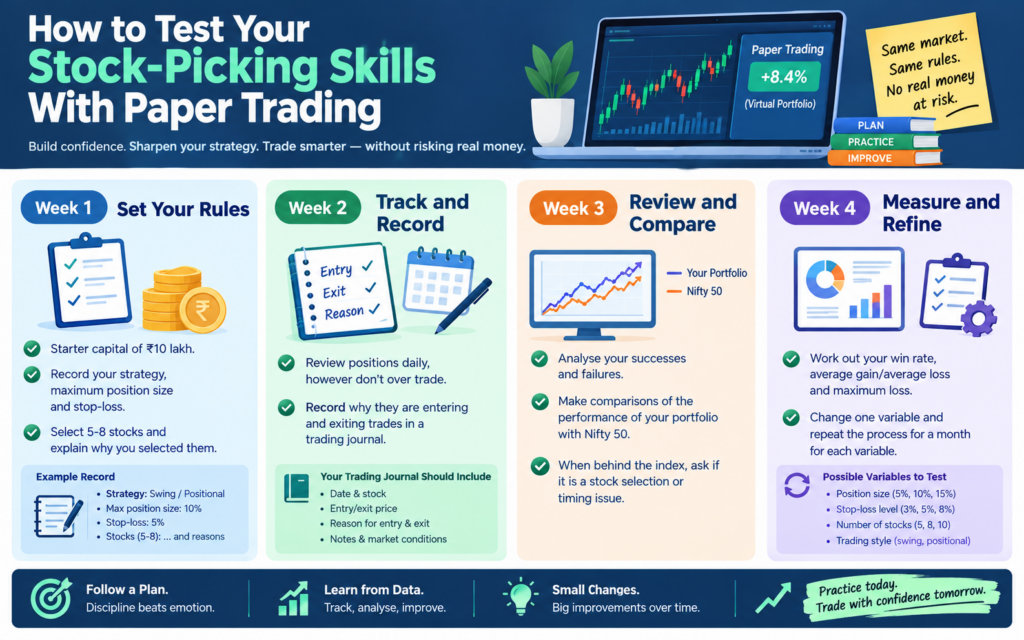
Week 1: Set Your Rules
Starter capital of ₹10 lakh. Record your strategy, maximum position size and stop-loss. Select 5-8 stocks and explain why you selected them.
Week 2: Track and Record
Review positions daily, however don’t over trade. Record why they are entering and exiting trades in a trading journal.
Week 3: Review and Compare
Analyse your successes and failures. Make comparisons of the performance of your portfolio with Nifty 50. When behind the index, ask if it is a stock selection or timing issue.
Week 4: Measure and Refine
Work out your win rate, average gain/average loss and maximum loss. Change one variable and repeat the process for a month for each variable.
How to Know If You’re Ready to Trade With Real Money
Follow these indicators before taking the plunge to real money:
- Over 2-3 months, and more importantly, consistently good results, rather than just one good month.
- A strategy (written) and a full trading journal
- Returns which outperform Nifty 50 with manageable risk.
- Don’t hesitate to be comfortable after your stop loss
Once you’re ready, take small steps and gradually build up.
Conclusion
Practice builds more than returns. It builds analysis, discipline and confidence. Set up a simulated portfolio today, track it for 30 days, and let the data show you where your skills stand.
Disclaimer: This content is for educational purposes only and is not investment advice.
Can I trade with virtual money using real NSE and BSE prices?
Yes, most good simulators use live or slightly delayed exchange prices so your results stay realistic.
How much virtual capital should I start with?
Pick an amount close to what you would actually invest, such as ₹1 lakh to ₹10 lakh, so your position sizing stays realistic.
What is a good win rate to aim for in paper trading?
A win rate above 50% is useful, but the average gain versus average loss matters more than win rate alone.
Should I paper trade every day or only a few times a week?
Check positions daily, but trade only when your strategy gives a clear signal, since over-trading ruins the test.
Why do my paper trading results look better than real trading?
Simulators lack real emotional pressure, slippage and order-fill delays, so real results are usually a little weaker.
How long should I paper trade before investing real money?
Most beginners benefit from 2-3 months of consistent, journaled practice.
Do I need a demat account to start paper trading?
No, most simulators let you start with just an email or phone number.
Can I practice F&O and intraday trades with virtual money?
Many simulators support equity, intraday and derivatives practice, depending on the platform.