In fact, if you have ever searched Google for “algo test” before you have been looking for two things: a) testing a trading strategy with an algorithm before you start investing in the market, or b) AlgoTest, one of the most trending no code trading tools in India. Both are covered in this guide. In this, we will discuss its meaning, its importance, and how it can be incorporated from the concept to the live implementation of a trading strategy.
Algorithmic trading has gone far beyond its niche usage by institutions, and is now a tool that retail traders use on a daily basis in India. However, the very worst error novice traders can make is not to test. They develop a plan, get giddy about the logic and execute it in real time without ever looking back at what it did in the past. Algo test is designed to fill that void.
What Is an Algo Test?
Algo Test is a type of trading strategy test that involves simulating or back-testing a trading strategy using historical or simulated market data. You don’t have to take a wild guess at whether a strategy is profitable or not – you will have numbers to work from such as win rate, drawdown, profit factor and risk adjusted returns. This is referred to as backtesting, and it’s the backbone of any good Algo trading procedure.
Typically, there are three phases to the right testing of a strategy.
1. Backtesting on Historical Data
Back testing lets you use your trading strategy’s criteria on an older market data set, typically years of tick-by-tick or candle data. The aim is to observe the strategy’s performance in the volatile conditions that include expiry sessions, days that move sideways, and real market conditions. If you have a strategy which only seems to work on a few trades it is not reliable. Most experts feel that it is too soon to make any judgements after 1 year of trading or even 2 years of trading before considering data from hundreds of trades.
2. Paper Trading in Live Markets
Backtesting can provide an idea of what works with a strategy in the past, but can’t include all the factors and conditions that may happen with a live market, such as delays in orders being executed, slippage or partial fills. This is where paper trading (forward testing) comes in and you can use the best trading app to apply the strategy. You’ll be putting the strategy into place with actual market data, but with fake money to determine how it works in live mode without risking real money. If you see that your results in live trading are quite different from your backtest results, then it’s time to start digging deeper into it before you start putting your money where your mouth is.
3. Live Deployment with Risk Controls
Once the traders back-test and paper trade the strategies, they start trading with real money, managing the risk and monitoring the markets, while trading in smaller quantities. But testing is not stopped even at this stage. Markets evolve and strategies have to be refreshed on a regular basis.
Why Algo Testing Matters
Over the past few years, the difference in the market for the participants and the degrees of participation have increased significantly in the case of India’s options and futures market, with retail participation being at par or surpassing some of the world’s biggest exchanges. But the figures in regulatory investigations are always the same: The overwhelming majority of the individual traders in the futures and options business lose money. Those who manage to get profitable on trading have the same habit; they try out the strategy on a systematic approach before investing their money.
An Algo Test removes emotion to trading choices. A strategy which is tested is a strategy which you follow through no matter what is going on in the market as long as it satisfies the right tests. It is a systematic approach and hence, algorithmic trading or rule-based trading has become so popular among Indian retail traders who are tired of trial and error trading.
How AlgoTest Simplifies the Testing Process
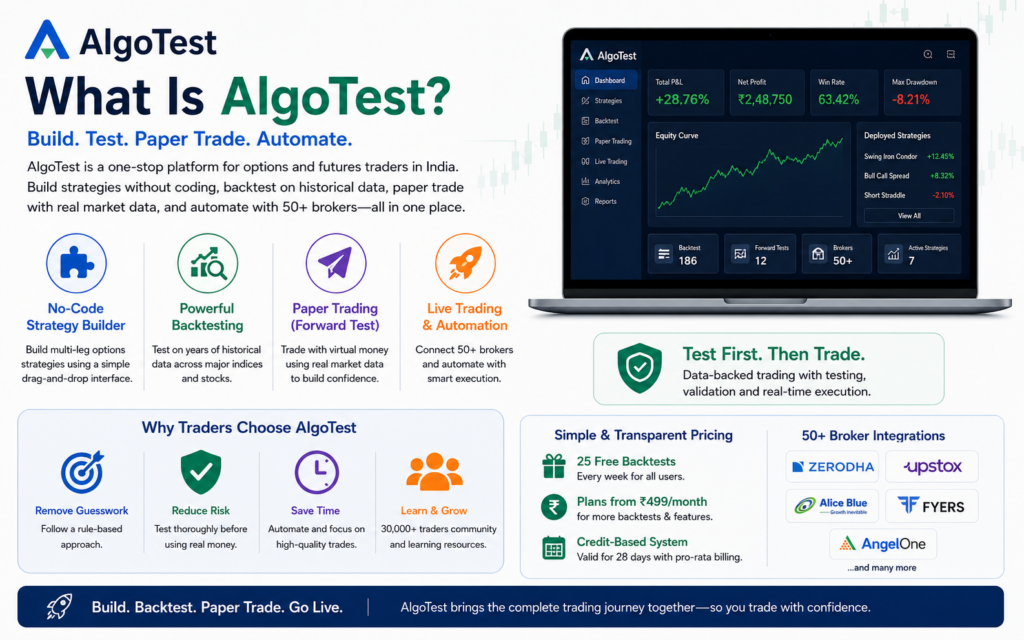
AlgoTest is a No-Code Algo Trading Platform for retail traders in India designed to create, back test, paper trade and automate their trading strategies, even if they don’t have any programming knowledge. The platform has been designed to make all aspects of the testing process as easy as possible.
No-Code Strategy Builder
Traders can easily create multi-leg option strategies by using a visual interface (drag and drop) without coding. That makes trading all the more accessible to traders who grasp the market logic but don’t know how to code.
Tick-Level Backtesting Engine
AlgoTest enables traders to backtest their strategies on options and futures historical data as it gives a realistic perception about how the strategy would have performed in different market cycles, even in the most volatile days and expiry days.
Built-In Paper Trading
Once a strategy is successfully passed the backtesting phase, the users can go straight to paper trading the same platform and watch the real trading as they would with real money, followed by real trading.
Margin Calculator and Analytics
Another important option in AlgoTest for Indian traders is the margin calculator to determine the required margin before entering trades into an options contract, allowing investors to properly allocate funds before executing trades.
Community and Learning Resources
AlgoTest has an over 35,000 active trader community, where they share ideas and strategies and has traders blogs, courses and documentation for every trader level.
Performance Track Record
The study by the SEBI suggests that only approximately 9% of individuals gained profits by trading futures and options, while 45% of AlgoTest users profited in the last year (FY 2023-24), suggesting a more structured and test-driven way is beneficial for traders.
Common Mistakes Traders Make When Testing Strategies
The very best tools can have a negative impact on a trader’s testing overall if they don’t use them wisely. Some common errors are:
- Testing with only a small number of data. The number of trades in a few weeks is not a good indicator of the performance of a strategy over various market regimes.
- Ignoring transaction costs. It can generate a lot of profit in the back test but the same approach might not work in the real market due to brokerage, slippage and taxes.
- Conveniently avoiding paper trading. If you’re taking a multi-step approach, the next step is capital deployment; if you do not see any execution issues arise, then you’ve taken the next step successfully.
- Overfitting the strategy. When you continuously adjust the rules until you have the back test you’re looking for, it’s probably a strategy that hones in on the past and may not be the best fit for the present.
- Adjusting test risk factors during the test. A meaningful backtest is made in the first place by having consistency of position sizing and rules for stops in position.
Backtesting in Paper Trading
Even though a person is still testing a strategy or maybe just would like to build self-confidence in live market conditions prior to investing real money, a paper trading site is the next step after backtesting. You can get accustomed to managing entries, exits and position size in real-time and track performance without risking capital, and build discipline without risking capital.
When it comes to putting your strategy to the test in a real-market simulation you are ready to go! Go to the Paper Trading App and experience trading without taking any risks, monitor your performance and build the confidence for real trading.
Frequently Asked Questions
What does “algo test” mean in trading?
An algo test refers to evaluating a trading strategy’s rules against historical or live simulated data to measure its performance before using real money.
Is AlgoTest free to use?
AlgoTest offers a free tier with basic backtesting features, along with paid plans starting at a modest monthly fee that unlock advanced tools like live automation and deeper historical data.
Do I need coding knowledge to use AlgoTest?
No. AlgoTest is built as a no-code platform, allowing traders to build and test multi-leg options strategies through a visual interface.
How much historical data should I use for backtesting?
Most experienced traders recommend testing across at least two years of data and a few hundred trades to get statistically meaningful results.
What is the difference between backtesting and paper trading?
Backtesting evaluates a strategy using past data, while paper trading simulates live trades in real time using current market prices, without risking actual capital.
Can algo trading guarantee profits?
No. Algo trading and testing improve consistency and reduce emotional decision-making, but they do not eliminate market risk or guarantee profits.
Final Thoughts
The Algo Test is a discipline, not a one-off exercise – it’s a way of doing business that helps to differentiate traders who do business on a gut feel from traders who do business with evidence. The bottom line is the same in either scenario: test out a strategy on a platform like AlgoTest or practice a strategy using a simulator to test it out before taking any risks. Test them first, and then take it down a notch and modify based on the test results.