You may have heard it at some point as a new trader in India: “Is there a trick to trading?It’s a question that almost every aspiring trader in India asks at some point in time, typically after a few weeks since joining the game entirely without asking themselves the question. Well, here’s one I can read: “I’ve been paper trading for quite some time now. Am I ready to put in real money?”
It’s a fair question about paper trading vs real trading. It’s also one that most people get wrong, either they get excited, and too soon, and jump in, or they never get to the point of putting in the time to build confidence and take a risk. Both errors come at a price. One costs you money. All the other costs you time.
So let’s just answer it correctly. Not with a general “It depends,” but with real indicators to which you can refer to your own trading experience — which is the type of indicator any good paper trading app in India should be able to help you track.
The reasons why this question is important.
One thing that is often missed: Opening a Demat account in India is always extremely simple. You can do it in 15 minutes on your phone, upload a couple of documents and be making your first live trade before lunch. The entry barrier is virtually nothing.
The problem is that’s what it is.
Trading isn’t all that easy though it is easy to get started. Year after year, SEBI’s own data on retail participation in futures and options has revealed that most retail traders in the F&O segment are end up losing money. Not two-thirds.Not three-fifths. A large one. In fact, when investigators have gone to the trouble of figuring out why, the reasons are typically not connected with bad luck or volatile markets. They’re the stories of traders who never had a proven strategy, never knew their own risk level, and never went through a losing streak until it happened with real money that they didn’t have.
Paper trading is a solution exactly to this problem. It allows you to experience all the things that happen when you’re losing — the emotional ups and downs, the revenge trading after making a mistake, the feeling of wanting to hit a few big ones — without it ever affecting your wallet. Paper trading is only effective if you take the time to use it properly – and if you understand what that means when you’re done.
The Honest Answer: There’s a Minimum, and It’s Not Two Weeks
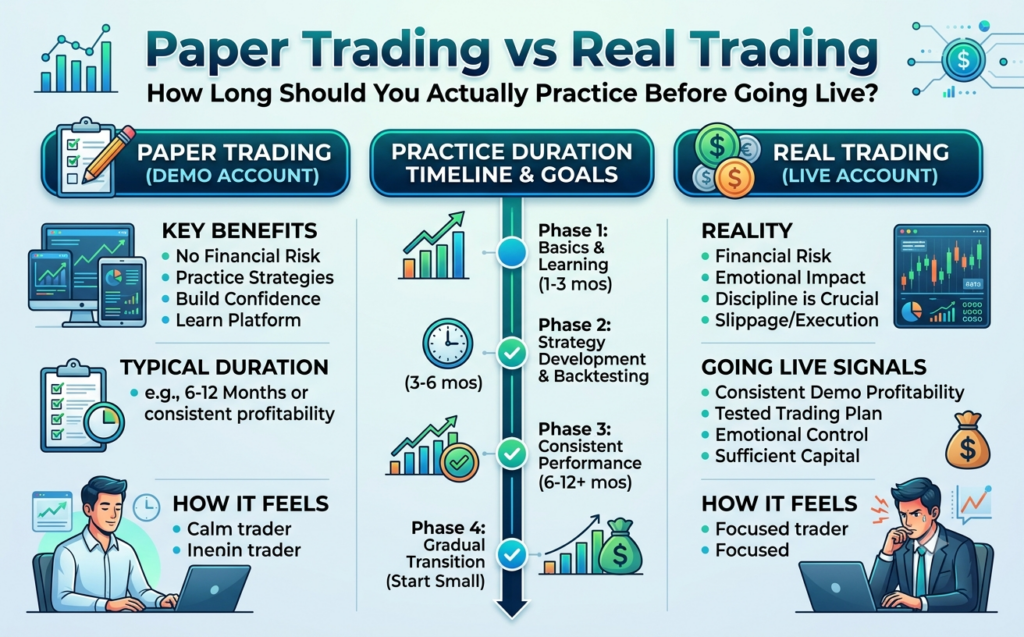
The majority of professional traders and trading teachers agree on a similar period around 3 to 6 months from paper trading to live capital, and then it is time to start trading real money. Not 3 – 6 months of buying and selling around random prices every few months, but 3 – 6 months of actually buying and selling and monitoring your trades and reviewing them as you would a real portfolio.
So what is the reason for this particular range? The Indian markets experience distinct phases in each of the quarters, with trending months, sideways months, high volatility periods such as results season or rate decision periods, and the occasional shock of news such as geopolitical events, or unexpected policy announcements. If you have only been paper trading in a flat, gradual market now you have no idea of how you will react once the market falls 3% in a single session and all your positions are in the red. You have to have your approach and yourself tested in various scenarios to have any confidence in them.
Three to six months isn’t some magic number, however, that you can count off a calendar. It’s a floor. The actual readiness test is the behavioral and data test, which looks like this.
Signal One: You Have Actual Numbers, Not Just a Feeling
There’s a red flag if you reply to “How’s your trading going?” with “Pretty good, I think. Not when things aren’t going well but because you don’t know.
There are some questions that ready traders can answer with certainty:
What is the percentage of my wins for the past 60 trading days?
If the points on winning trade vary, what is the average winning trade in rupees or percentage?
What is the average of my losing trades?
Let’s say I make 100 of these trades, what’s my expectancy?
The one that’s big is that one. If you use a strategy which wins 40% of the time, but wins 3x more than you lose, you can be a very profitable player. If your losing streak takes away 5 winning streaks, you still can lose money with a 70% winning streak. Win rate is the first thing most beginners seek as it sounds good to their ears. Professional traders are looking for expectancy, since it’s the one thing that’s paying the bills.
If you have been trading paper for a long time and can’t get these numbers up, it’s not a bad thing, it’s just that it’s time to begin doing it right. This one is one of the clearest indicators of whether you’re using the best paper trading app for you: The best ones will have a built-in performance dashboard that automatically tracks your win rate, average win/loss, and drawdown and saves you the trouble of creating a separate spreadsheet to keep track of your performance.
Signal Two: Your Rules Are Written Down, and You Actually Follow Them
There’s this kind of trader who’s only a fantasy trader — you can hear the one who says, “I have a plan,” but when he’s in reality, he says, “I have a general idea of what I like to do. That’s not a strategy. A strategy is something that you could show to someone else and have them do nearly the same thing.
You should have answers in writing to the following before going live:
Under what circumstances do I get into a trade? Not it “looked good” but it “matched the criteria” (such as a breakout over a level, a specific candlestick pattern, a moving average cross over, whatever your set of criteria is.)
Where is the stop loss? Is it at a level or a percentage of capital or volatility or wherever it “feels safe”?
What is the exit signal, or what am I looking for to get out?
What’s the maximum amount that I can lose per trade?
The more difficult part is here, though. The first step is to have these rules recorded. The second step is to actually do them EVERYDAY, even if you want to do other things. If you see on paper trading that you have a tendency to ignore your own stop loss “just this once” when you think that it will recover, that is a valuable piece of information. Better to find out this way with fake money than in a real trade that is losing 8% and rising.
Signal Three: You’ve Eaten Both Sides of the Market
This one deserves its own place as it’s the most ignored piece of the lot.
Congratulations if you began paper trading when the market was in a strong bull market! Almost all strategies seem to work when the overall market is rising and they dip low enough to be bought in days. This isn’t the real test. The true test is when:
The sideway and range bound market where breakouts are continuously deceiving you.
When your portfolio is in the red, and you have to choose between cutting your losses and holding on, it’s a sharp correction.
A news event of high volatility is defined as a surprise decision by the RBI, a global market shock, an earnings season event that moves stocks 10 percent or more in a day.
A long stretch with low volume and no obvious direction that can get taken up with excessive trading for lack of something to do
If you have paper trading experience in just one of these types, you simply haven’t had experience in the other yet. This is one of the best reasons why it’s not three months, but three to six months — it just takes the calendar time for various market moods to manifest.
Signal Four: understand their own emotional patterns
This is the part which virtual money cannot replicate absolutely and facing it forthright is the best way to go. Paper trading is great to learn the mechanics, order types, stop loss, fast moving prices during volatile sessions, the T+1 settlement process. This may not be able to replace the gut punch feeling of losing real cash in front of you.
However, even if you don’t have any money to trade, paper trading can give you a good understanding of your emotional tendencies. Pay attention to:
Are you prone to taking prices when they are anxious and close, despite the plan to hold?
Have you ever rushed to trades after missing an entry, and got in too late because you were afraid you missed out?
After a losing trade, do you immediately want to take another trade to “win it back”?
Can you make a trade and not check your portfolio during the market hours, or do you check it constantly?
If these trends are emerging in a regular fashion during paper trading, they will likely emerge (and probably magnified) when real money is in play. This is not bad news, but good news actually. It means you can develop coping strategies (such as “no matter how much I lose today, I’ll find the money later,” etc.) before those habits cost you any real money.
What If You Don’t Do This Process?
It’s important to illustrate what is likely to occur to traders who jump straight to live trading, as the pattern is very consistent.
Someone opens up a demat account, places some funds and enjoys the first week — in part because they got lucky in the market rather than because the process they used was correct. With that first victory, they are sure they have gotten the hang of it. They amplify their position size. Then a loss is incurred and there never was any discipline to stop the losses so the loss is heavier than expected. That leads to a revenge trade to sell off fast and get back in. The revenge trade is costing too, too often because it was taken emotionally and not due to a real set up. In a few months, the trader loses money off the account, and either gives up on the market altogether or — worse — continues to replenish it with more funds in the hopes of “recovering their losses.In a month or two, the trader loses a lot of money on the account and either stops trading or — worse yet — puts more money back in the account in hopes of “catching up.
This is not an unusual occurrence. It is very close to what people who do not practice these exercises get and the same is what SEBI’s data on retail F&O losses has just confirmed once again for the year. Paper trading is an exercise that exists for just this reason: so you can experience all that without really losing anything.
Choosing the Right Paper Trading App India Makes This Easier
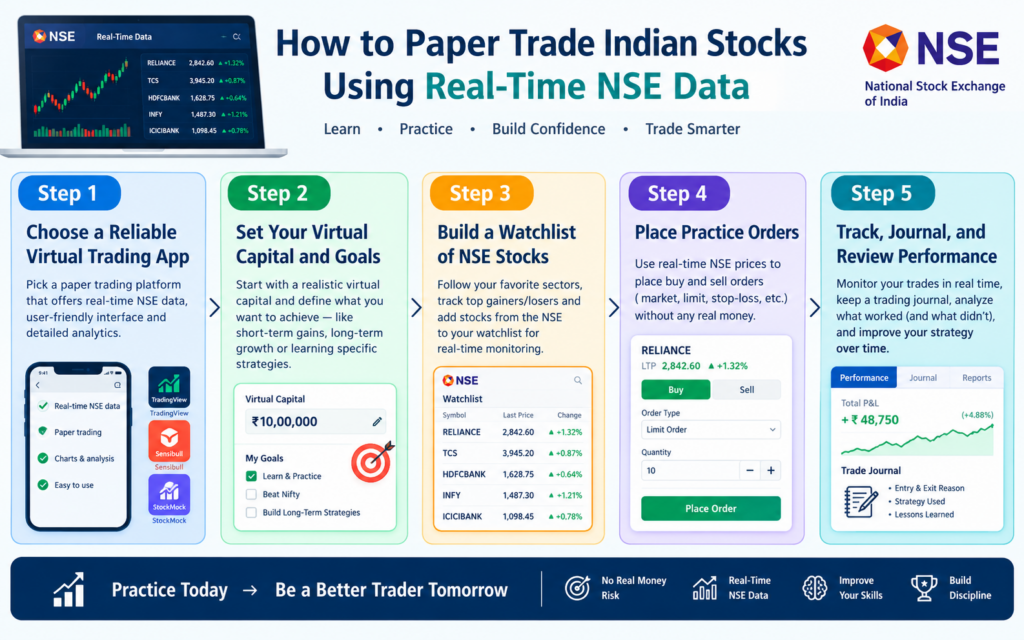
All the above tracking is useless without having Market Data and good reporting to use with a paper trading app. The choice of platform is more important than most people think at this point.
A good paper trading platform in India should provide you with some non-negotiables: live NSE and BSE price dumps (not delayed or simulated ones), a realistic virtual balance that you can trade with, a support that includes equity trades as well as F&O trades if you plan to trade on the equity market in the future, and most importantly, a performance dashboard that will automatically keep track of your win streaks, expectancy, and drawdown.
If someone asks you what the best paper trading app looks like, they’re likely thinking of three things: the order mechanics do not require you to re-learn the interface later; the reporting features are solid; and there is some form of structured learning with the simulator; raw practice without feedback can just as easily reinforce bad habits as good ones. If there are any of these missing in the app you use, you may want to get a new one, given that you don’t want to spend anymore months practicing with a missing part.
A simple framework to make your own Go Live decision
If you prefer a simple list over vague recommendations, here is one you can use:
- Experience: Consistent paper trading for at least 3-6 months (not “dabbling” on and off).Trading under at least one trending period, sideways, and one high volatility market.
- Data: You have an idea of the percentage win/loss, average winnings, and average loss without needing to compute them as you go.
- Discipline: You can show them specific times you followed through with your stop-loss when it was difficult to do, rather than when you were lucky and didn’t.
- Sizing up for real money: In advance, you’ve determined that if you lose all of your money, you will not be ruined for life, so you know how much to bet. Many of the more experienced traders recommend that they do trading with a portion of what they will eventually be able to trade with in the live market, so that it can be considered as a continuation of paper trading, but with slightly bigger bets during the initial few months of the live trading market.
If you can truly tick all five of these circles, then you have a solid chance to become a live dealer casino. Two or three of them may be rough, but it’s not a failure, it’s telling you what to concentrate on before you switch.
The Bigger Picture
A lot of traders use the old saying about paper trading and it’s true, paper trading is similar to a flight simulator. Simulators are designed to be as realistic as the plane’s cockpit, with the same instruments, physics, procedures, and so on — just in case there is a problem in flight, the pilot responds automatically, and not panicked. It would be foolish to think that someone wouldn’t fly hundreds of hours in a simulator before taking to the skies with real people on board. Stakes of real money should be taken seriously, despite the fact that the amounts of money are clearly much smaller.
The market can’t be stopped. All the stocks, all the indexes, all the opportunities that are here now will be there in three months, in six months, in a year. The only thing that’s you’re really risking by taking time is your own impatience — and that’s a much more inexpensive loss than capital.
If you’re currently paper trading and in doubt, if you want to be honest, there’s a number of things you need to do: Check your numbers, check your discipline, check how many different market moods you’ve traded through, and be honest with yourself about the emotional patterns you see. If these things align, you’ll know. As long as they don’t, every session you spend learning with virtual cash is a session that is making your actual trading more safe, consistent, and much cheaper.
Frequesntly Asked Questions
1. How long should I paper trade before going live?
At least 3–6 months of consistent, active practice — not on-and-off dabbling.
2. Is 3–6 months a strict rule?
No, it’s a floor. Real readiness comes from your data, discipline, and emotional patterns, not just time.
3. What numbers should I track?
Win rate, average win, average loss, and expectancy — expectancy matters most.
4. Is a high win rate enough to go live?
Not by itself. A high win rate can still lose money if losses are large; expectancy tells the real story.
5. What rules should I write down before going live?
Entry criteria, stop-loss level, exit signal, and max risk per trade.
6. Do I need to practice in a bull market only?
No. You need experience in trending, sideways, volatile, and low-volume markets too.
7. Can paper trading prepare me emotionally?
Partly. It reveals patterns like FOMO or revenge trading, but real money adds emotional weight it can’t fully replicate.
8. What happens if I skip paper trading?
A common cycle: early luck, overconfidence, bigger positions, a loss, then a revenge trade — often ending badly.
9. What should a good paper trading app offer?
Live NSE/BSE prices, a realistic virtual balance, equity and F&O support, and an automatic performance dashboard.
10. How do I know I'm truly ready?
Check: enough practice time, exposure to varied markets, clear win/loss data, proven discipline, and a sensible position size.
11. Should I start live trading with full capital?
No — start small, using a portion of your intended capital, and scale up gradually.