
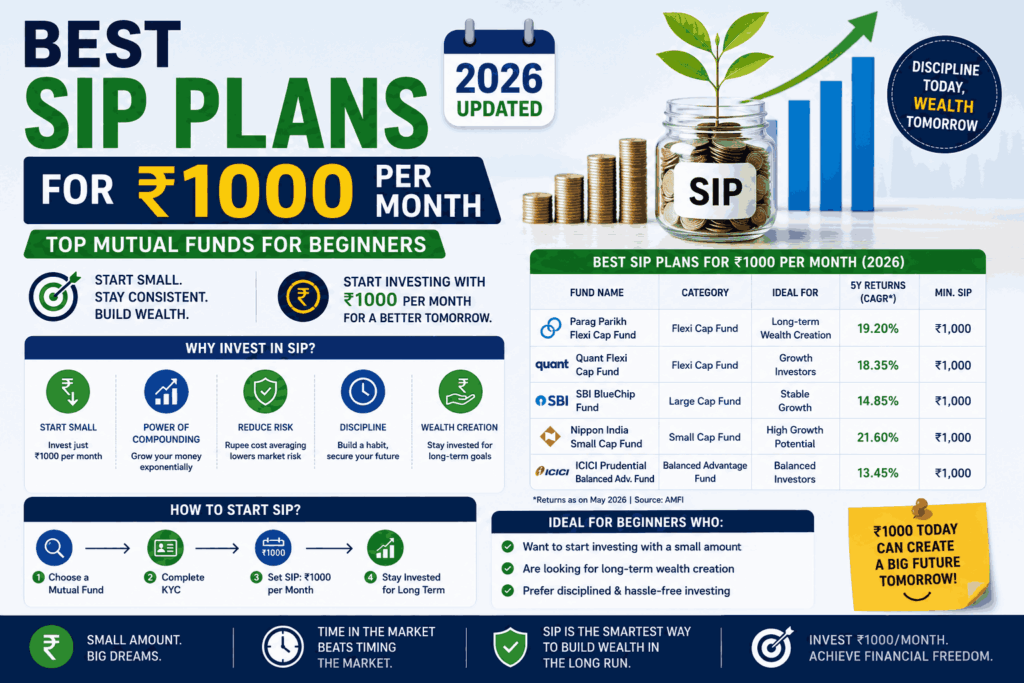
SIP or Systematic Investment Plan is the most common method to invest in mutual funds by depositing a fixed amount regularly, either on a monthly or quarterly basis, for a certain period of time. In this investment plan, rather than investing a huge lump sum amount in any asset, equity, debt instrument, or institution, you pay small regular installments that are affordable and feasible for the best SIP plans for 1000 per month.
There are many SIP plans that you can consider for long-term returns. This blog provides you with an overview of the 10 best SIP plans for 1000 per month, how to start a SIP, and why you should invest in SIP.
10 Best SIP Plans for 1,000 per Month
Here is the list of the best SIP plans for 1,000 per month in 2026, along with their category, expense ratio, AUM, and 5-year CAGR. You should go through the details of these plans to make a wise investment decision.
| Scheme Name | Minimum SIP Amount (Rs) | 1-Year Return (Rs) | 3-Year Return (Rs) | 5-Year Return (Rs) |
|---|---|---|---|---|
| Nippon India Large Cap Fund | 100 | 1,263.60 | 4,796.80 | 10,099.40 |
| ICICI Pru Bluechip Fund | 100 | 1,281.20 | 6,630.00 | 14,600.00 |
| Invesco India Infrastructure Fund | 500 | 7,732.00 | 31,183.00 | 53,350.00 |
| HDFC Mid-Cap Opportunities Fund | 100 | 1,376.60 | 6,331.40 | 12,193.00 |
| Nippon India Multi Cap Fund | 100 | 1,351.40 | 6,566.60 | 11,483.60 |
| ICICI Prudential Dividend Yield Equity Fund | 100 | 1,021.20 | 6,394.00 | 13,734.00 |
| ICICI Prudential Equity and Debt Fund | 100 | 1,273.00 | 5,966.00 | 10,525.00 |
| Kotak Debt Hybrid Fund | 100 | 1,282.20 | 4,952.80 | 9,828.00 |
| UTI Nifty 50 Index Fund | 500 | 6,528.00 | 27,977.00 | 51,291.00 |
| Axis Strategic Bond Fund | 100 | 1,318.40 | 4,758.80 | 8,529.00 |
Best SIP Plans for 1,000 per Month – Company Overview
1. Nippon India Large Cap Fund
Inaugurated in January 2013, Nippon India Large Cap Fund is one of the top-performing SIP plans that offers stable growth and high returns. The mutual fund is a large-cap equity firm with a 5-year CAGR of 26.93%. This plan is suitable for investors looking to invest in equity for huge capital appreciation. Since its inception, the fund has invested in the financial sector, industrial and technological sectors, and oil, gas, and electronics sectors.
2. ICICI Pru Bluechip Fund
Established in 2008, the fund invests in large-cap stocks and manages diverse portfolios. With a 5-year CAGR of 23.96%, the fund aims to offer high long-term returns and risk management to the investors. The key sectors where the firm invests include banks, the IT sector, auto, pharma, refineries, and engineering. Since its inception, the fund has shown steady and continuous growth.
3. Invesco India Infrastructure Fund
The fund was established in January 2013, and since then, it has effectively managed its portfolio among different sectors, including energy, telecom, construction, capital goods, and electrical equipment. The fund offers a 5-year CAGR of 34.45% and is more suitable for investors who want to invest their capital in long-term assets for aggressive returns.
4. HDFC Mid-Cap Opportunities Fund
Incepted in June 2007, HDFC mid-cap opportunities fund invests the capital in mid and small-cap stocks for maximum return and risk management. The major sectors where the fund parked its capital include financial, automobile, technology, and healthcare. The fund offers a comprehensive 5-year CAGR of 31.12% and is more suitable for investors who want to take a high risk for an aggressive return in the long term.
5. Nippon India Multi Cap Fund
Nippon India Multi Cap Fund was incepted in March 2003 and offers a 5-year CAGR of 33.02% to the investors. The key sectors where the fund invests include private banks, pharmaceuticals, finance, electric components and equipment, and oil, gas, and refining. Investors who want to undertake moderate risk for a huge return on a long-term basis can prefer investing in this fund.
6. ICICI Prudential Dividend Yield Equity Fund
Established in May 2014, ICICI Prudential Dividend Yield Equity Fund offers long-term gains and a 5-year CAGR of 30.86% to investors. The multiple sectors across which the fund parked its capital include automobile, finance, healthcare, energy, and construction. This fund offers a healthy and steady cash flow and is more preferable for investors looking for regular returns, moderate growth, and low risk.
7. ICICI Prudential Equity and Debt Fund
Incepted in November 1999, ICICI Prudential Equity and Debt Fund is a balanced mixture of debt and equity to maximise return and efficient risk management. The fund invests in key areas like technology, automobiles, finance, and the healthcare sector, offering a 5-year CAGR of 25.42% to the investors.
8. Kotak Debt Hybrid Fund
Incepted in January 2013, the fund’s main objective is to generate huge and continuous returns from highly liquid debt instruments. The key investment areas of the fund include the government sector, corporate sector, technology, financial sector, and consumer sector. With a 5-year CAGR of 13.82%, the fund is suitable for investors looking for a moderate return with low risk factors.
9. UTI Nifty 50 Index Fund
UTI Nifty 50 Index Fund was established in January 2013 with the aim of generating high returns and offering investment flexibility to investors. The fund parks the investors’ funds in key areas like consumer, automobile, technology, and telecom sectors. It offers a 5-year CAGR of 19.87% and stable long-term returns.
10. Axis Strategic Bond Fund
Axis Strategic Bond Fund was established in March 2012 with a view to offering optimal returns and maintaining liquidity in the portfolios. The sector where the fund invests includes the real estate sector, government securities, and the banking and brokerage sectors. The fund offers a 5-year CAGR of 7.99% to the investors and effectively manages the risk considerations.
Conclusion
As a result, it is safe to say that the best SIP plans offered for an investment of ₹1,000 per month offer a great way to create wealth for oneself. If you choose the most appropriate mutual funds and stick to your investment approach, you will be able to shield yourself from the negative effects of market fluctuations and enjoy gains in the end. As it was mentioned above, each of the schemes provided here has specific advantages, which may suit your financial goals. Don’t forget to monitor your investment performance regularly and make adjustments when necessary!
Practice Smart Investing Before You Start Your SIP
While a SIP of Rs. 1,000 capped at Rs. 100,000 is a good idea to invest long-term, it is advisable to understand the way the performance of the funds, the NAV and market cycles work before starting one. That’s where you can see the difference in playing with the best paper trading app, you get to practice your SIP investing style and the stock trading without putting any money at risk and find out how your strategies would have done. Many new traders in India avail of a best trading app to trade with virtual money before investing real cash, it helps in gaining confidence, understanding the volatilities, and the behavior of the portfolio through practical experience. When you get a feel for it, you’ll be able to transfer all of these concepts to your actual SIP or equity investments.
Frequently Asked Questions
1. Can I start a SIP with ₹1000 per month?
Yes, you can easily start a SIP with ₹1000 per month, as many mutual funds in India allow minimum investments starting from ₹100–₹500.
2. Which are the best SIP plans for ₹1000 per month?
Top SIP options for ₹1000 include large-cap, flexi-cap, and index funds that offer stable growth with relatively lower risk over the long term.
3. Is a ₹1000 SIP enough for a long-term investment?
Yes, investing ₹1000 monthly can generate significant wealth over time due to the power of compounding, especially if invested for 10–20 years.
4. What returns can I expect from a ₹1000 SIP?
On average, equity mutual funds may offer 10–15% annual returns over the long term, but actual returns depend on market conditions.
5. Is SIP better than a lump sum investment for beginners?
Yes, SIP is generally better for beginners as it reduces market timing risk and allows disciplined investing over time.
6. How long should I invest ₹1000 SIP to get good returns?
A minimum investment horizon of 5–10 years is recommended, while 15+ years can significantly maximize returns.
7. Can I increase my SIP amount later?
Yes, most mutual fund platforms allow you to increase or modify your SIP amount anytime.
8. Are SIP investments safe?
SIPs are market-linked and carry some risk, but investing in diversified mutual funds reduces risk over the long term.
9. Do I need a demat account to start a SIP?
No, a demat account is not mandatory. You can invest directly through mutual fund apps or AMC websites after completing KYC.
10. Can I practice SIP investing before starting a real one?
Yes, using a paper trading app lets you simulate SIP and stock investments with virtual money before committing real funds.
11. Which is the best trading app to learn investing basics?
Beginners in India often start with a free paper trading app to understand markets risk-free before moving to real trading or SIPs.