It’s easy to take the same dose of a losing streak taking place on paper as it is when actually doing it. The money isn’t real, but five or six losing red trades in a row can make one doubt and want to throw away a viable plan. Thankfully, a losing streak is one of the most beneficial lessons you can learn from practice trading. Take care of it now and they’ll take care of your real capital later.
In this guide, you get to see why streaks occur, how to act in the first hour and how to make it a better strategy.
Why Losing Streaks Happen (Even With Virtual Money)
All strategies go out of fashion. Several losses in a row will occur with a system even if it’s winning 55% of the time. Know what type of streak you have, before making any adjustments.
Normal Variance vs. a Real Problem
Proper entries, stops and size, if your losses have been in accordance with your rules, then you are facing ordinary variance. In any hand of playing cards, there are statistically speaking guaranteed streaks. If you have been taking a few trades, but missing the opportunities, or if you’ve been jumping in and out of the market because you were impulsive, then you need help with the trade, not the strategy.
Here’s a simple test: If you’ve experienced your last 10 losing trades, you should ask yourself whether each of them was in line with your written plan. If they most likely did, remain calm. If most did not, it is first discipline that needs to be fixed.
Hidden Psychological Triggers
With fake money, it’s a matter of trading psychology. Common triggers include:
- Revenge trading: taking oversized or low-quality trades to win back losses quickly.
- Overconfidence after wins: a hot streak often leads to loosened rules.
- Boredom: trading just to stay active.
- “It’s only virtual” thinking: risking far more than you would with real money.
The final one is the most deceptive one. If you trade in practice, differently from how you would live if you were trading, then you are never learning anything.
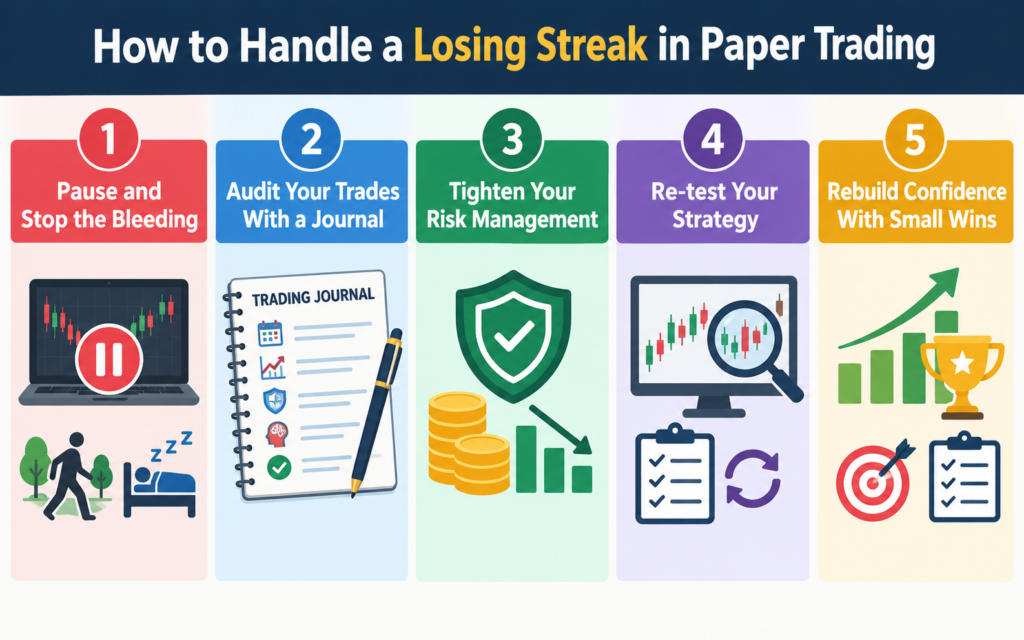
Step 1: Pause and Stop the Bleeding
The first step is to refrain from trading. If you have a bad run, close your platform for the day or 24 hours. The pause interval introduces a moment of reintegration into the emotional chain of the person’s trading, which makes each subsequent trade better than the preceding one.
Take a short walk, sleep and do not consult charts on the pause. You are not breaking your pledge. You’re changing your mind.
Step 2: Audit Your Trades With a Journal
A trading journal transforms an abstract sense of the bad from feelings to numbers.
What to Record
As you lose each trade, record:
- In the past the name was used for the date, the instrument and direction.
- The prices at which a product is sold or bought.
- Similar to the previous question, the amount of money staked and the percentage of the account at risk.
- Your motive for making the entry
- Your mind state prior to the trading.Your mood before the trading.
- Did you do what you had planned (yes or no)
Patterns to Look For
Look at the past 15-20 trades and categorize the losses. It could be that the majority occurred during the first 15 minutes of the market opening, after a previous loss or in a specific setup. One fact is worth more than a hundred opinions. For most of the time, the solution is to remove the particular set up or time frame from the trading list.
Step 3: Tighten Your Risk Management
Risk management is the key to avoiding a losing streak from becoming a disaster. A trader that risks 5% per trade, for example. Losing eight of her first nine games reduced her account by nearly one-third.Losing eight of her first nine games would reduce her account by almost one-third. The same time amount of risk at 1% is below 8% easy to recover.
Cut Your Position Size
During the drawdown lower the risk per trade by half. Helping to reduce the emotional stress and provide a clear head. Only increase size when a string of trades are made that adhere to the rules.
Set a Daily Loss Limit
Set a daily limit (e.g. 2% of the account) before you start trading. If you strike it out, that’s all for the day. Most revenge trading can be avoided by this one rule.
Step 4: Re-test Your Strategy
If you followed the rules and your journal shows you lost, try the strategy again. Review if markets have turned, such as a trending system that’s not getting very far in a choppy, range market. Test it on a new set of charts in the past and perform a new forward test of 30 or more trades before stating your findings. Only change one variable at a time to see if any variable was responsible for any improvement.
Step 5: Rebuild Confidence With Small Wins
Your confidence needs to be built up because of consistency, nothing else. Set process objectives not profit objectives:
- Take 10 trades following all stop loss rules.Take 10 trades following all stop loss rules.
- Only use A grade setups.
- Fill in your journal entry for each trade.
Small wins are each completed goal. These wins help to restore trust in you, in your process, over the course of a few weeks.
When Is It Safe to Move On?
A bad run isn’t a reason to give up on sports, and when you bounce back from a run of bad luck, it doesn’t indicate that you should go live. These indicators will be found:
- At least 50 – 100 trades of positive expectancy
- Consistent rule-following, above 90%
- Withdrawals that were within your planned levels of drawdown
- Coping with losses with a sense of tranquility.
When you encounter these, you’ve got evidence that you’ll be able to handle real pressure, because your plan and your temperament can encounter that.
Conclusion: Turn Every Losing Streak Into an Edge
Feedback is a result of a losing streak in paper trading, not failure. Stop, check, strengthen your case and reestablish context in your journal, and set more stringent risk limits and restore confidence with small, process-based victories. Avoid going live until you have a good sample of trades and have discipline.
Ready to practice? Open a free paper trading app, download our trade journal template, and turn every losing streak into a lesson.
What is a losing streak in paper trading?
It is a run of consecutive losing trades in a virtual account, usually caused by variance, poor execution or emotional decisions.
How many losses in a row is normal?
Five to eight consecutive losses can occur even in profitable strategies, depending on win rate.
Should I stop trading after a losing streak?
Yes, take a short break, then review your trades before placing new ones.
Is revenge trading a problem in a virtual account?
Yes, it builds bad habits that carry over into live trading.
How do I know if my strategy or my discipline is the problem?
Check your journal: if losses broke your rules, it’s discipline; if they followed the rules, test the strategy.
How much should I risk per trade during a drawdown?
Many traders cut risk to 0.5% or less per trade until they regain consistency.
Can a losing streak happen to experienced traders?
Absolutely, every trader experiences them, which is why risk rules matter.
Should I reset my virtual account balance after big losses?
Only after you have reviewed what went wrong, otherwise you repeat the same mistakes.
How long should I paper trade before going live?
Most traders aim for at least two to three months and 50 to 100 documented trades.