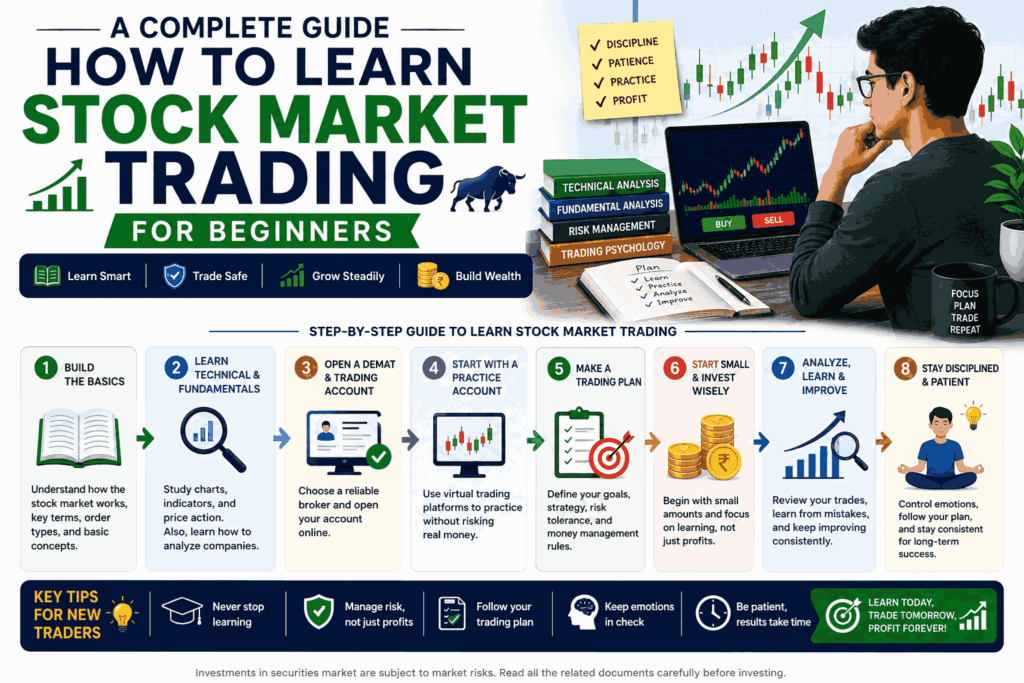
The vast majority of new traders discover the market the hard way – the hard way, which is losing money. There’s a better way. Paper trading allows you to trade for free using virtual money at real market prices, test your strategy, make mistakes and correct them without any cost. In this guide, we will discuss what is swing trading and how you would select the best paper trading app in India, which ones are recommended and a step by step paper trading guide to help you practice before you get live.
What Is Swing Trading and Why Practise First?
Swing trading in simple words
A swing trader is a type of trader who trades a stock for a few days to a few weeks, looking to profit from “swings” in stock price. The primary tools employed by swing traders are technical analysis, including support/resistance, moving averages, RSI and volume. It falls somewhere in between intraday trading (which involves closing out trades the same day) and long-term investing (where one trades over a period of months or years). Although positions are held overnight, there is still a level of discipline required with regards to entry, stop-losses and position size as an intraday trader.
Why beginners lose money without a practice phase
Most early losses are not due to bad luck – it’s due to the process, not following, not exiting early from winners, chasing breakouts, and stop-loss. The place to find and correct these habits is in paper trading, where there are no real capital losses.
Paper Trading Apps in India for Swing Traders
| App | Best for | Cost | Swing-trading strength |
| TradingView | Chart-based swing trading | Free and paid plans | Advanced charts and built-in paper trading |
| Sensibull | Options practice | Free and paid plans | Virtual options strategy testing |
| Streak | Strategy testing | Free and paid plans | Backtesting and no-code strategy building |
| Stock market simulators (e.g. Moneycontrol-style virtual trading) | Absolute beginners | Mostly free | Simple interface, easy to start |
| Broker demo or sandbox platforms | Pre-live practice | Varies | Familiar interface before going live |
Features, pricing and availability change often. Check each platform’s current offering before you sign up.
TradingView
TradingView is a platform that offers robust charting capabilities and has a vast library of indicators, with a paper trading feature suitable for Indian stocks. It is ideal for traders who look to create patterns and price action setups.
Sensibull
There is a lot of options that Sensibull is based on, and there is also virtual trading that enables you to practise strategies without risking any capital. It’s well suited for traders with swing time frames, who are interested in trading with options.
Streak
With Streak, you can develop and test strategies without any coding, and determine if a setup has been profitable in the past before you paper trade it ahead.
Stock market simulators
Newer trading simulators provide you with virtual capital and a simple trading screen. They are not the best choice for order types and market fundamentals, but tend to be more lightweight when it comes to analytics.
Broker demo or sandbox platforms
There are some brokers that provide demo environments. These assist in teaching you the specific application you will make use of live, but they are not always provided; confirm with a broker.
How to Select the Ideal Paper Trading App in India
Not all of the simulators are appropriate for swing traders. Check out these qualities.
Real-time or near-real-time NSE and BSE data
You must have proper market rates for your practice if you want it to be useful. Delayed data can be misleading and prevent entries and stop-losses.
Support for delivery and positional orders
These are over night trades and the app should be able to deal with delivery or positional orders, and stop and target orders.
Charting and technical indicators
Properly planning setups requires candlesticks, moving averages, RSI, volume and drawing tools.
Performance analytics
The best apps display the win rate, risk-reward ratio and drawdown so you can determine whether or not your strategy is profitable.
Cost, ease of use and broker integration
It’s okay to use a free plan to begin with. A live platform that is linked to your broker makes it easier to make the transition if you are planning to go live soon.
How to Practise Swing Trading with a Paper Trading App
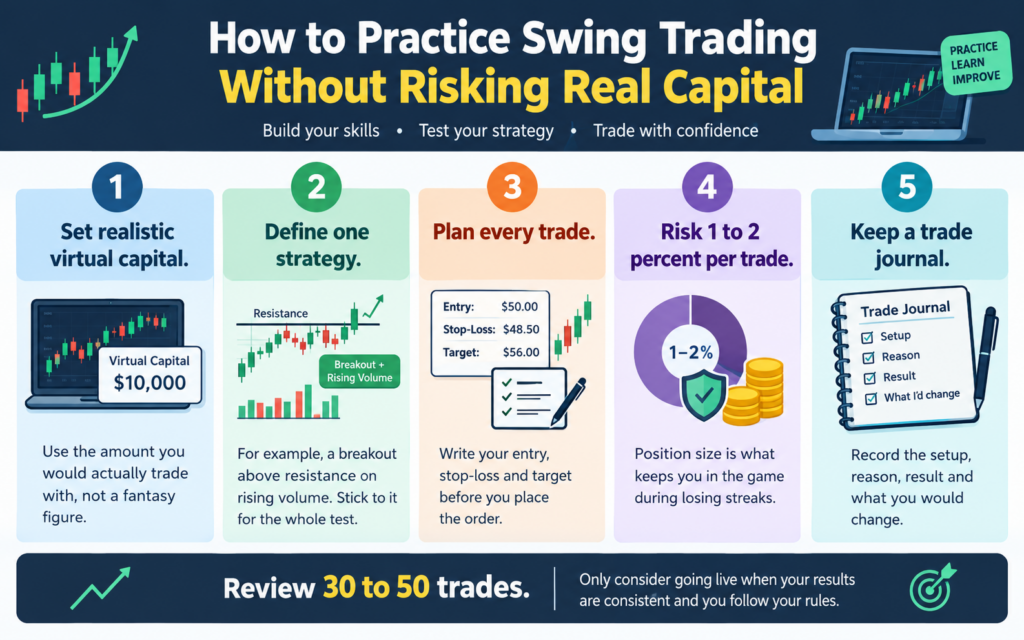
- Set realistic virtual capital. Use the amount you would actually trade with, not a fantasy figure.
- Define one strategy. For example, a breakout above resistance on rising volume. Stick to it for the whole test.
- Plan every trade. Write your entry, stop-loss and target before you place the order.
- Risk 1 to 2 percent per trade. Position size is what keeps you in the game during losing streaks.
- Keep a trade journal. Record the setup, reason, result and what you would change.
- Review 30 to 50 trades. Only consider going live when your results are consistent and you follow your rules.
Common Mistakes to Avoid
- Playing carelessly with virtual money and risking large amounts of money
- The fact that there is no cost doesn’t mean that people can trade too much.
- Not considering the effects of brokerage, taxes and slippage on your results
- Failing to stick with a strategy following each setback
- Failing to wait for sufficient tests, to go live too early
Also Read:How to Test Your Stock-Picking Skills With Paper Trading
Final Thoughts
Paper trading won’t guarantee profits, but it builds the habits that protect your capital: planning trades, managing risk and reviewing results. Pick an app that fits your style, follow a clear process, and let the numbers tell you when you are ready.
FAQs
How long should I paper trade before using real money?
Typically one to three months, or 30 to 50 completed trades with consistent rules.
Does paper trading give the same results as live trading?
Not exactly. It doesn’t capture emotions, slippage or order-fill delays, so live results will differ.
Can I paper trade swing trades in Indian stocks?
Yes. Most platforms support NSE and BSE stocks with delivery or positional orders.
Which paper trading app is best for beginners in India?
Pick a simple interface with delivery orders and stop-losses. TradingView works well for charts, while basic stock simulators are easier to start with.
Do I need a demat account to paper trade?
Usually not for standalone simulators, but broker demo platforms may require an account with that broker. Check each app’s sign-up requirements.
Can I practise options and futures too?
Yes, on platforms that support derivatives. Sensibull is built around options, but confirm current features before relying on it.
When should I switch from paper trading to real money?
After 30 to 50 trades with consistent results and rule-following, usually one to three months. Start small, since live trading adds emotions and slippage.