The majority of new traders make some mistakes along the way. They place the first live trade and end up panicking and losing all the real money. There is an easier route. Paper trading app allows you to trade with virtual cash in real market conditions and you won’t lose anything in case of any mistakes. In this guide you will learn five techniques you can practice in the lead up to risking your first rupee; moving average crossovers, breakout trading, support and resistance swings, mean reverting off the RSI and momentum day trading.
Why Use a Paper Trading App Before Trading Live?
Paper trading involves trading with virtual or close-to live prices, but without using real money. It can be considered as a trading flight simulator.
Learn the Platform Without Financial Risk
Order types, stop-losses and position sizing mystifies most beginners and an incorrect click on a live account can cost you a lot of money. Using a virtual trading app, you can familiarize yourself with market, limit and stop orders until they seem instinctive.
Build Discipline and Test Your Edge
A winning strategy can be a fantastic idea, but it doesn’t necessarily work in the real market. Paper trading allows you to get real numbers like win rate, average gain and drawdown, in order to make real data-based decisions, not guesswork.
5 Trading Strategies to Practice on a Paper Trading App
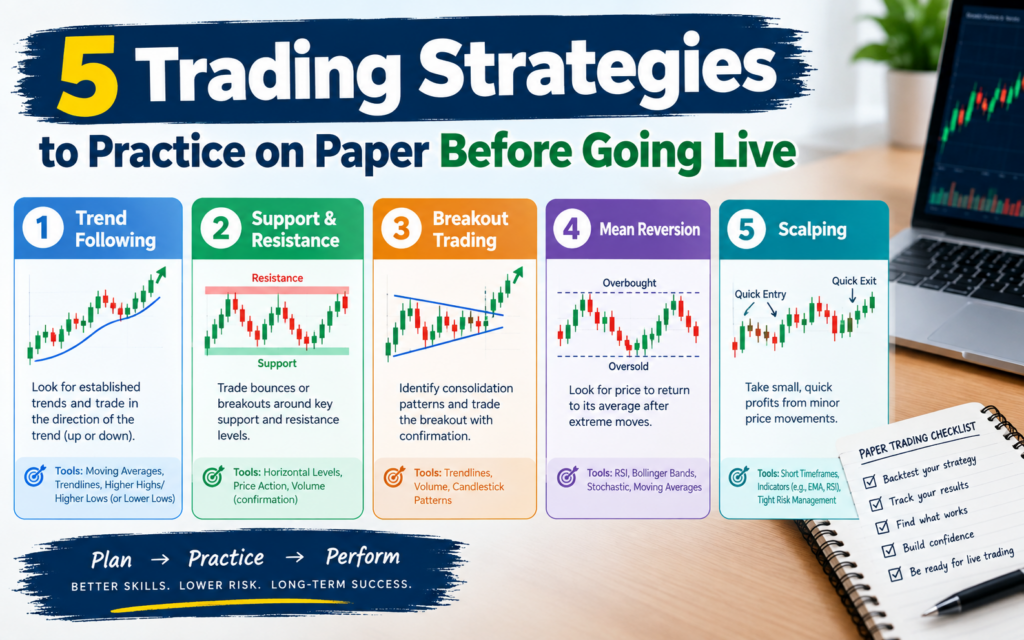
The following strategies are all appropriate for a different style and/or timeline. Perform each of them for at least 30 trades, and record the win rate, risk-reward ratio and max drawdown.
1. Moving Average Crossover (Trend Following)
This approach involves taking a combination of two moving averages, typically the 20-day and 50-day moving averages. When the shorter average price crosses above the longer average price, a buy signal indicates that the situation is favorable.If the shorter average price crosses over the longer average price it is a buy signal because the situation is favorable.
How to sell: Take every signal regardless of the stock or index without missing a beat, using the five liquid stocks or an index. Set stop loss after the latest swing low.
Measures to track: Win rate; Average holding period. This is a strategy for you to learn from false signals in sideways markets, as you will see them frequently.
2. Breakout Trading
Breakout traders join when prices break above resistance (or below support) and when the volume traded is above the average. The premise is that a big move is likely to be preceded by a long consolidation.
The way to work out this: Draw support/resistance lines on the daily chart and wait for a volume confirmed breakout, and then put your stop just inside the broken level.
What to measure: Record your false break-out rate. Make comparisons between volume confirmed and volume unconfirmed trades.
3. Swing Trading with Support and Resistance
Swing trading focuses on events that occur on the daily or weekly time frame. Trades are made around the support and resistance levels while the rest of the trade is done by the market.
How to play it: Appearance of confirmation candle, like bullish engulfing pattern, close to support. Place a stop-loss below that price level and your target just above the next resistance level.
Evaluate the following: Risk/Reward. Do not take setups where there is less than 1:2.
4. RSI Mean Reversion
When a stock is stretched, the Relative Strength Index (RSI) will warn that it is. Below 30 indicates oversold while above 70 indicates overbought. A mean reversion bet is one that is wagered on the price returning to its average.
The best way to trade: Purchase when RSI falls below 30 and begins to move higher, especially in stocks that are in range bound markets. Get out close to an RSI of 50 or when it gets to the 60-70 area.
The number of times this happens in strong trends where RSI may be oversold for several weeks is what you are interested in measuring. Propose a quick trend filter and compare outcomes, such as trading only when the price moves above the 200-day moving average.
5. Momentum Day Trading with Fixed Risk-Reward
Day traders seek stocks trading heavily or on news and trade in tune with the momentum, exiting all trades at the end of the day.
How to practice: Take no more than a 1% risk per trade, 1:2 risk-reward ratio, and limit trades to 3 trades a day.
To measure: Keep an eye out for overtrading, the largest single day trading pitfall. Consider Net Profit (not necessarily Gross Gains) after any brokerage costs that you estimate.
How to Get the Most Out of Paper Trading
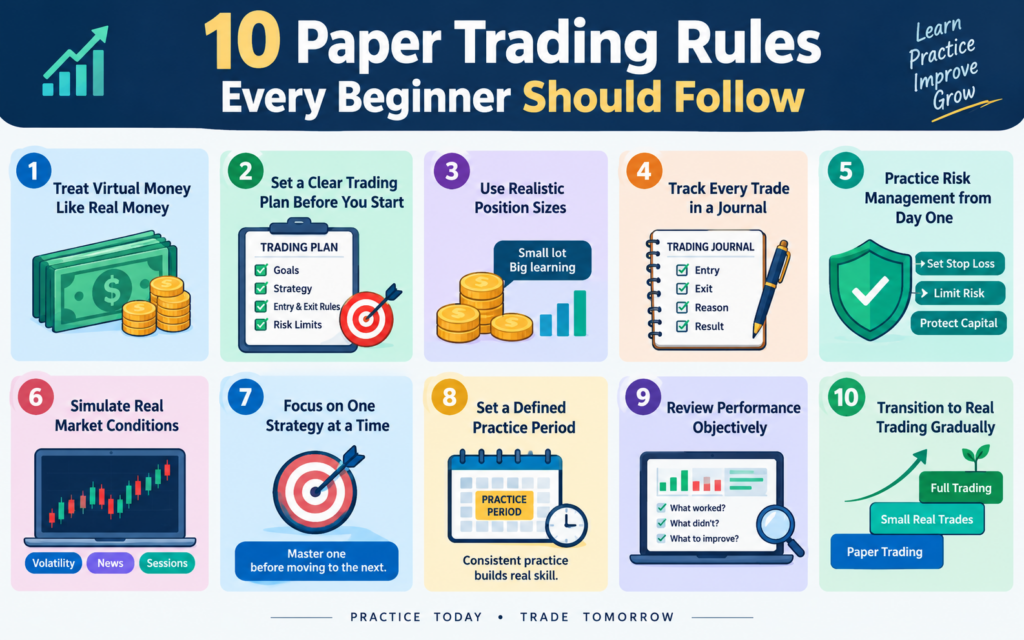
Treat Virtual Money Like Real Money
Don’t make a paper trade if you wouldn’t risk half of your money on it. Poor habits acquired in simulations are carried over to live markets.
Keep a Trading Journal
Write down the time you entered/left, why you made the trade, and what you thought of the trade. Faulty patterns become apparent in one’s errors within a few weeks.
Set Graduation Criteria
Make a definition of “ready” before starting. For instance, 30 trades or more, positive expectancy, drawdown within your limit, and rules followed on 90 trades or more.
When Are You Ready to Go Live?
You will probably be ready when your results are not just good on one lucky week, but are consistent in other market situations, and when you adhere to your rules without exception. Nevertheless, there will be a difference even then. While virtual money doesn’t cause fear and greed to enter a trader’s mind, real money does and live orders may experience slippage. Take a small position size and gradually increase it as you become more confident.
Start Practicing Before You Start Risking
Each of the techniques that is taught will independently teach you a different skill; a paper trading app is the safest place to learn all five. Choose one of the strategies and stick with 30 trades, allowing the numbers to tell you what to do next.
What is a paper trading app?
An app that lets you trade with virtual money in real market conditions so you can practice without risk.
Is paper trading really free?
Yes, most paper trading apps and simulators are free to use.
How long should I paper trade before going live?
Most traders practice for 1-3 months, or until they see consistent results across 30+ trades.
Can I make real money from paper trading?
No, but it helps you build the skills and confidence that support profitable live trading.
Is paper trading the same as real trading?
Not quite, because emotions and order-execution slippage differ, so start small when you go live.
What features should a good paper trading app have?
Look for live or near-live prices, realistic order types (market, limit, stop-loss), and a performance report that shows win rate and drawdown.
Can I paper trade options, futures, and crypto?
Yes, many apps support them, but availability varies by platform, so check the asset classes before you sign up.
Are paper trading prices real-time?
Some apps use live data while others use delayed quotes (often 15 minutes), so confirm this before testing intraday strategies.
How much virtual money should I start with?
Start with an amount close to what you plan to trade live, so your position sizing and risk habits stay realistic.
Which strategy should beginners practice first?
A moving average crossover is a good starting point because its rules are simple and easy to track.