The most ideal method for entering the stock market without risking any money is by paper trading. With the best paper trading app, novice traders can practice trades in a virtual environment, test their strategies, and gain insights into market dynamics without risking real money. But there’s a catch — most of the beginner traders still do regular fallacies on a virtual trading app which hampers the learning curve. If you really want to learn about stock trading in India then you will want to know about these mistakes and avoid them.
Let’s take a look at the 10 most common paper trading errors and how to avoid them.
What Is Paper Trading and Why Does It Matter?
Paper trading, also known as virtual trading, is the practice of engaging in trading without using real money. The ideal virtual trading app will have the same options as the real world market, including real-time prices, order types and market depth — so you can make trades and decisions without risking your real money. This is the best place to practise stock trading India markets, without taking the plunge before you actually start trading. It gives you confidence, checks strategies, and uncovers any areas of your trading knowledge which you are lacking.
10 Common Paper Trading Mistakes Beginners Make
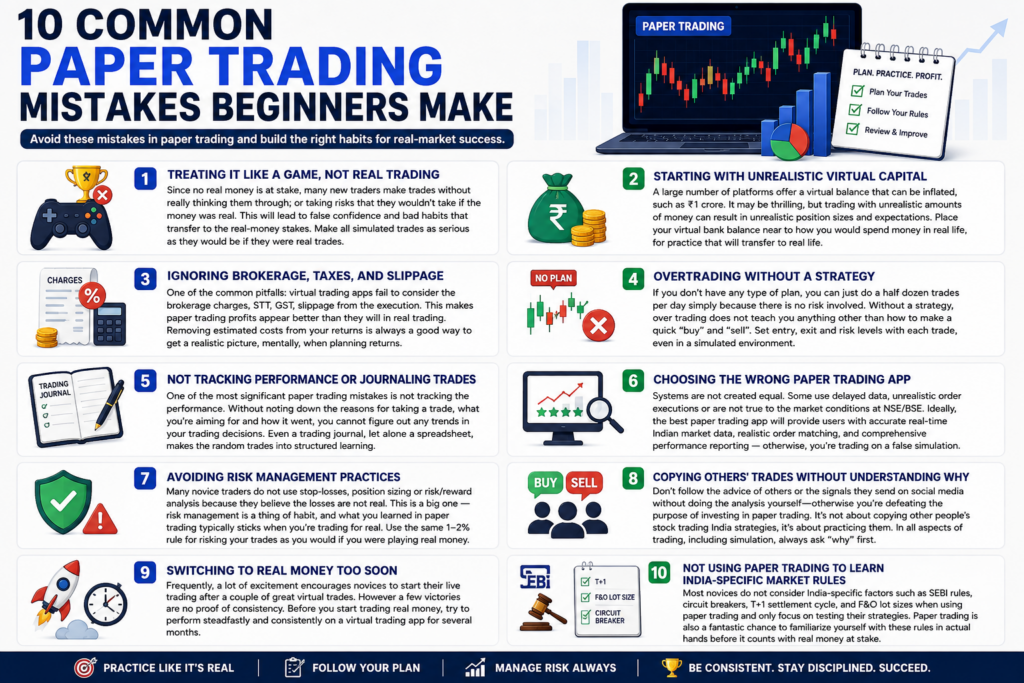
1. Treating It Like a Game, Not Real Trading
Since no real money is at stake, many new traders make trades without really thinking them through; or taking risks that they wouldn’t take if the money was real. This will lead to false confidence and bad habits that transfer to the real-money stakes. Make all simulated trades as serious as they would be if they were real trades.
2. Starting With Unrealistic Virtual Capital
A large number of platforms offer a virtual balance that can be inflated, such as ₹1 crore. It may be thrilling, but trading with unrealistic amounts of money can result in unrealistic position sizes and expectations. Place your virtual bank balance near to how you would spend money in real life, for practice that will transfer to real life.
3. Ignoring Brokerage, Taxes, and Slippage
One of the common pitfalls: virtual trading apps fail to consider the brokerage charges, STT, GST, slippage from the execution. This makes paper trading profits appear better than they will in real trading. Removing estimated costs from your returns is always a good way to get a realistic picture, mentally, when planning returns.
4. Overtrading Without a Strategy
If you don’t have any type of plan, you can just do a half dozen trades per day simply because there is no risk involved. Without a strategy, over trading does not teach you anything other than how to make a quick “buy” and “sell”. Set entry, exit and risk levels with each trade, even in a simulated environment.
5. Not Tracking Performance or Journaling Trades
One of the most significant paper trading mistakes is not tracking the performance. Without noting down the reasons for taking a trade, what you’re aiming for and how it went, you cannot figure out any trends in your trading decisions. Even a trading journal, let alone a spreadsheet, makes the random trades into structured learning.
6. Choosing the Wrong Paper Trading App
Systems are not created equal. Some use delayed data, unrealistic order executions or are not true to the market conditions at NSE/BSE. Ideally, the best paper trading app will provide users with accurate real-time Indian market data, realistic order matching, and comprehensive performance reporting — otherwise, you’re trading on a false simulation.
7. Avoiding Risk Management Practices
Many novice traders do not use stop-losses, position sizing or risk/reward analysis because they believe the losses are not real. This is a big one — risk management is a thing of habit, and what you learned in paper trading typically sticks when you’re trading for real. Use the same 1-2% rule for risking your trades as you would if you were playing real money.
8. Copying Others’ Trades Without Understanding Why
Don’t follow the advice of others or the signals they send on social media without doing the analysis yourself—otherwise you’re defeating the purpose of investing in paper trading. It’s not about copying other people’s stock trading India strategies, it’s about practicing them. In all aspects of trading, including simulation, always ask “why” first.
9. Switching to Real Money Too Soon
Frequently, a lot of excitement encourages novices to start their live trading after a couple of great virtual trades. However a few victories are no proof of consistency. Before you start trading real money, try to perform steadfastly and consistently on a virtual trading app for several months.
10. Not Using Paper Trading to Learn India-Specific Market Rules
Most novices do not consider India-specific factors such as SEBI rules, circuit breakers, T+1 settlement cycle, and F&O lot sizes when using paper trading and only focus on testing their strategies. Paper trading is also a fantastic chance to familiarize yourself with these rules in actual hands before it counts with real money at stake.
How to Avoid These Mistakes: Best Practices for Virtual Trading
- Establish a realistic virtual capital investment amount in line with your investment plan.
- Keep a trading log of all trades and decisions to record why and how they have been successful or unsuccessful.
- Select a virtual trading app that has real-time data and proper order executions.
- Use the same risk management principles, even if it isn’t real money.
- Trade for at least 1-3 months and trade on a live account.
- Learn market rules and regulations specific to India, and test your strategies.
Choosing the Best Paper Trading App in India
Before you get started, ask your platform the following questions:
- You can now access real time NSE/BSE data – Delayed feeds will mislead you in practice results.
- Realistic orders execution – Simulates the slippage and market depth.
- Performance metrics – Measures winning rate, average returns and drawdowns.
- Accessible on mobile and web — Practice whenever and wherever you like.
- No hidden costs — no pressure to make an instant purchase when you sign up.
- Community or Leaderboard features — Provides motivation and benchmarking.
Choosing the right platform from the get-go is crucial for the success of your paper trading experience.
Conclusion
Paper trading is an excellent way for anyone to learn how to trade stocks in India — but only when done properly. By steering clear of these 10 common trading pitfalls, you can develop the discipline of trading and enhance your trading strategy while getting ready to trade live. The aim is not simply to practice – practice smart.
Start Practicing Risk-Free — Try Our Virtual Trading App Today
Frequently Asked Questions
What is paper trading and how does paper trading work?
Paper trading is a technique that allows you to make fake transactions with fake cash to practice without risking any real money.
What is the most suitable paper trading app for new traders in India?
The best apps provide NSE/BSE data in real-time, realistic executing, and performance tracking tools.
Is paper trading a method for me to learn about stock trading in India?
Yes, it is indeed one of the best methods to learn stock trading India strategies with no financial risk.
When do I start trading on a virtual trading app?
At least 1 – 3 months of consistent and profitable virtual trading is recommended by most experts.
Is paper trading completely accurate compared to real trading?
Not completely, as often it overlook the emotional pressure, slippage and brokerage costs that are found in a real market.