As a new investor, you may have heard of two terms which are almost synonymous – paper trading and demo trading account. You can enjoy both for trading without putting your money to risk and both are promoted as the safest method to learn. Are they synonymous, though?
Not quite. A paper trading app and demo trading account both have the same purpose: to practice trading without any risks involved; however, they differ in their design, markets, and target audience. It’s important to know the difference because it helps you to select the right instrument and, crucially, the optimal trading app for your trading area, including stocks, options, forex or cryptocurrencies. Let’s take a look at what each of them is, how they compare, and which one is the best option for your trading needs.
What Is Paper Trading?
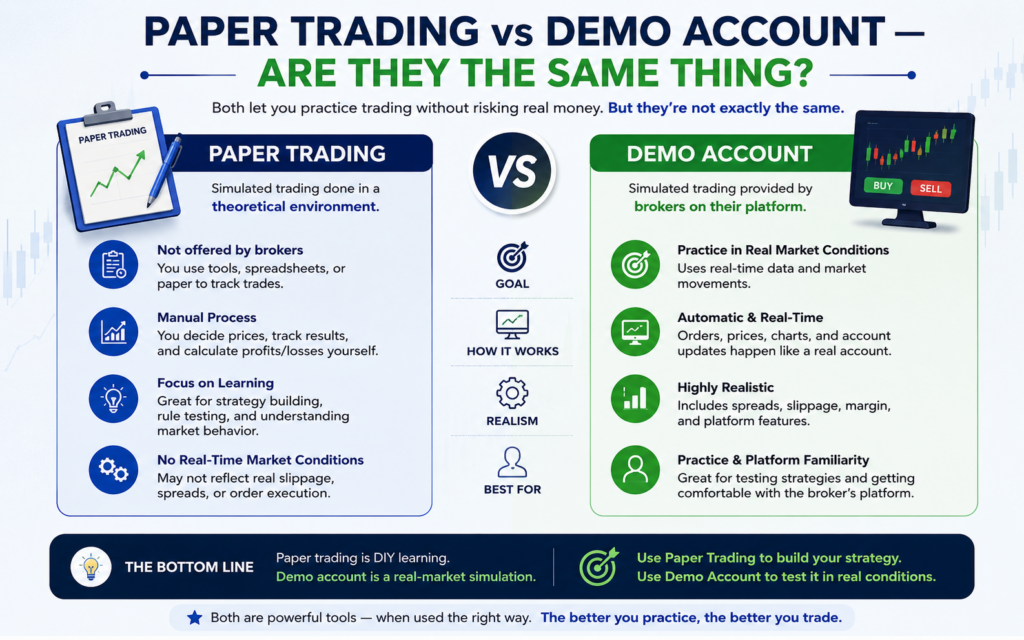
Paper trading is a technique for practicing trading with only paper money. The word originates from the period when traders actually recorded potential trades on paper, to keep track of potential profits and losses. Nowadays a paper trading app has become digital, enabling you to enter mock buy and sell orders for stocks, options, or ETFs with real time or slightly delayed data.
How a Paper Trading App Works
The majority of the paper trading platforms will look like a real brokerage. You receive a virtual cash balance, watch lists, charting features and order types, such as market, limit and stop orders. Some applications will be based on live information feeds, others will be based on end of day or slightly outdated prices. The underlying concept is to allow you to try out strategies in the same way as you would do in actual trading, but without any financial risks.
Who Uses Paper Trading
Stock and options traders, ranging from novices to veterans, love this method of trading, particularly those looking to test a new trading plan without putting real money at risk — or those eager to learn more about the mechanics of order execution. It also applies to day traders who wish to optimize in/out points but don’t let emotion and/or money ruin their decisions.
What Is a Demo Trading Account?
The majority of the time, a broker will provide a demo trading account as a part of their trading platform. Demo accounts are integrated into an actual trading platform, so that the user interface, execution speed, and tools are the same as in their live account.
How Demo Accounts Work on Broker Platforms
Signing up for a demo account involves getting a broker to provide you with virtual money (or a programmable amount of money) and see you matched with live market feeds. This is to indicate that the price swings reflected are real-time and not simulated. In particular, demo accounts are more frequently found in Forex, CFD, and cryptocurrency trading, where the spread, leverage, and volatility in trading are a significant factor in testing strategies.
Who Uses Demo Accounts
For anyone that needs to learn the ins and outs of forex trading and cryptocurrency trading, demo accounts are the perfect option. They’re also helpful for anybody considering a new broker, as the demo account enables you to check out the platform’s speed, tools, and reliability before placing actual cash.
Paper Trading vs Demo Account — Key Differences
The ideas are similar, but there are some distinct differences in their work.
| Feature | Paper Trading App | Demo Trading Account |
| Provided by | Standalone apps or platforms | Brokers directly |
| Market data | Real-time, delayed, or historical | Real-time (live feed) |
| Best for | Stocks, options, ETFs | Forex, crypto, CFDs |
| Account duration | Often unlimited | Frequently time-limited (30–90 days) |
| Tied to real account? | Usually independent | Often linked to a future live account |
Platform & Broker Dependency
Paper trading apps don’t require a brokerage account, and are typically separate programs. Demo accounts are, however, typically associated with a broker’s website and trading experience will be dictated by the broker’s execution and tools.
Market Data: Real-Time vs Simulated
When it comes to demo trading, the fact that most use live market data ensures that one gets a more accurate picture of what is actually happening in the market. Paper trading apps can differ — some will employ live data, others will duplicate utilizing historic data, that could offer a bit of a “mis” impression of what it’s like.
Asset Classes Covered
Paper trading apps are typically oriented towards stocks and options. Demon accounts are more prevalent in forex and crypto and CFD trading where brokers are interested in getting their users used to trading with margin and leverage.
Benefits of Practicing Before Real Trading
Whether you go with the first or second option, there are definite benefits to practicing first before engaging in live trading:
- Risk-free learning — mistakes cost nothing but time
- Strategy testing — validate an approach before scaling it with real capital
- Confidence building — get comfortable with order types and platform tools
- Platform familiarity — learn the interface before speed and accuracy actually matter
Common Mistakes to Avoid While Paper Trading or Using a Demo Account
While simulated trading is good, you should be aware of the following limitations, and form bad habits if you’re not careful:
- Overconfidence – Despite wins in the simulator, it doesn’t mean you will win in real life.
- Ignoring psychology —Psychology gets flushed out of the virtual realm and real decision making is not affected by emotional stress.
- Too much leverage – trading with paper money does not allow time to develop the discipline necessary for a trading account with limited capital.
FAQs
Are paper trading and demo account the same thing?
Not exactly. In the financial world, paper trading usually applies to the practice of trading with simulated or historic or delayed market data, usually for stocks and options. A demo trading account is available from a broker and contains genuine market data, typically for trading forex, crypto, or CFDs.
Is there an option paper trading app?
Yes. The majority of focused paper trading apps support stock and options simulation—including realistic order execution and strategy testing.
Are demos permanently suspended?
Numerous broker demo accounts have time constraints (occasionally 30-90 days) or must be ‘reactivated’ periodically. Paper trading apps, on the other hand, can typically be used as long as you want.
Paper trading vs a demo account, which is the better choice for the beginner?
It depends on which you are able to trade. Stocks or options traders that are just starting out are better off with a paper trading app while traders who are interested in forex or crypto are better off with a demo account from a broker.
Are virtual trades a true representation of the real market?
Most of the time, if not all. Price information can be correct, but simulations cannot capture the feelings and psychology involved in real money trading, and other issues such as slippage and liquidity can act differently in the live market.
Conclusion
While both paper trading and demo trading accounts have the same main function — practice without risking money — they aren’t one and the same. The paper trading app is ideal for stock and options traders who require a simulator that can be used on a variety of platforms, possibly one that is not broker-specific. Forex and crypto traders with a need for live market data directly connected to a particular forex or crypto broker will find demo accounts best suited to their requirements.
It is up to the discretion of the investor, depending on what they wish to trade, and the platform they will be using in the future. When comparing options, the best trading app will be the one which provides you accurate information regarding the market, has a clean interface, and tools that are similar to your trading strategy. Many traders find it useful to use both throughout their trading life.