The majority of new traders do not lose money as a result of their concepts being poor. They waste money as they did not put their real money behind the ideas and tested them first.
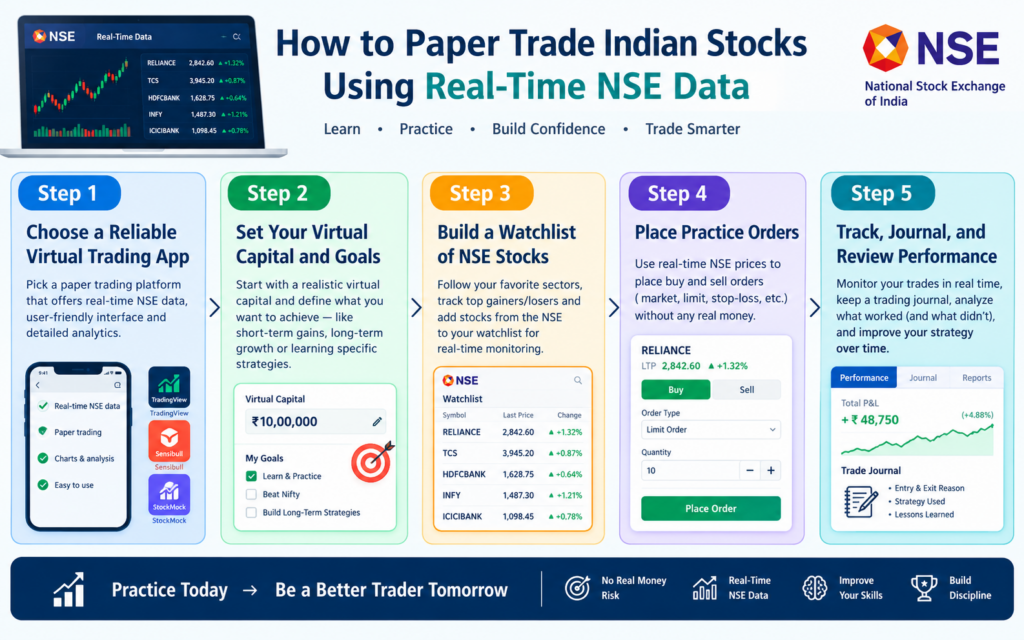
That’s where paper trading comes into play. A paper trading app allows you to trade with paper money and prices, charts and market conditions are just like in the real market. It’s the best place to determine if your plan is successful or not — before wasting time and money trying it out the hard way.
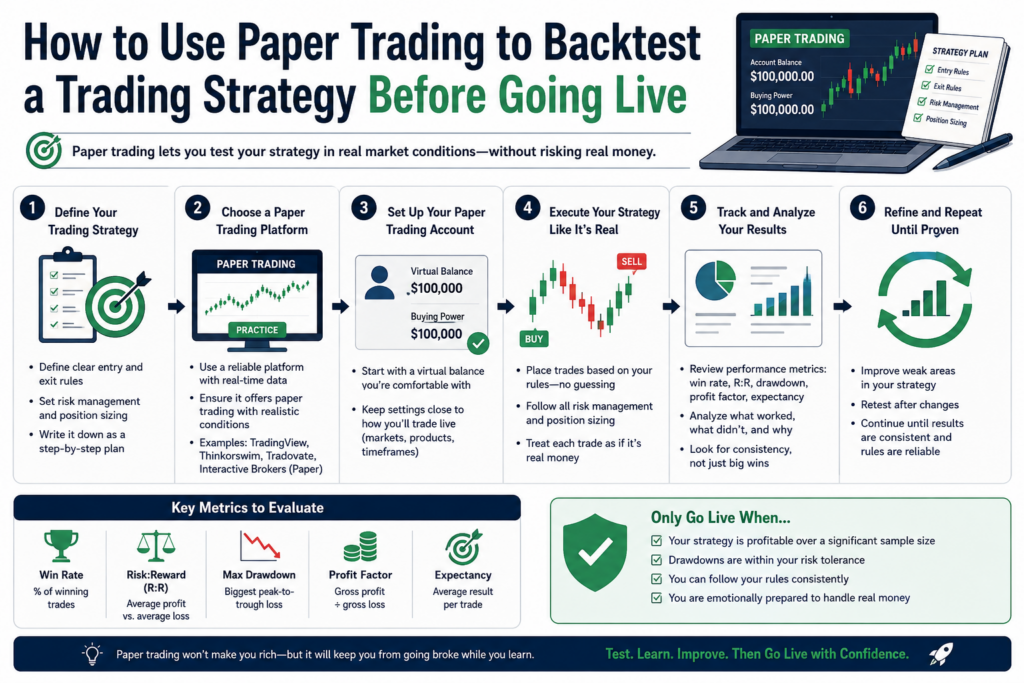
This paper trading tutorial will help you understand exactly how to paper trade a trading system step-by-step: how to choose an appropriate paper trading platform, how to design your system test, what to monitor while paper trading and when to feel comfortable with your trading system that you can take it to real money.
Paper Trading vs. Back Testing – What is the difference?
These two are often used interchangeably, but are not synonymous.
Back-testing – Back-testing is the process of searching the past performance of your strategy on the price data. If you ask yourself that question, you will find that few stocks have been reliable in comparison to gold.If you take into account the gold price action in the last 2 years, and the price action of a few other stocks, you will realize that few of them are consistent. It’s quick and can be used to test data over the years in minutes.
Paper Trading – Paper trading is to test your strategy in real time with the actual prices in the market, but with fake money! You do not buy or sell when the market has gone up or down in the past, but as it is going up or down.
The best way is to make use of both. First of all, run the strategies through a backtest to eliminate obviously broken strategies. After that, paper trade with the ones you think stand a chance and see how they perform in the real and volatile market — and you’ll see how they manage when the market doesn’t behave the way they’d like, such as when the price action is choppy, slippage occurs, and you’re not a superhuman who instantly clicks buy.
Why Simulated Trading Builds Real Trading Skill
The rationale behind Simulated Trading and how it aids in real trading.The logic of Simulated Trading and its benefits to real trading.
Paper trading is not simply clicking buttons with faux money; when done correctly, it’s a worthwhile experience. You’re working on pattern recognition, which setups will work and which ones will just look good post mortem. You’re also developing process discipline; putting your words into writing, sizing positions before entering them in, and setting stops without exception. Traders who don’t do this in simulation, will not do it in real markets, and that is typically where they lose their money.
Step 1 — Choose the Right Paper Trading App for Backtesting
The first step is selecting the appropriate paper trading app for backtesting.The first step is to pick the correct paper trading app for back-testing.
To get the most from the results, the simulator used does not have to be the same, and the platform much less so.
The top paper trading app has a few characteristics to look out for.
There are certain features to look for in a best paper trading app:
Prior to beginning testing, ensure that your platform has:
Real Time or Near Real Time Data – Delayed data can lead to misleading performance of your strategy in high-frequency trading.
Order fills on a realistic basis – some apps will complete orders immediately when they are ordered at the quoted price, raising the results. Find a platform that will simulate slippage and partial fills, as you will see live.
Eventually you may want to trade options, futures, or crypto, so make sure to test on a platform that actually mimics options, futures, and crypto, including the option Greeks, and time decay (if applicable).
Historical replay or inbuilt back testing — ability to run the strategy in the past to test the strategy over a different time period not just today’s session.
Performance tracking – Win-rate, Average win/loss, Drawdown and Trade history should be displayed without you having to create a spreadsheet.
Free vs. Paid Paper Trading Platforms
↠ You can trade for free or pay for paper trading.There are two types of paper trading platforms: free and paid.
Most beginners don’t need to take the plunge into a costly paper trading account, as there are many brokers who have virtual accounts that are free of any cost or funding. Higher level charting, extended historical data and more realistic execution modelling are more prominent on paid or professional grade platforms, and are more important when using higher frequency or options trading.
Quick comparison: Beginner-Friendly vs Advanced Simulators
Type | Best For | Typical Features |
Beginner-friendly apps | Ideal for new traders who are just getting started with their trading. | Easy to use interface, plentiful virtual currency and educational guidance. |
Advanced/professional platforms | Traders executing the complex or multi-leg trading strategies.Traders who are testing the complex or multi-leg trading strategies. | Realistic slippage, look back at history, and perform advanced charting and options analytics. |
Charting-based simulators | Traders who would like to take a visual approach to backing test before entering live trading. | These tools include strategy backtesting, historical replay, and custom indicators.These tools encompass strategy back testing, historical replay and custom indicators. |
There is no “best” answer – the best paper trading app is the one best suited for the trading strategy you want to undertake.
Step 2 — Define Your Trading Strategy Before You Test It
It’s impossible to backtest a strategy that isn’t actually written down. Anything with a fuzzy idea behind it can’t be measured, repeated or improved.
There are no entry and exit rules
Formulate your rules in clear, unambiguous terms: If what?State your rules in clear, specific terms: If what? What makes you think it’s time to sell? What is the finish to the trade if it is losing money? Without being able to say in one sentence what your rule is, it’s not specific enough to test.
Position Sizing and Risk Management Rules are essential to every successful trading strategy
Determine, prior to your start of trading, how much of your virtual account to risk on each trade and where your stop-loss is going to be. It’s as important as your entry signal — a winning strategy that you use can still lose you money if you don’t size your positions well.
Creating a Measurable Goal
Provide a conclusion to your test. One strategy is to execute the strategy many times (50-100) or over a specific time frame (1 month to 3 months), and then analyze the outcomes. Test trading without a fixed point usually goes on without a time limit, and traders are not aware of shifting the target whenever they see the results they are not satisfied with.
Step 3 — Run Your Strategy Through Simulated Market Conditions
Now that you have your strategy ready, test it under simulated market conditions.Once you have a strategy that you’re happy with, run it through simulated market conditions.
The test is conducted under various market conditions.The test is carried out in different markets.
What works well during a solid uptrend could prove ineffective when a market is choppy and trading sideways — or even when it becomes very volatile. Do not stop testing just after a week of good testing. If possible, use your strategy on a trending market, a range market, and a minimum of one vol event, these are the times that you will most likely be able to find a weakness.
Historical Replay and Backtesting Tools within the App.
Numerous platforms provide the feature to fast-forward through price information, candle by candle, which can be helpful in studying past price information over a span of months in a manner of days or a few minutes. It is a good way to spook test a strategy in a short amount of time before taking the plunge and spending weeks paper trading.
Writing in a Trading Journal to keep track of all trades:
All trades (both profitable and unprofitable) should be recorded with an entry reason, position size, exit reason and result. This is the one thing the most traders neglect to do, and it’s the one thing that makes a difference in paper trading being more than a game.
Step 4 — Analyze Your Paper Trading Results
In Step 4, you’ll review your paper trading results and assess how well your strategy is working.
Track Key Metrics
At minimum, track:
- Win Rate — Percentage of winning trades
- The odds of winning and the size of the win (or loss) relative to the average loss (or win) size.
- Your highest loss from a peak in your virtual account – called max draw down.
- The number of trades that have been made — there needs to be a decent number of trades made to feel confident in the outcome, not just a few lucky wins.
Identifying your Patterns in Wins and Losses
Observe the common factors of your profitable trades, and the common factors of your losing trades. A strategy is not necessarily a bad thing, it’s just a strategy that’s used in markets it doesn’t fit. (For instance, a breakout strategy used in a market without any strong trend).
If the Data is saying “Not Ready Yet”
If your draws become more than you can emotionally handle or your win percentage relies on a few “big hits”, this is a sign to hone your skills before betting real money, not a reason to take your head out of the sand.
Common Mistakes When Backtesting With a Paper Trading App
There are common errors that traders make when using a paper trading app.There are some common mistakes that traders make when they use a paper trading app.
The level of detail is not enough to make any distinction between Order Fill Realism or Ignoring Slippage.
There are free simulators that will instantly pop up each trade at the same price you can see on screen. In reality, markets don’t operate this way, particularly in fast-moving markets. If your paper trading app does not simulate slippage, then discount your return by a few percent — that is just what you can expect to see when trading with a real account.
Too Big to be Traded, Because It’s Not Real Money
Easy to assume too large of a stance in the simulator because no one is really in danger. However this undermines the intent. Make sure your paper trades are the same size that you would make when trading for real money—otherwise, the position sizing you practice will be completely ineffective when you start trading for real.
Learn to skip the Emotional Side of Trading
This is the most challenging restriction to overcome with any paper trading app: making an actual loss feel the same. Paper trading teaches mechanical skills and strategy validation, and only the psychological stress of real money comes into play when trading with real money — so get started with small amounts of money.
When to know that it’s time to Go Live
The following are some of the most common consistency indicators that traders can use:
There is no hard-and-fast guideline, but a good number of experienced traders use a threshold of about 50-100 trades over a pertinent sample size (not necessarily weeks or months). It is not time but consistent and rule-reliant performance that is the criteria.
Paper trading is a term used to describe the practice of trading virtual currency.Paper trading is the term used to refer to the trading of virtual currency.
Rather than trading live with a large account, you should take a step back and try trading live with a small account size, and continue to simulate trading at the same time. This combination enables you to get used to real emotional stress gradually, rather than all at once.
Wrap Up: Paper Trading Is Not a Goal, It’s a Tool
One of the most handy paper trading apps is a tool that lets you test a strategy without risking money, but that doesn’t mean it guarantees success. It’s not to learn paper trading indefinitely, it’s not to go live trading after one good week. It means developing and executing a plan, testing it and being honest with yourself if it doesn’t work, reviewing the data, and only scaling up when the data — AND YOU — say it’s time.
Frequently Answer Questions
What is the difference between paper trading and backtesting?
Backtesting is the process of applying the rules of a strategy to historical data and estimating the past performance of that strategy; Paper Trading is the same process as backtesting, but the rules are applied to live (but not real) market conditions. Backtesting is quicker and paper trading is more realistic.
When to paper trade before going live?
A time of three to six months, or at least 50 to 100 trades on which you’ve made rules that you have documented, is a better proposed guideline than a fixed calendar period, as many experienced traders say.
Is it possible to learn trading with a paper trading app?
Yes, particularly for mechanics, chart reading and strategy testing – but there is no substitute for the emotional stress of putting real money at risk, so a simulator should be used in conjunction with a few small trades when results are positive.
What's the best paper trading app for novices?
This is based on your objectives. Simple, mobile apps that provide virtual cash and built-in education work best for new traders, while more advanced traders prefer platforms that offer more realistic order execution and professional quality tools.
How much does paper trading cost?
The majority of the bigger paper trading apps present free virtual accounts, generally requiring simply a simple sign up process with no funding required.
What are the advantages of paper trading?
Paper trading helps traders:
- Practice without financial risk
- Test trading platforms
- Improve discipline
- Validate strategy execution
- Gain confidence before live trading
Is paper trading suitable for beginners?
Yes. Paper trading is one of the safest ways for beginners to learn order placement, risk management, position sizing, and market behavior without risking actual funds.
What comes after paper trading?
Once a strategy performs consistently during paper trading, many traders begin with a small amount of real capital. This gradual transition helps evaluate real-world execution and emotional discipline while limiting financial risk.