One of the first, but most overlooked, decisions that every new trader or investor has to make is what broker they will use. The majority of people are interested in design of the application, brand name of the broker or the speed at which the account is opened. Far fewer make a line-by-line comparison of brokerage fees. But on the surface, these charges seem negligible – and they can be – but they can still take a serious bite out of your profits over time. When it comes to selecting the best stock broker for your requirements, you cannot afford to overlook fee structures — it’s the basis of a smart choice.
It explains each of the types of charge you might come across, how these charges differ from discount and full-service brokers, and how to compare brokers correctly before you invest.
Why Brokerage Charges Matter When Choosing a Stock Broker
On a single trade a 0.1% difference in brokerage may seem insignificant, but a 0.1% difference in brokerage over hundreds of trades per year can make a big difference. When you’re a man or woman trader, the costs you incur with the broker can be among the largest road blocks to your profitability, and sometimes it can be larger than the risk you must take in the marketplace. Charges such as account maintenance fees and other hidden transaction costs that may be applied to a user’s account can be eating away over time at the compounding value of the portfolio for long-term investors.
That is why it’s critical to compare costs when you’re looking to determine the best stock broker for your trading style. The broker that seems to have low fees to you, such as offering “zero brokerage” might do it elsewhere. Real Cost Comparison involves more than simply comparing head-to-head figures.
Types of Brokerage Charges You Should Know
Account Opening & Annual Maintenance Charges (AMC)
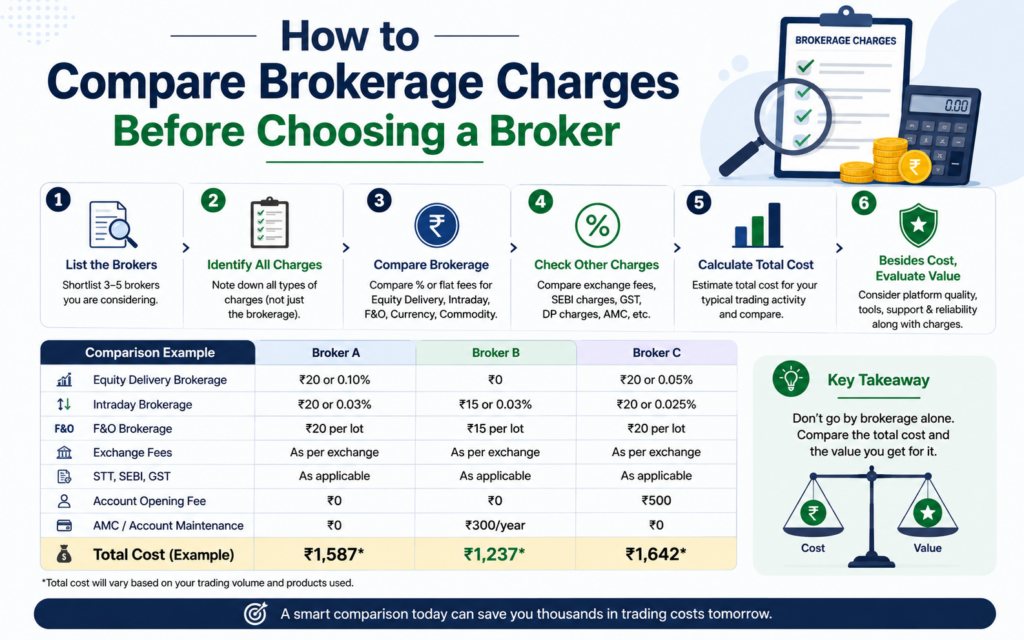
The majority of the brokers ask for an AMC (Annual Maintenance Charge) along with a one time account opening fee for the demat account. There are some brokers who don’t charge any opening fee as a marketing strategy, but they make up for the expenses in the future with a higher AMC. Always compare the two numbers, not one at a time.
Brokerage Fees on Equity Delivery vs Intraday Trading
Typically, there are different charges for delivery trades (ones in which you hold on to shares) compared to intraday trades (ones that are bought and sold on the same day). Many brokers have no brokerage on delivery trades, but impose a flat fee or percentage on intraday trades. Be familiar with your trading style before making a comparison on this line item.
Charges on F&O (Futures & Options) Trading
Brokers for derivatives typically levy the brokerage per lot/per order instead of as a percentage of the value of the trade. This can cause a broker to be not only inexpensive for equity trading, but also costly for options trading — or the opposite — depending on which segment you trade.
Transaction Charges, STT, and GST
These are compulsory charges, which are applicable on both types of brokers (e.g. Securities Transaction Tax (STT), stamp duty, exchange transaction charges, and GST). These are not included in the broker’s fee but they do increase the total cost of trading, so consider their costs when making your calculations.
Hidden or Miscellaneous Charges
It is at this point where quite a few traders make a mistake. Watch out for:
- Call and trade charges (buying/selling programs over the phone rather than the app).
- A fraction of the amount sold, called a Depository Participant (DP) charge, is deducted from the sale price of every sale.
- Charges for withdrawal/t transfers
- The charges for physical contract documents or statements.
- Inactivity charges for savings accounts that have no activity.
How to Compare Brokerage Charges Step-by-Step
Step 1 – Identify Your Trading Frequency and Style- Do you trade on a long-term or swing trading time frame or are you a high frequency/ intraday trader? Your answer will determine what kind of fees are of the most concern to you.
Step 2 – Get a Complete Fees Schedule from Every Broker – Don’t just take their marketing pages. Request (or download) the official tariff sheet, which includes all relevant charges in detail.
Step 3 – Determine the Total Cost of Ownership: Determine the brokerage, AMC and DP charges, along with the statutory charges, on the basis of expected trading volume and not just the brokerage charges.
Step 4 – Make sure there aren’t any hidden charges in the fine print – read the account opening agreement thoroughly. Be aware of the inactivity fees, the fees for withdrawing, and fees for orders placed offline.
Step 5 – Research Value-Added Services Factor: Research reports, trading tools, charting platforms and customer support quality. If you have to pay a little more for additional tools or quicker support, then that’s worth it, too.
Common Mistakes Traders Make When Comparing Brokers
- Calculating brokerage percentage only without considering AMC and DP charges which can make up for brokerage savings on an annual basis.
- Avoiding any fees for moving funds in and out of your account, these will be hidden and will impact your net profits.
- Failure to review outstanding trading fees — some brokers will charge a fee whenever a user doesn’t trade for a certain amount of time, so this is a problem that could surprise investors who are simply not trading often.
Choosing the Top Stock Broker for Your Needs
Of course, the best stock broker is not necessarily the one with the cheapest advertised brokerage — it’s the one whose total cost of trading is right for you. If you are just starting to invest and buying stocks occasionally, then you will have different needs than an active options trader who is making dozens of trades per day. Apart from the numbers, it’s essential to have transparency, a transparent fee structure where there are no fine print details, a trusted trading platform, and responsive customer support.
Thetopstockbroker has been created specifically to facilitate brokers in comparing these elements side-by-side, rather than manually searching through a number of broker sites and tariff sheets.
Conclusion
The best way to ensure that you are working with a broker that really suits your trading needs and that will help you best protect your investment in the long run is to compare brokerage fees carefully, rather than just at a headline rate. Before opening an account, draw up an outline of account charges, transaction fees, and any hidden fees that you may incur – this will help you to avoid the unpleasant surprises that many traders face.
Looking to make the right decision? Check out the various brokerage plans side-by-side on thetopstockbroker and find the broker that best suits your trading style.
FAQs
What is the average brokerage charge for stock trading?
It varies widely — discount brokers often charge a flat fee (or zero) per order for delivery trades, while full-service brokers typically charge a percentage of trade value, which can range higher depending on the segment.
Do all stock brokers charge the same fees?
No. Fees differ based on broker type (discount vs full-service), the trading segment (equity, F&O, currency), your chosen plan, and sometimes your trading volume.
What is the difference between brokerage and other trading charges like STT or GST?
Brokerage is the fee your broker charges for executing trades. STT, GST, and stamp duty are statutory charges set by the government and exchanges, and apply no matter which broker you use.
Is a zero-brokerage broker really free?
Not entirely. “Zero brokerage” usually applies only to specific segments like equity delivery. Brokers often still charge AMC, platform fees, or higher rates on intraday and F&O trades.
How do I know if a broker has hidden charges?
Always request the official tariff sheet or fee schedule and read the account opening agreement in full, paying close attention to sections on DP charges, inactivity fees, and withdrawal charges.
Which is better — a discount broker or a full-service broker — in terms of cost?
Discount brokers are generally cheaper for active, self-directed traders who don’t need advisory support. Full-service brokers can be worth the extra cost for investors who value research and personalized guidance.