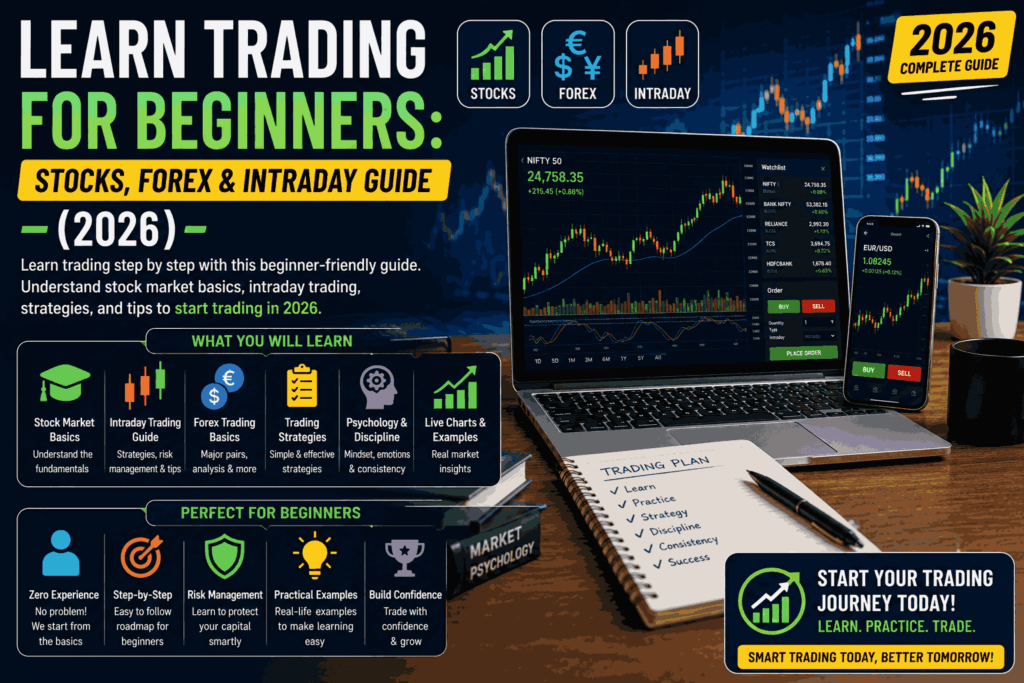
The trading world is extensive and can be exhaustive, especially for beginners learning to trade. For many of you, the thought of losing your hard-earned money can be nerve-wracking. Yet, the brighter side of the trading world is the perfect opportunity it offers to grow wealth. But how do you crack the hack?
The first and foremost requirement is confidence as you start your trading journey. Next, set aside a small budget so you are not afraid to lose your money and can learn trading from scratch, the art of trading. Two essential parameters to keep in mind are patience and practice. Patience will enable you to make mindful decisions and practice will help you excel in the market.
What Is Trading?
General trading involves buying and selling stocks, bonds, commodities, or currencies to profit from short-term price movements. There are two main types of stock markets: primary markets and secondary markets. These two types are connected and work together in the stock market system.
1. Primary Market:
When a company sells its stocks to the public for the first time, it’s called an initial public offering (IPO). This happens in the primary market. Companies do this to get money for different things like growing their business, trying new ideas, or paying off debt.
2. Secondary Market:
The secondary market, often called the stock exchange, is where people buy and sell previously issued stocks and bonds. These stocks and bonds were first sold in the primary market. In the secondary market, both regular people and big organizations can trade them. This market offers liquidity, which means it’s easy to buy or sell assets depending on what people want and how the market is doing.
Before you start learning stock market trading, you should learn about various types of financial instruments.
Some of the common types include:
- Stocks: These represent ownership in a company, providing stakeholders with a share in the company’s profits through dividends and voting rights. They are traded on stock exchanges or markets such as NSE, BSE, Nasdaq, NYSE, LSE, and others.
- Bonds: Debt instruments issued by the government, municipalities, or corporations, enabling the entities to raise capital through bonds. The bondholder lends money to the issuer in exchange for a bond that pays periodic interest. In bonds, the principal amount is returned at maturity.
- Mutual funds: The mutual fund pool invests the funds of multiple investors to create a diversified portfolio. This portfolio usually contains various financial instruments. The port is managed by professional fund managers.
- Exchange-traded Funds (ETFs): These investment funds are traded on stock exchanges like stocks, track specific indices or asset classes, and offer liquidity and diversification.
- Options: These give the holder the right to buy or sell the underlying asset at a specific price, with no obligation to exercise.
- Futures: These are agreements to buy and sell an underlying asset, such as currencies or commodities, at a predefined price and future date, traded on futures exchanges.
- Derivatives: Financial contracts whose value is derived from an underlying asset, such as futures & options, swaps, or contracts, are known as derivatives. These are used for arbitrage, speculation, or hedging.
However, these are just a few of the financial instruments. Yet remember that each of them has its own risks and returns, depending on various factors. You must research them further before investing in any.
How To Start Trading in India
Starting a trading journey may make you feel overwhelmed to take the first steps; getting started is easier than you think. Start with the basics: learn the essentials of the stock market, understand how shares work, and consider the factors that influence share prices. After you learn that, set up a demat and trading account with a reputable broker. Start with a small investment, get used to trading, and start a paper trading account, like the Paper Trading App.
After you see which companies you want to trade, make an order for shares. As the saying goes, never invest money you aren’t prepared to lose, and practice good risk management. Do not make decisions based on emotion; it is vital not to let emotion dictate your decisions. Patience and discipline will be necessary, and you will still have a lot to learn. With patience and practice, anyone can learn how to start trading both comfortably and intelligently.
Steps to Start Stock Trading:
1. Open a Demat account
To start online trading as a beginner, you first need to open a Demat account, which is an online account that holds your shares and allows you to trade them. A Demat account differs from a bank account because it holds securities rather than money. To open a Demat account, you need to choose a broker or depository participant to act as an intermediary between you and the stock exchange. Additionally, you need to provide the required documents. These include your identity proof, address proof, and PAN card. You need to pay the account-opening fees, as some brokers charge them for opening a Demat account.
2. Learn the basics of technical analysis and fundamental analysis
The basics of technical analysis and fundamental analysis, which are methods for evaluating the performance and value of stocks using charts, trends, indicators, financial statements, etc. Technical analysis examines how stock prices move and the patterns they form, using tools such as charts and indicators. Fundamental analysis, on the other hand, digs into the business and financial side of stocks. both method has its good and bad points. It’s smart to use both, along with other factors, to make sure you get the returns you’re hoping for.
3. Learn what stop loss is and how to apply it.
Learn what a stop loss is and how to apply it, which is a way of limiting your losses by setting a price at which you will automatically sell your shares if they fall below it. A stop loss is a crucial risk management tool. It can help you protect your capital and avoid losing more than you can afford. You can set a stop loss either as a fixed amount or as a percentage of your investment.
For example, if you buy a stock at Rs 100 and set a stop loss at Rs 90, you will sell it if it drops to Rs 90 or lower. Alternatively, you can set a stop loss at 10%, meaning you will sell if it drops by 10% or more from your entry price.
4. Get information from experts
Never stop learning in your trading phase. Try to get information from experts. They can guide you and give you tips and recommendations. To know more, you can take the help of books, articles, blogs, and podcasts. These resources will teach you more about stock trading and the market. However, you should not blindly follow anyone’s advice or opinion, as it may not align with your goals or risk profile. You should always do your research and analysis before making any decision.
5. Go for paper trading first
Start by learning paper trading in India first. It is a way to practice stock trading without using real money by using a simulator or a demo account. Paper trading can benefit you in many ways. Such as it will help you test your strategies and learn from your mistakes. It will also help you gain confidence and become familiar with the trading platform and its tools.
However, paper trading cannot fully replicate the real market conditions and emotions that come with trading with real money. Therefore, you should not rely on paper trading results alone and be prepared for the challenges and risks of real trading.
6. Start to develop a strategy
Develop a strategy, which is a plan of action that defines your goals, risk tolerance, entry and exit points, etc. A strategy can help you stay focused, disciplined, and consistent in your trading. You should also have a trading journal or a record of all your trades, where you note down the reasons for entering and exiting each trade, the outcome, the lessons learned, etc. With a trading journal, you will be able to track your performance, identify your strengths and weaknesses, and improve your skills.
7. Start with safer stocks
Start with safer stocks, such as blue-chip stocks or index funds, which are less volatile and more reliable than speculative or penny stocks. Safer stocks can help you reduce your risk. It will build your confidence as a beginner trader. They can also provide you with steady returns and dividends over time. However, safer stocks may not offer high returns or growth potential as compared to riskier stocks. For this reason, you must balance your portfolio with different types of stock. Keep your risk appetite in mind while choosing stocks.
Ways You Can Start Learning About Trading?
Learning about trading for the first time? Yeah, it’s a lot. Feels like you’re about to leap into a pool with no idea if you can swim. But honestly, once you break it down, it’s not rocket science. Here’s how I’d tackle it if I were starting from scratch:
1. Understand the Basics
Man, you don’t wanna be that person nodding along and secretly Googling “What is a derivative?” during lunch. So, just bite the bullet—learn the basics: stocks, bonds, mutual funds, derivatives (sounds intimidating, but it’s doable). Get your head around words like intraday, stop loss, and all that jazz. YouTube is a lifesaver, and there are a million blogs. Just… don’t get sucked into some random dude’s conspiracy theory channel.
2. Keep an Eye on the News
Markets move faster than TikTok trends. One day everything’s chill, next day, some CEO tweets something dumb, and the market’s in meltdown. So yeah, check Bloomberg, Moneycontrol, or whatever floats your boat. It’s not about memorizing every headline; just get a feel for what’s happening out there.
3. Pick a Broker That Doesn’t Suck
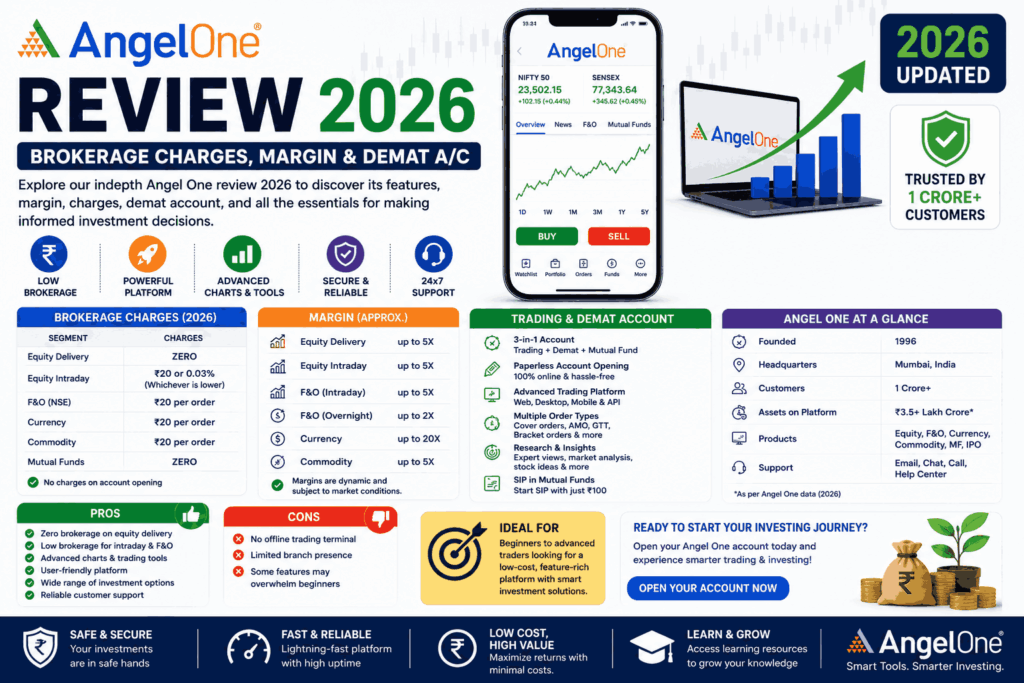
You want a trading app that doesn’t look like it was built in 2002. Stuff like Zerodha, Angel One, Upstox—they’re pretty solid and actually explain things. Plus, demo accounts are gold. Play around, lose fake money, no shame.
4. Play Pretend First (Paper Trade)
Honestly, jumping in with real cash before you know what you’re doing? Not the move. Paper trading apps let you screw up without losing your rent money. Test strategies, see what works, laugh at your imaginary losses, repeat.
5. Find Your People
Trading alone is like yelling into a void. Take a course, hop into a Discord server, whatever. Other newbies make dumb mistakes too, and you can all laugh/cry together. Sometimes someone else’s “oops” saves you a ton of pain.
6. Start Small, Don’t Go Full Vegas
When you’re finally ready to put some skin in the game, keep it tiny. Like, embarrassingly small. Track what you do. Celebrate wins, cringe at losses, figure out what the heck happened, and keep learning. The market has zero chill, so stay humble.
Which stocks to choose and how to choose?
Always rely on your research to decide which stocks to choose. Before choosing any stocks, keep your preferences, objectives, research, and analysis in consideration. To decide, there are various criteria that you can use. These include market capitalization, earnings growth, dividend yield, price-to-earnings ratio, and more, to help you filter and select the stocks that suit your needs.
You can also use various tools, such as screeners, scanners, watchlists, etc., to find and monitor the stocks that interest you. However, you should not buy or sell any stock based on impulse, rumours, or hype. Always research and do your due diligence before buying any stock.
Learn from your mistakes
Learn from your mistakes and improve your skills and knowledge by reviewing your trades, keeping a journal, managing your emotions, etc. Stock trading is a continuous learning process, and you will inevitably face losses and failures along the way. However, you should not let them discourage you or affect your judgment. You should treat them as opportunities to learn and grow as a trader. You must ensure your emotions don’t interfere with your trading decisions. You should always follow your strategy and stick to your rules.
Conclusion
Once you are in, learning the stock market in India requires a lot of hard work and patience. With risk comes a certain level of uncertainty. You should not enter the stock market with unrealistic expectations or emotions. You should enter it with a clear plan, a solid strategy, and a rational mind. Follow the steps outlined above to start your stock trading journey with confidence. You can also improve your stock trading skills and performance over time by learning from your mistakes and successes.
FAQs about Learn Trading
How can beginners start learning trading?
Beginners can start by learning stock market basics, opening a demat and trading account, using demo platforms, and practicing with small investments.
Is trading safe for beginners?
Trading involves risk, especially for beginners. However, proper education, risk management, and disciplined strategies can help reduce losses.
How much money is required to start trading?
You can start trading with as little as ₹500–₹1,000, but higher capital provides greater flexibility and better risk management.
What is the best way to start trading?
The best way to start trading is to decide the type of trader you want to be and start with a low-risk, minimum-investment approach. To learn trading effectively, you can start with paper trading.
Can a beginner learn trading by themselves?
Yes, a beginner can learn the principles and strategies of trading independently. However, they can seek the help and guidance of a mentor to improve their performance.
What is the 3-5-7 rule of trading that everyone should know about?
The 3-5-7 rule of trading is an effective risk management strategy that states that investors should never risk more than 3% of their total capital, should limit exposure across all activities to 5% and aim for a minimum 7% profit on trading sessions
What is the difference between the primary and secondary market?
The primary market is where companies first sell shares to the public via an IPO, while the secondary market is where those shares are later traded among investors.
What is a stop loss in trading?
A stop loss is a preset price at which your shares are automatically sold to limit potential losses.
Why should beginners try paper trading before real trading?
Paper trading lets you practice buying and selling with virtual money, helping you test strategies and build confidence without financial risk.