
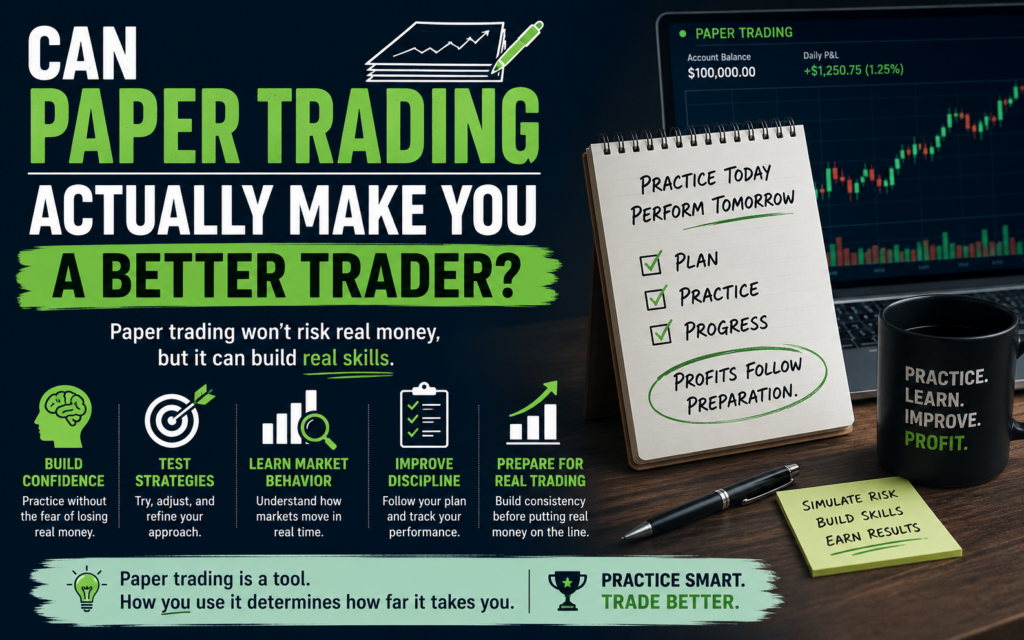
Have you ever opened a paper trading app and made a virtual trade with ₹10 lakh of virtual money before? If so, you’ll have wondered, is it actually assisting me or is I just playing a video game? When new traders start trading in India, one of the most frequent questions they ask before they put their money into the game is: “What is the best way to trade?When new traders get into the game, one of the most frequent questions they ask before they put their hard-earned cash is: “What’s the best way to trade?
Paper trading isn’t a waste of time. It is not the quick way to making money, however! It’s a good idea to dissect the question to master the skills it assigns and to become familiar with those it doesn’t teach, and to know how to employ it in a manner that leads to tangible outcomes.
What Paper Trading Actually Teaches You
1. Understanding Market Mechanics
Paper trading will eliminate all the worry and fear that comes with a first-time purchase. You don’t risk money to learn how to trade financials in the market with orders and margins, how the underlying price of a financial moves in relation to the price of the contract, or how a chart reacts to news or earnings. This mechanical fluency is authentic, transferable and beneficial. An inexperienced trader with real capital is much more risky than an inexperienced trader who has had a simulator and made and had to fix (learn) the beginner’s mistakes.
2. Building and Testing a Strategy
Paper trading is one of the few methods available to test a rule-based system in the real time market without any financial risk. If you’ve built a strategy – a breakout system, a moving average crossover, an options-selling approach – it is much better to test that strategy on a simulator for several weeks to see how that strategy will perform in the market action that is taking place than to test it with real money and find out the hard way.
This is not “back-testing” as done with historical data. Paper trading requires you to make real-time decisions and whether or not to take the trade when your set up comes up at 2:47 pm Tuesday when the volume is not clear. Backtests don’t bother you with that. Paper trading does.
3. Getting Fluent With the Platform
Each broker’s terminal is unique — there are different options, different places for the stop loss, different ways of placing your bracket orders, and different refresh speeds for options data etc. By simulating what it will look like to execute trades on a paper trading platform that’s similar to a real broker’s platform, by the time you execute that trade live, you’re not trying to do that on the platform too. This alone avoids many of those costly beginner mistakes, such as executing an unplanned market order, rather than a limit order, during a big, unexpected spike.
Where Paper Trading Falls Short
1. There’s No Real Emotional Stake
Looks at the situation without being emotionally invested.Takes a neutral perspective.
It’s the number one restriction and the one most beginning children’s writers don’t take into account. It just doesn’t have the same effect as using real money. It is fear, greed, panic selling, revenge trading, not booking profits, and “averaging down” on a losing position that are the emotional triggers between a winning and losing trader. None of them are displayed in an accurate representation in a simulated account.
If a paper trader can be calmed when he/she loses ₹40,000, they might get panicked or freeze the first time that someone incurs a ₹4000 loss on a real account “print screen” on their phone. The amount of the dollar is irrelevant – the important thing is that money isn’t money, so it doesn’t activate the nervous system.
2. Execution in Real Markets Is Messier
A Paper trading app makes the assumption that there will be no fills at other prices when they are at the screen price. Real markets do not operate so. Partial fills, slippage due to extremely rapid movement, liquidity gaps (particularly in options and small/mid-cap stocks) can significantly alter your real-world results from any simulator results. That means that paper trading gives a better idea than it actually does of how profitable a strategy will be. What appears as a 2% strategy on paper may not break even after costs of real-world execution.A strategy that seems to make 2% on the paper trades can barely break even in practice, once trading costs are taken into account.
3. It Can Manufacture False Confidence
The biggest danger of paper trading is a trader who does well and thinks it will happen again when he has real money; usually with a much bigger position size than the one he is about to trade in real money. With inflated expectations that are based on unrealistic conditions, it’s one of the most frequent pitfalls for new traders to take excessive risks and lose time and money in the initial months of their live trading experience.
So, Does Paper Trading Actually Work?
The straight-up, no-holds-barred answer is this: Paper trading does not necessarily make you a better trader, just a better mechanic.
It’s excellent for:
- Understanding the mechanisms and instruments of the markets
- Determining if the strategy’s logic is sound or not
- It is crucial to get used to a trading platform.Learning to feel comfortable on a trading platform is very important.
- Learning the basics without having to worry about losing money!
It is not capable of teaching:
- Your own behaviors and actions in the face of actual financial strain
- How true loss aversion affects your decision making process.
- Execution frictions and how they diminish the advantages of a strategy.
- Consistency in discipline when it counts!
How to Actually Turn Practice Into Skill
The most successful traders who benefit from paper trading view it as a quick, short-term or strategic exercise – not a permanent comfort zone. The goal is to build confidence and test a strategy, then move to real capital once you’ve validated your edge. An action plan looks something like this:
- Pick the right platform. Start with the best trading app in India that mirrors live market conditions as closely as possible — real-time NSE/BSE data, realistic order execution, and no artificial advantages that real trading won’t have.
- Set a fixed timeline. Give yourself a defined window — 2 to 4 weeks, or a set number of trades (say, 20–30) — rather than trading on paper indefinitely. A deadline forces you to treat it as a test, not a hiding place.
- Trade one strategy at a time. Pick a single setup or system you want to validate, and only test that. Testing five strategies at once tells you nothing about which one actually works.
- Size positions like they’re real. Use the same position sizing and risk-per-trade rules you’d use with real money. Paper trading with unrealistic size defeats the purpose.
- Track every trade. Log entries, exits, reasoning, and outcomes in a trading journal so you have data to review — not just a gut feeling of “it went well.”
- Set a graduation trigger. Decide in advance what “success” looks like (e.g., a positive win rate over 20 trades, or hitting a target risk-adjusted return) — and when you hit it, move to a small live account rather than staying on paper.
- Review, then transition with small capital. Don’t jump straight to full size. Start live trading with an amount you can afford to lose, and scale up only as your live results confirm what your paper trading suggested.
The Bottom Line
Paper trading is a true place of learning and testing a strategy’s logic prior to the introduction of money to the game. But it’s not a sign that it is going to be profitable down the road and it’s not a replacement for the psychological aspect of trading with actual money you don’t want to lose.
Traders who are the ones that benefit most from paper trading are the ones that use it as a stepping stone, not as the end goal; getting out of “practice mode” into trading with small amounts of real money as early as necessary, not as late as to avoid the feeling of being out of the comfort zone.
Is paper trading good for beginners in India?
Yes, it’s ideal for learning market mechanics and testing strategies without financial risk.
Does profit in paper trading guarantee profit in real trading?
No, real trading involves emotional pressure and execution costs that simulators don’t replicate.
How long should I paper trade before going live?
Most experts recommend 2–4 weeks, just enough to test a strategy without overstaying in “safe mode.
Why do I perform worse in real trading than in paper trading?
Real money triggers genuine loss aversion and emotional decision-making that a simulated account can’t replicate.
What’s the best way to transition from paper trading to real trading?
Start with a small amount of real capital and compare your trading journal from both phases to spot behavioral gaps.